No single method of teaching English-language learners is more effective than any other, according to a five-year study of California’s Proposition 227, which curtailed bilingual education in the state and switched most such students into English-immersion classrooms.
Released last week by two prominent independent research organizations, the Washington-based American Institutes for Research and the San Francisco-based WestEd, the study found that the differences between those two educational approaches were “minimal or nonexistent.”
“Based on these findings, we conclude that Proposition 227 focused on the wrong issue,” the authors write. “It does not appear to be the model of instruction employed, or at least not the name given to it, but rather other factors that are much more operative in distinguishing between failure and success with [English-learners].”
“Effects of the Implementation of Proposition 227 on the Education of English Learners, K-12" is available from the American Institutes for Research.
Meanwhile, the latest results from a California test used to determine proficiency in English show that the percentage of students scoring at the “early advanced” level or higher remained the same in 2005 as the previous year, at 47 percent. Up until last year, the percentage at those levels on the California English Language Development Test had been steadily increasing.
Implementation Problems
State education officials caution against making year-to-year comparisons because in each school year, the populations of English-language learners can change dramatically as new students arrive and others are reclassified as fluent English-speakers.
California districts allow the use of primary languages under different circumstances. A ballot measure passed in 1998 sought to curtail bilingual education.
*Click image to see the full chart.
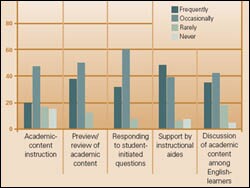
SOURCE: American Institutes for Research and WestEd
The AIR-WestEd evaluation was mandated by the California legislature after voters passed the 1998 state ballot initiative. The researchers analyzed student-achievement data, conducted phone interviews and site visits, and reviewed written surveys to examine how the measure has been implemented and to gather information on effective teaching strategies.
Proposition 227 accomplished at least one of its objectives: The proportion of California’s English-language learners receiving bilingual instruction dropped significantly, from 30 percent prior to the measure’s approval to around 8 percent now.
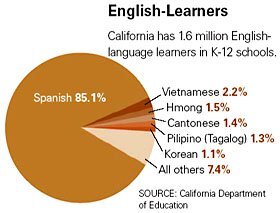
Of the roughly 1.6 million California students who are English-language learners, almost 85 percent speak Spanish. But teachers’ interpretation of Proposition 227’s requirement that students be instructed “overwhelmingly in English” has varied significantly, the researchers found. And the still-frequent use of “primary language” instruction has blurred the lines between bilingual education and what is called “sheltered” or “structured English immersion.”
Under the latter, instruction is given in English, though a student’s primary language, usually Spanish, is used for clarification or extra support. In bilingual education, students are taught in their native language for at least part of the day and then over time are gradually taught more in English.
The study also shows that the achievement gap between English-language learners and native English-speakers has remained virtually the same in most subjects and most grades since Proposition 227 went in effect.
The authors found it significant, however, that the achievement gap has not widened, even though state and federal accountability laws have driven up the percentage of English-language learners taking statewide achievement tests since the initiative passed.
Their performance on those tests has also improved since Proposition 227, the study shows. But the researchers say that because so many other education changes have been implemented since then—class-size reduction and a new accountability system, for example—it’s hard to credit the gains only to the phasing-out of bilingual instruction.
Jamal Abedi, an education professor at the University of California, Davis, agreed that a variety of factors could explain the performance increase, and he called the gain “trivial.”
He added that the continuing achievement gap between English-language learners and native speakers of English can be partly explained by the fact that the assessments used—the Stanford Achievement Test-9th Edition and the California Standards Test—were originally designed for native English-speakers.
While he agreed with some of the report’s findings, Mr. Abedi added that “to make any conclusion on the effectiveness of any component of Proposition 227, an experimentally controlled randomized design must be used.”
“Since the existing data are not collected for research purposes,” he said, “there are many limitations in the data that may affect interpretations of the findings.”
But Ron K. Unz, the Palo Alto, Calif., businessman who sponsored Proposition 227 and similar measures in other states, described AIR and WestEd as “research bureaucracies” that, he asserted, work hard to make the differences between students in bilingual classes and those in immersion programs “go away.”
He added that his own examination of earlier state test results, obtained from the state education department’s Web site, showed that students in immersion programs were outperforming those who stayed in bilingual education.
Even if achievement rates are improving, the study shows that an English-language learner has only a 40 percent chance of being reclassified as proficient in English after spending 10 years in a California school
Reclassification Issues
The state’s report on the California English Language Development Test shows that during the 2004-05 school year, only 9 percent of English-language learners were reclassified as not needing sheltered English—a figure that drew concern from state Superintendent of Public Instruction Jack O’Connell. “It is critical that California districts continue to review their reclassification procedures as well as the current academic support they provide to English-learners,” he said in a press release.
Read the results from the California English Language Development Tests, posted by the California Department of Education.
In the AIR-WestEd report, the researchers identify a number of factors they see as key to the success of English-language learners.
Schools need teachers who have been trained to meet the linguistic and academic needs of English-language learners, a schoolwide focus on language development, common priorities and expectations for students learning the language, and careful use of assessment results, the report says.
“Given the diverse learning needs of English-learners,” it adds, “we recommend less emphasis on dictating specific methods, continuing on the more general path of rewarding school academic success and intervening in the case of failure wherever it occurs.”


