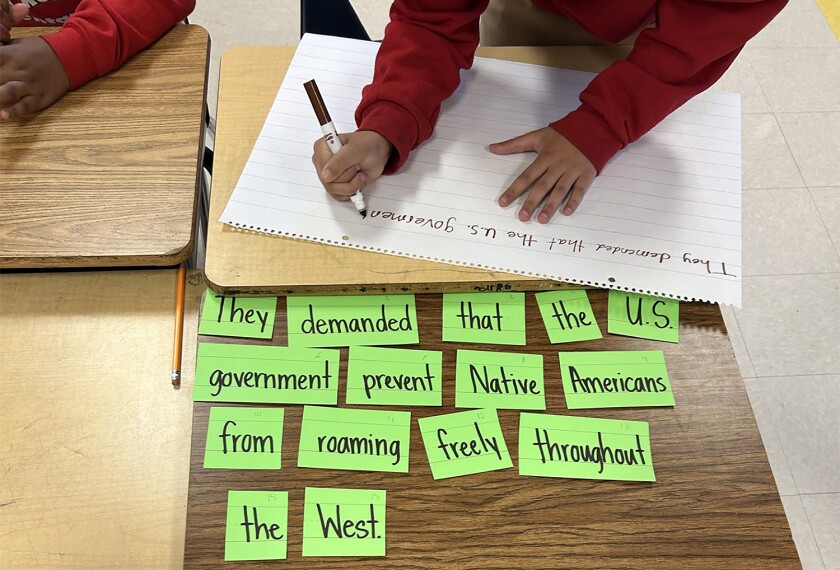
Signs are a time-honored teaching tool.
Why can’t kids spell today? While there are no doubt lots of reasons, one may have to do with signs I’ve been seeing lately on the shops and in the streets of New York.
One large sign on a fence around an empty lot in the Bronx, for example, reads: “Will Built to Suit.”
Not far from the United Nations, above an art and framing shop, massive block letters advertise: “Jackie Kennedy: An Exhibition of Photograghs.”
The sign above a convenience store in Westchester County notes that the establishment sells “Stationary.” And the awning of a store near Times Square that sells musical instruments announces the availability of “Harmonica’s, Metronome’s, Flute’s, Trumpet’s, Violin’s.”
New York is not, of course, alone. I saw this warning posted on a boat docked in Puerto Rico: “Keep water tight door close at all times.”
If I rote this peace the weigh many sighns are written, u wood understand why many kids can’t spell or send grammatically correct letters.
Such mistakes may be worth a laugh—but it’s a laugh at the expense of our children. The reason: The signs around us are among the tools that model for children how to use words and spell them—skills they’ll need later to get good jobs, support themselves, and become intelligent citizens.
Signs are a time-honored teaching tool. In a kindergarten classroom, simple signs introduce children to the alphabet, the sounds of letters, and the words that identify the objects around them. Can you imagine the reaction of the student whose teacher marks “photogragh” wrong on a spelling test and who then sees the same misspelling on a large sign on the corner store?
Businesses with such linguistically challenged signs also do themselves a disservice. When I need notepaper and pass a store that sells “stationary,” I unconsciously ask myself, as a former teacher, what quality of notepaper will I find there? I pass it by. Jacqueline Kennedy was a woman dedicated to the quality of furnishings in the White House and protecting the landmark status of buildings in New York City. When I see a display of her “photograghs,” I find myself questioning the care and authenticity that went into that exhibit and wonder how Jackie would have reacted. I pass it by. I have no plans to “built” a building on that empty lot—but if I did, I wonder how well I could communicate my ideas with its owner. I would pass it by.
To help ensure properly spelled signs, wouldn’t it be nice, the First Amendment notwithstanding, if we could impose a fine on the sign painter or the storeowner who litters the verbal landscape just as others litter the sidewalks? Isn’t the damaging of our country’s most precious property, the developing minds of our children, a crime? We have a rating system for software and movies to protect our children from inappropriate content. How about demanding a standard of quality for the signs they see in their world?
Legislation and rulemaking aside, there may be a simpler way to get the job done. Each of us can become a one-person “Literacy Squad.” When we see a misspelled sign, we can simply walk into that store and, factually and politely, point out the mistake as well as the possibility of the store’s losing customers. Some shopkeepers will welcome the information; others may respond with some version of “mind your own business.” But I suggest that helping our children learn how to spell properly, to use words correctly, to communicate effectively, and to grow up to be intelligent citizens and neighbors is part of our business.
Providing an environment that encourages children to spell, punctuate, and use words and sentences correctly is critical for an educated and literate society. This will help reinforce and extend what they learn in school and could, in its own way, make a reality of the promise explicit in the “No Child Left Behind” Act of 2001. Let’s leave no sign unscrutinized.
Charlotte K. Frank, a former New York City teacher and administrator, recently served as a New York state regent for Judicial District 1. She is the vice president for research and development for McGraw-Hill Education, a unit of the McGraw-Hill Cos.