For those who have not heard, the Canadian independent publisher Pamela McColl has updated Clement Clarke Moore’s 1823 Christmas poem, “A Visit From St. Nicholas,” by deleting two lines regarding Santa’s pipe and its ubiquitous cloud of smoke. McColl, an anti-smoking activist, hopes her version of the poem will deter children from smoking. Although the recent publication of this bowdlerized version of “ ‘Twas the Night Before Christmas” has become fodder for comedians, I am not amused.
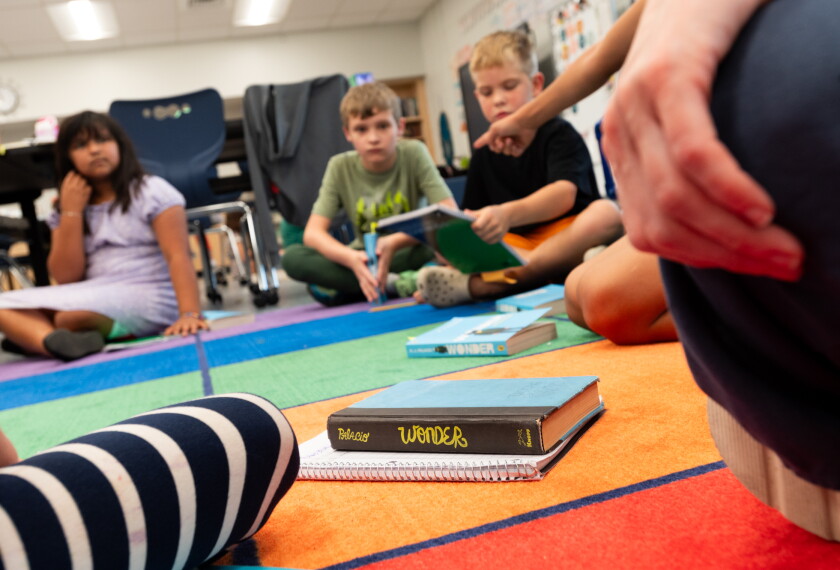
This event reminded me of an incident that occurred when one of my student-teachers read The Tale of Despereaux, by Kate DiCamillo, to her 4th graders. As she shared the scene in which a father, cigarette in his clamped mouth, sells his daughter, she looked up to find 24 pairs of horrified eyes upon her. She paused, recognizing this was troubling. Wisely, she created time for conversation.
She assumed that the children were disturbed by the selling of a child. But, in whispered unison, the children warned their young student-teacher that the word “cigarette” is forbidden at their school. They insisted that she replace “cigarette” with “chicken.” Strikingly, a man with a chicken in his mouth made a strange substitution, but the children were surprisingly satisfied and seemingly unfazed that a child was being sold by her father ... as long as he was not smoking!
I am not an advocate of smoking, nor am I receiving a kickback from the tobacco industry, but I grieve the loss of this small, 6-inch paper-wrapped bundle of nicotine. Not for what it was, but for what it represented. I anguish over what other images will also be erased. What other truths discarded?
To those who care deeply about children, I offer an alternative. Rather than eliminate images or words that offend, advance the notion of information literacy alongside critical literacy for children.
The American Library Association uses the term “information literacy” to describe “the set of skills needed to find, retrieve, analyze, and use information.” David Shenk, an emeritus professor from Columbia University, warned in the book Data Smog: Surviving the Information Glut that we enter dangerous territory when members of society, including children, are not equipped with the ability to use information literacy.
Much like information literacy, “critical literacy” is a stance that enables readers to consider text and images, not simply at face value, but through historical, cultural, and political lenses. In a Q&A on critical literacy, Patrick Shannon, a professor of education at Pennsylvania State University, said critical literacy encourages readers to use the question “Why are things the way they are?” as a tool.
Imagine what would be gained if parents discussed why things are “the way they are” as they read a book together. In the case of Moore’s poem, parents could point out the 1823 publication date and share how medical research about smoking occurred well after the poem was published. My hunch is that many 21st-century preschoolers have viewed images of their great-grandfathers, great-grandmothers, or other relatives smoking cigarettes or pipes inside the yellowed pages of old photograph albums. I would hope that the children would not consider their ancestors to be evil or dim-witted because of a cigarette or pipe. But, rather, I hope children will be apprenticed in how to situate an image or text within the historical and cultural context of the times.
I believe in children and their ability to think critically. I also recognize that some may consider my reaction to one deleted pipe and wreath of smoke as unnecessarily radical. But I cringe at the possibility of children living in an unreal, utopian world where images that do not fit the current culture are erased. Children do not need us to artificially sanitize the world. Quite frankly, we cannot.
However, children do need us. There is no doubt about that. They need us to show them the past, even if it was shrouded in smoke. Then we can teach them how to find perspective. In doing so, we offer our children a much more useful gift: the ability to read and think critically. In the process, they may create their own, better future.