Opinion
Reading & Literacy Letter to the Editor

Librarians’ ‘Beast That Won’t Die': The Five-Finger Strategy

November 03, 2015 1 min read
  • Save to favorites
  • Print

To the Editor:

As a semiretired teacher-librarian, I nodded in agreement while reading Barbara Wheatley’s Commentary “Reading by Choice: Let Students Choose the Books to Tackle.” That is, until Wheatley invoked the name of that beast that won’t die: the “five-finger strategy.”

This abomination suggests to students that instead of meaning, learning, growth, pleasurable entertainment, or any of the other myriad gifts reading provides us, the highest value resides in being able to pronounce the words.

Daniel Fader and Elton McNeil proved otherwise nearly 40 years ago in Hooked on Books: Program and Proof (Berkley Pub Corp, 1966). In discussing students’ reading choices, they write: “In fact, the threshold of understanding—of meaningful interaction—is surprisingly low, and even in many complex books can be crossed by many simple readers.”

Furthermore, how would the five-finger strategy apply to poetry, for example, or books (as well as magazines, websites, and other media) with abundant nontextual material? And what about student motivation, as Fader and McNeil remind us?

As a library media specialist, Wheatley should know better. There are no “bad choices” in the library.

Our students have a right to read whatever they want, and that right should be abrogated only when required by law. Much of the value of a library to students results from their freedom to choose what to read. So, go ahead and read aloud to them, suggest books, play, sing, and laugh, but please do not prejudice a child’s reading with the five-finger strategy or any other comments that imply anyone can possibly know what library book is best for another human being.

Mark Goldstein

Green Bay, Wis.
Related Tags:

A version of this article appeared in the November 04, 2015 edition of Education Week as Librarians’ ‘Beast That Won’t Die': The Five-Finger Strategy

Events

Jobs Regional K-12 Virtual Career Fair: DMV
Find teaching jobs and K-12 education jubs at the EdWeek Top School Jobs virtual career fair.
This content is provided by our sponsor. It is not written by and does not necessarily reflect the views of Education Week's editorial staff.
Sponsor
Artificial Intelligence Webinar
Making AI Work in Schools: From Experimentation to Purposeful Practice
AI use is expanding in schools. Learn how district leaders can move from experimentation to coordinated, systemwide impact.
Content provided by Frontline Education
This content is provided by our sponsor. It is not written by and does not necessarily reflect the views of Education Week's editorial staff.
Sponsor
Student Well-Being & Movement Webinar
Building Resilient Students: Leadership Beyond the Classroom
How can schools build resilient, confident students? Join education leaders to explore new strategies for leadership and well-being.
Content provided by IMG Academy

EdWeek Top School Jobs

Teacher Jobs
Search over ten thousand teaching jobs nationwide — elementary, middle, high school and more.
View Jobs
Principal Jobs
Find hundreds of jobs for principals, assistant principals, and other school leadership roles.
View Jobs
Administrator Jobs
Over a thousand district-level jobs: superintendents, directors, more.
View Jobs
Support Staff Jobs
Search thousands of jobs, from paraprofessionals to counselors and more.
View Jobs

Read Next

Reading & Literacy Quiz Quiz Yourself: How Much Do You Know About Helping Struggling Students Get Back on Track?
Too many students struggle with reading. Test your knowledge of what works—and discover strategies to help them get back on track.
Reading & Literacy How a School's Language Lab Teaches Non-Phonics Reading Skills
In 'language lab,' teachers work on vocabulary and syntax to help students understand complex text.
5 min read
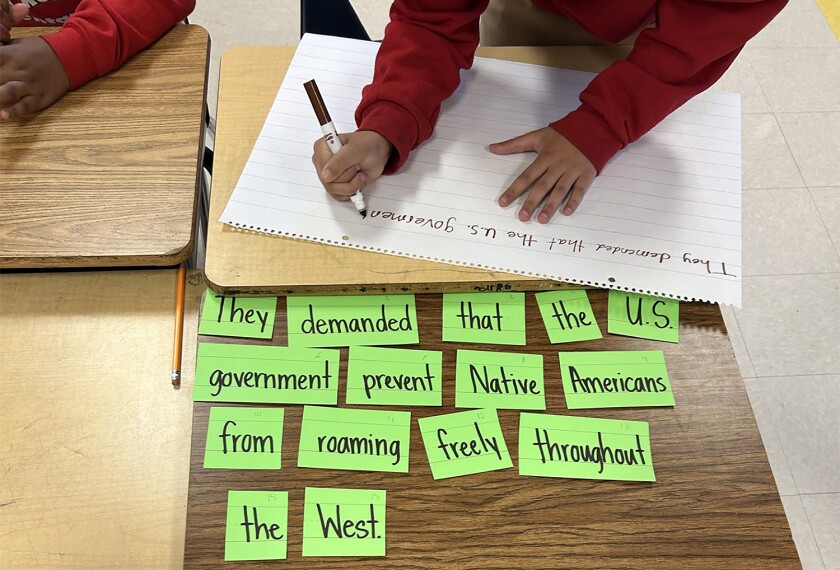
5th grade classroom in February. A morpheme word sort, sentence combining practice, and syntax surgery.
In a 5th grade classroom at Rock Rest Elementary, near Charlotte, N.C., students practice combining sentences and participate in "syntax surgery" to order the parts of complex sentence.<br/>
Madison Hart, Rock Rest Elementary
Reading & Literacy Quiz Risk vs. Reward: How Defensible Is Your Literacy Strategy?
Build a stronger case for your literacy approach. Test your knowledge of research-driven strategies that support reading success with this quick quiz.
Reading & Literacy Opinion What the 'Science of Reading' Movement Has Meant for English Learners
We should think of reading instruction for multilingual learners as a bridge, not a checklist.
8 min read
Conceptual illustration of classroom conversations and fragmented education elements coming together to form a cohesive picture of a book of classroom knowledge.
Sonia Pulido for Education Week
