Opinion
Curriculum Letter to the Editor

Handwriting Is Still Alive and Well

February 21, 2012 1 min read
  • Save to favorites
  • Print

Head of School The Windward School

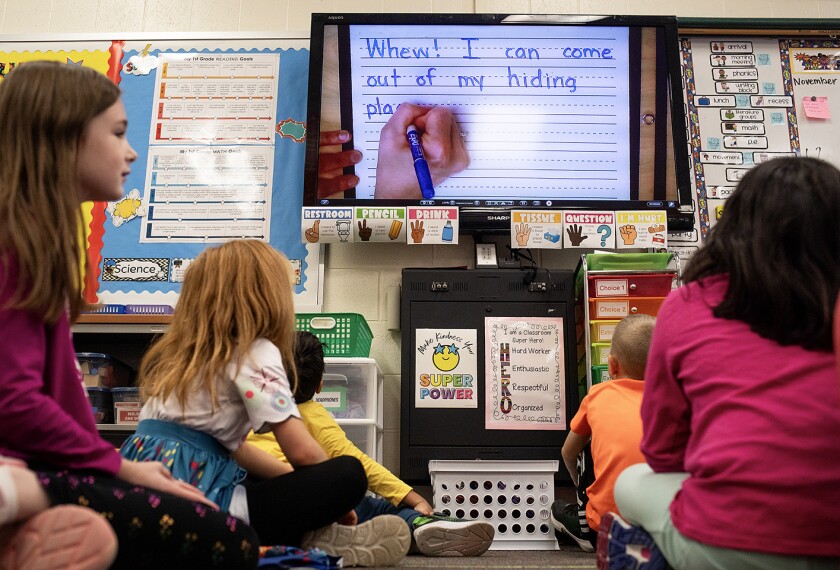
The article “Experts Fear Handwriting Will Become a Lost Art,” (Jan. 25, 2012) reported that while experts fear handwriting is becoming a lost art, a summit was held in Washington, D.C., to make a case for teaching handwriting. This is not the first time that handwriting has been given up for dead.

In the Feb. 13, 2009, issue of Newsweek, an article titled “The Curse of Cursive” predicted the doom of writing in longhand: “Penmanship, like hieroglyphics and the IBM Selectric, has lost its purpose. Let’s erase it for good.” Another piece, “The Handwriting Is on the Wall,” published in 2006 in The Washington Post‘s Higher Education blog, claims that many teachers are not concerned about the drop in the use of cursive, while scholars point to research that shows children without proficient handwriting skills produce simpler, shorter compositions.

With populist outcries for doing away with cursive and with apparent teacher apathy toward its demise, it is time to examine the evidence that supports the teaching of handwriting in our schools.

Unfortunately, students are receiving less and less instruction in handwriting. Vanderbilt University professor Steve Graham found in 2003 that primary grade teachers spent less than 10 minutes a day on handwriting. He found the decline in the instruction of handwriting and its diminished use by students is not because handwriting has lost its purpose; it is due to a lack of teacher preparation, as a majority of teachers admitted they had no training and no curriculum materials for it.

To paraphrase Mark Twain: Reports of the death of handwriting are exaggerations. Handwriting is alive and well at my school and others where instructional practice is informed by the research and supported by a comprehensive professional-development program that includes strategies for teaching handwriting. There is clear evidence that handwriting is an important tool in the acquisition of reading and writing skills and should be part of every language arts program.

John J. Russell

Head of School

The Windward School

White Plains, N.Y.
A version of this article appeared in the February 22, 2012 edition of Education Week as Handwriting Is Still Alive and Well

Events

This content is provided by our sponsor. It is not written by and does not necessarily reflect the views of Education Week's editorial staff.
Sponsor
Reading & Literacy Webinar
Unlocking Success for Struggling Adolescent Readers
The Science of Reading transformed K-3 literacy. Now it's time to extend that focus to students in grades 6 through 12.
Content provided by STARI
Jobs Virtual Career Fair for Teachers and K-12 Staff
Find teaching jobs and K-12 education jubs at the EdWeek Top School Jobs virtual career fair.
This content is provided by our sponsor. It is not written by and does not necessarily reflect the views of Education Week's editorial staff.
Sponsor
College & Workforce Readiness Webinar
Climb: A New Framework for Career Readiness in the Age of AI
Discover practical strategies to redefine career readiness in K–12 and move beyond credentials to develop true capability and character.
Content provided by Pearson

EdWeek Top School Jobs

Teacher Jobs
Search over ten thousand teaching jobs nationwide — elementary, middle, high school and more.
View Jobs
Principal Jobs
Find hundreds of jobs for principals, assistant principals, and other school leadership roles.
View Jobs
Administrator Jobs
Over a thousand district-level jobs: superintendents, directors, more.
View Jobs
Support Staff Jobs
Search thousands of jobs, from paraprofessionals to counselors and more.
View Jobs

Read Next

Curriculum The Many Reasons Teachers Supplement Their Core Curricula—and Why it Matters
Some experts warn against supplementing core programs with other resources. But educators say there can be good reasons to do so.
7 min read
First grade students listen as their teacher Megan Goes helps them craft alternate endings for stories they wrote together at Moorsbridge Elementary School in Portage, Mich., on Nov. 29, 2023.
First grade students listen as their teacher Megan Goes helps them craft alternate endings for stories they wrote together at Moorsbridge Elementary School in Portage, Mich., on Nov. 29, 2023. In reading classrooms nationwide, teachers tend to mix core and supplemental materials—whether out of necessity or by design.
Emily Elconin for Education Week
Curriculum Shakespeare, Other Classics Still Dominate High School English
Despite efforts to diversify curricula, teachers still regularly assign many of the same classic works, a new survey finds.
6 min read
Illustration of bust of Shakespeare surrounded by books.
Chris Whetzel for Education Week
Curriculum Why Most Teachers Mix and Match Curricula—Even When They Have a 'High-Quality' Option
Teachers who supplement "may be signaling about inadequacies in the materials that are provided to them,” write the authors of a new report.
6 min read
An elementary school teacher helps a student with a writing activity.
Allison Shelley for All4Ed
Curriculum How Digital Games Can Help Young Kids Separate Fact From Fiction
Even elementary students need to learn how to spot misinformation.
3 min read
Aerial view of an diverse elementary school classroom using digital  devices with a digitized design of lines connecting each device to symbolize AI and connectivity of data and Information.
iStock/Getty
