Social Studies

New York Union Urges Teaching About R.F.K.

By Kathleen Kennedy Manzo — November 17, 2008 1 min read
  • Save to favorites
  • Print

The legacy of Robert F. Kennedy has inspired an unusual alliance over school curriculum in New York that joins the state teachers’ union, a private foundation, the state education department, and the governor.
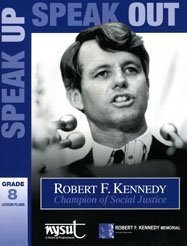
The guides for grades 4, 8, and 11, titled “Speak Up, Speak Out: Robert F. Kennedy, Champion of Social Justice,” include biographical information, vocabulary, lessons, and activities.

All are urging teachers to infuse the ideals of social justice—which Mr. Kennedy championed as U.S. attorney general and later as a United States senator from New York before his death in 1968—into their lessons through the use of curriculum guides developed by the New York State United Teachers.

The union, an affiliate of the National Education Association and the American Federation of Teachers, is sending the guides, which include history and English/language arts lessons aligned to state standards, to schools throughout the state.

The guides for grades 4, 8, and 11, titled “Speak Up, Speak Out: Robert F. Kennedy, Champion of Social Justice,” include biographical information, vocabulary, lessons, and activities. The state education department and Gov. David A. Paterson, a Democrat, have endorsed the materials and are encouraging schools to “examine and memorialize the life and work of a great American ... and a truly remarkable New Yorker.”

Development and distribution of the curriculum materials is a first for the union, which was persuaded to take on the project by the Washington-based Robert F. Kennedy Memorial Center.

The union convened teachers from each of the three grade levels to write lessons aligned with the existing curriculum and state academic standards.

For example, a lesson for 4th graders describes the work of the Freedom Riders and the nonviolent protests they organized to speak out against discriminatory laws and policies in the 1960s. It introduces related vocabulary words, such as “citizenship” and “responsibility,” along with reading and writing activities.

“The project allows us to concentrate on the importance in any school curriculum to address social awareness and social responsibility,” said nysut President Richard C. Iannuzzi.

Related Tags:

A version of this article appeared in the November 19, 2008 edition of Education Week

Events

Teacher Preparation Webinar What Teacher Education Should Look Like in the Age of AI
Explore the current trends around the use of AI in teacher preparation and continuing education with data from the EdWeek Research Center.
English Learners Webinar How Can School Districts Better Support English Learners With Disabilities?
Join this webinar to hear recent findings from the EdWeek Research Center and discover practical strategies for improvement.
This content is provided by our sponsor. It is not written by and does not necessarily reflect the views of Education Week's editorial staff.
Sponsor
Classroom Technology Webinar
Better Tools, Not More: What Educators Say About Teaching and Technology
Optimism is up. AI use is rising. Coherence is the next challenge. Hear what the 2026 Educator Confidence Report reveals about the field.
Content provided by HMH

EdWeek Top School Jobs

Teacher Jobs
Search over ten thousand teaching jobs nationwide — elementary, middle, high school and more.
View Jobs
Principal Jobs
Find hundreds of jobs for principals, assistant principals, and other school leadership roles.
View Jobs
Administrator Jobs
Over a thousand district-level jobs: superintendents, directors, more.
View Jobs
Support Staff Jobs
Search thousands of jobs, from paraprofessionals to counselors and more.
View Jobs

Read Next

Social Studies In Social Studies, Does AI Shortcut Historical Thinking? Or Deepen It?
A national student history contest banned AI use, raising questions about its role in social studies.
5 min read
Caitlyn Wilder, a social studies teacher at Northern Lehigh High School, helps a student who is using artificial intelligence software and a chatbot to complete a worksheet in English and Spanish on Sept. 23, 2025 , at the Slatington school.
Caitlyn Wilder, a social studies teacher at Northern Lehigh High School, helps a student who is using artificial intelligence software and a chatbot to complete a worksheet on Sept. 23, 2025, in Slatington, Pa. A history organization's ban on AI tools to help students brainstorm or create products for their history competition entries raises new questions about whether, in social studies, the tools can help aid historical thinking—or short-circuit learning.
April Gamiz/The Morning Call via TNS
Social Studies Trump Admin. Calls Popular Smithsonian History Teaching Materials 'Radical'
The White House criticized the Smithsonian's classroom lessons. But some teachers say the materials are invaluable.
5 min read
Children look at the Star Spangled Banner, the flag that inspired the lyrics of the American national anthem, at the Smithsonian's National Museum of American History, Tuesday, June 10, 2025, in Washington.
Children look at the Star Spangled Banner, the flag that inspired the lyrics of the American national anthem, at the Smithsonian's National Museum of American History on June 10, 2025, in Washington.
Mark Schiefelbein/AP Photo
Social Studies Most Schools Report Teaching Civics. But Hands-On Lessons Aren't as Common
Only 13% of district leaders say their schools require "experiential" civics learning.
3 min read
Students at Hudson Primary School study about what it means to be a citizen during the 2024-25 academic year. The Pasco County school district is expanding its civics education program amid a state and national push to do so.
Students at Hudson Primary School study about what it means to be a citizen in this March 24, 2026 photo. The Pasco County school district is expanding its civics education program amid a state and national push to do so.
Jeffrey S. Solochek/Tampa Bay Times via TNS
Social Studies Opinion America at 250: Our Classrooms Are Too Quiet
Respectful disagreement is an essential habit for self-governance. Can schools recover it?
David J. Bobb
•
5 min read
Student hands hold speech bubbles, they contribute to an exchange of ideas. Each one contains the colors of the flag of the United States of America. Civics education.
Vanessa Solis/Education Week + Getty