
Updated: This story has been updated to reflect recent developments in Israel and Gaza.
Soon after the surprise Hamas attack on Israel earlier this month, the San Diego County Office of Education released a memo with a list of resources that educators and parents can use to help young children and adolescents think and talk about this international crisis. The Associated Press reported that the violence had caused at least 2,800 deaths on both sides as of Oct. 13 and unleashed some of the greatest violence the region has seen in years.
“California is home to students and staff with cultural ties to Israel and Palestine, and has seen a rise in antisemitic and Islamophobic incidents even before the outbreak of war,” according to the Oct. 7 memo. “As educators, we must make sure we provide a safe space for all members of our community to learn about current events and process their emotions.”
Other school district leaders are taking similar steps to help their communities process the Hamas attack and the ensuing Israeli response.
“It is heartbreaking to see the devastating impact of terrorism on innocent civilians, especially our most vulnerable—children,” tweeted New York City schools’ Chancellor David C. Banks. He added that his district will be “providing resources to our schools to facilitate discussions about the conflict and supporting our students in being compassionate global citizens.”
Fred Rundle, the superintendent of Mercer Island school district in Washington state, sent out an Oct.9 memo providing resources for educators and parents to use to discuss the crisis with their students and children.
“Our hearts are with our students, staff, and families impacted by the horrific events in Israel and Gaza,” Rundle wrote. “This is a scary and emotional time, especially for our Mercer Island community who is so connected to this part of the world.”
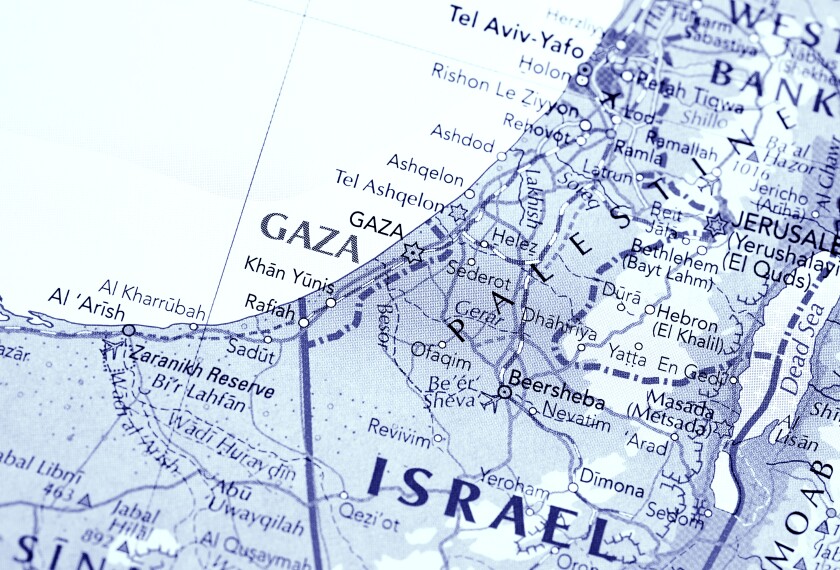
On Oct. 7, Hamas, a Palestinian militant group that has governed more than 2 million Palestinians in the Gaza Strip since 2006, launched its largest surprise attack ever on Israel, prompting Israeli Prime Minister Benjamin Netanyahu to declare war. While Hamas has governed the territory since 2006, dozens of countries label it a terrorist organization, and it receives substantial support from Iran, according to the Council of Foreign Relations, a nonpartisan think tank.
Israel responded with airstrikes on cities in the Palestinian territory, and Hamas has continued to fire rockets into Israel.
Israel has blocked deliveries of food, water, and fuel, and shut down electricity to the Gaza Strip. On Oct. 13, Israel’s military ordered more than a million civilians living in northern Gaza to evacuate, a possible precursor to a ground invasion. Israel has been massing troops along the Gaza border since the Hamas’ attack, and on Oct. 13, they entered the border to battle militants, according to reporting from the Associated Press.
The Israeli-Palestinian conflict is rooted in a millennia-old territorial dispute over the Holy Land, a region in the Middle East with religious and historical significance to Jews, Muslims, and Christians. Israel and Hamas have exchanged attacks for decades. For instance, in May 2021, an Israeli police raid on the al-Aqsa mosque in Jerusalem set off an 11-day war between the two. This weekend’s attack took place on the 50th anniversary of the Yom Kippur War, when a coalition of Arab states attacked Israel, and just before the Jewish holiday of Simchat Torah.
To help educators explain the conflict and guide students in how to talk about emotionally charged, violent events like this in measured, respectful ways, Education Week has collected several resources. Those resources are intended to help students understand historical context, process current events, and use media literacy skills to analyze news coverage and social media responses and misinformation about the conflict.
- Making a Difference in the Midst of the Israeli-Palestinian Conflict | Wide Angle: Lesson Plan: This high-school-level lesson plan from PBS explores the history and complexity of the Palestinian-Israeli conflict through videos, websites, and interactive activities that provide more insight into the conflict.
- Fears of bigger war grow as Israel-Hamas fighting continues: PBS has also created “Daily News Lessons” to guide discussions with students about the Israel-Hamas war using PBS News Hour’s reporting.
- What Is U.S. Policy on the Israeli-Palestinian Conflict?: This guide from the Council on Foreign Relations provides background information behind the conflict and explains what the United States has done to negotiate a resolution to the conflict.
- Conflict in Israel and Palestine: Crash Course, an educational YouTube channel, explains the origins of the long-standing conflict in under 13 minutes.
- How do I talk to my kids about violence in the news? and Explaining the News to Our Kids: These two guides from Common Sense Media, a nonprofit that examines the impact of technology on children, provide age-appropriate tips on how to talk to kids about what’s happening in the news, especially when it involves violence.
- How to talk to your children about conflict and war: This guide from UNICEF provides 8 tips on how to support and comfort children when war dominates headlines.
- Handle With Care: Supporting Young People During Crises: Learning for Justice, a social justice and activism program for schools, provides ideas to support “meaningful” discussions about emotionally charged topics, such as the Hamas attack on Israel, with young people and potential follow-up steps and responses.
- Fostering Civil Discourse: How Do We Talk About Issues That Matter?: This guide from nonprofit Facing History and Ourselves gives educators ideas for how to prepare students to engage in reflective conversations on controversial topics.
- Teaching Controversial Issues: A Framework for Reflective Practice: This guide from Judy Pace, a teacher educator at the University of San Francisco, provides a research-based framework for teaching controversial issues.
- In brief: Misinformation: This infographic from the News Literacy Project provides an overview of the pervasive use of misinformation and how people can be more critical readers of news and other information.
- Israel-Hamas War Media Literacy: The News Literacy Project has also started collecting misinformation about the war to help readers separate fact from fiction.
- The Israel-Gaza War: A Forum for Young People to React: The New York Times’ The Learning Network has provided a space for students to react to the news and share their thoughts. They provide discussion questions that teachers can use when talking about this conflict with their students.


