Reading & Literacy

At Puerto Rican School, Lifting Spirits With Read-Aloud Event

By Andrew Ujifusa — October 10, 2017 2 min read
Students participate in "From Reading to Hope" activities at Maria Vasquez de Umpierre School in Bayamon, Puerto Rico. School principal Jessica Hernandez and others organized the event to help students reorient themselves in the wake of Hurricane Maria.
  • Save to favorites
  • Print

Bayamon, Puerto Rico

Alianey Arana, 13, normally doesn’t attend Maria Vasquez de Umpierre School here. But a great deal is abnormal about her life since Hurricane Maria, and when the school got word out that it was hosting an event called “From Reading to Hope” earlier this week, she wanted to attend.

“It feels different,” said Arana, who doesn’t have any friends at the school, but is still upbeat. “I feel happy because I can see everybody’s OK.”

The event on Monday featured a read-aloud activity for about 75 school-age children and their parents, as well as other physical and artistic activities structured “in order to create a growth mindset” after the disaster, said Jessica Hernandez, the K-8 school’s principal. Teachers trained for the event, including in some crisis-intervention techniques.

See Also: In Puerto Rico, a Daunting Effort to Reopen Schools, Headed by a Determined Leader

“The school is the essence of what is the school community, and the extended community,” Hernandez said. “And it should be ... where the community can come together and deal with these issues.”

Puerto Rican actress Mariana Quiles read The Day the Dog Said “¡Quiquiriqui!” (the last word is the Spanish version of a rooster’s crow) to children of various ages at Maria Vasquez de Umpierre. In the story, other animals pulled switcheroos: After a big storm, a cow, for example, starts quacking like a duck.

Carefully Chosen

The organizers didn’t choose this story haphazardly.

“The story is very elementary,” said Marisa Gonzalez, an English coach at the school who also works for Scholastic, Inc., which helped to organize the event. “But when you look at the essence of the story, the animals go through something like a hurricane.”

Hernandez said the children bring different experiences concerning the storm to school with them. Still, she hopes events like this prepare students a little bit for when Maria Vasquez de Umpierre reopens, ideally on Oct. 23.
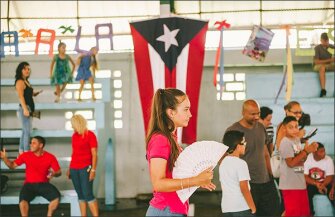
Aliancy Arana, 13, passes by the flag of Puerto Rico at the read-aloud event at Maria Vasquez de Umpierre School in Bayamon.

But the “From Reading to Hope” activities won’t erase the memories of the storm for Alianey, who recalled that the hurricane “was scary because of the rain. ... It was terrifying.” One structure attached to her house blew away, but otherwise her home remained intact, and she has the basic supplies she needs for living.

And when it comes to what Alianey misses most about school, the list she ticks off seems prosaic until you factor in Hurricane Maria: “Talking with my friends, seeing my teachers, going to class.”

Events

This content is provided by our sponsor. It is not written by and does not necessarily reflect the views of Education Week's editorial staff.
Sponsor
Professional Development Webinar
Grow Leaders, Keep Teachers: Leadership Development as a Staffing Strategy
Find out how to turn leadership development into a staffing strategy and grow your next generation of school leaders from within.
Content provided by Frontline Education
This content is provided by our sponsor. It is not written by and does not necessarily reflect the views of Education Week's editorial staff.
Sponsor
Teaching Webinar
Closing the Practice Gap: Essential Insights for Leaders
Three instructional experts will share strategies for making students’ reading and math practice more engaging and impactful this year.
Content provided by Renaissance
This content is provided by our sponsor. It is not written by and does not necessarily reflect the views of Education Week's editorial staff.
Sponsor
School & District Management Webinar
The Principal's Role in Collective Efficacy and Student Outcomes
Learn practical strategies that help principals translate their confidence into stronger collective teacher efficacy and student outcomes.
Content provided by Otus

EdWeek Top School Jobs

Teacher Jobs
Search over ten thousand teaching jobs nationwide — elementary, middle, high school and more.
View Jobs
Principal Jobs
Find hundreds of jobs for principals, assistant principals, and other school leadership roles.
View Jobs
Administrator Jobs
Over a thousand district-level jobs: superintendents, directors, more.
View Jobs
Support Staff Jobs
Search thousands of jobs, from paraprofessionals to counselors and more.
View Jobs

Read Next

Reading & Literacy What is 'Linguistic' Phonics and Why Are Some Schools Adopting It?
A new question is emerging in the "science of reading": Is one type of phonics instruction better than another?
8 min read
Julie Celestial, center, teaches her kindergarten class a literacy lesson at Mark Twain Elementary School in Long Beach, California on Tuesday, May 6, 2025 . A new bill could change how literacy is taught in elementary schools by providing transitional kindergarten through fifth-grade teachers with training and textbooks that stress what's known as science of reading, an approach to literacy that focuses heavily on phonics and foundational reading skills to combat California's literacy crisis. Though other states have shifted to this evidence-based reading, California's reading instruction has largely been left to the control of school districts, many of which have not made the switch. The school has begun their shift to a science of reading approach and are seen as an example for other California districts.
Julie Celestial, center, teaches her kindergarten class a literacy lesson at Mark Twain Elementary School in Long Beach, Calif. on Tuesday, May 6, 2025. Proponents of a "speech-to-print" phonics approach say it works more efficiently than other methods. But research evidence is inconclusive.
Allen J. Schaben/Los Angeles Times via TNS
Reading & Literacy Middle Schoolers' Reading Scores Are Still Stuck at Post-Pandemic Lows
New data shows that the lowest-performing students are falling the furthest behind.
4 min read
Sixth graders read a passage and give constructive feedback to their partners during Nancy Barajas' class at Fairview Elementary School on May 6, 2026, in Modesto, Calif.
Sixth graders read a passage and give constructive feedback to their partners during Nancy Barajas' class at Fairview Elementary School on May 6, 2026, in Modesto, Calif. New research shows the nation's 6th graders' reading scores have flatlined, and the lowest-performing students are losing ground.
Annie Barker/AP
Reading & Literacy Federal 'Science of Reading' Bill Advances
A Senate committee also passed a proposal to classify dyslexia separately under federal disability law.
5 min read
AT LEFT, US Senator Maggie Hassan (D-NH) listens as US Senator Tim Kane (D-VA) speaks regarding the Special Education Administration Act (S. 5038), and the profit the transfer of certain offices to other Federal Agency (S.5046) Act during a Health, Education, Labor and Pension Executive Session at the Dirksen Senate Office Building on Capitol Hill, Washington, DC on Thursday, July 30, 2026.
U.S. Sen. Maggie Hassan, D-N.H., left, listens as U.S. Sen. Tim Kaine, D-Va., speaks during a Senate Health, Education, Labor, and Pensions committee meeting at the Dirksen Senate Office Building on Capitol Hill in Washington on July 30, 2026. The committee advanced two bills related to reading, as well as another opposing the transfer of certain U.S. Department of Education offices to other agencies.
Demetrius Freeman for Education Week
Reading & Literacy Is Required Summer Reading a Good Idea? What the Research Says
Studies show benefits for summer reading in general. But little evidence supports assigning specific books.
4 min read
The desktop of a student at the Wells Preparatory Elementary School reflects the literature they are studying in Charlotte Owens' fifth grade class on Friday, March 8, 2024, in Chicago. In Chicago Public Schools, the average reading score went up by the equivalent of 70% of a grade level from 2022 to 2023. Math gains were less dramatic, with students still behind almost half a grade level compared to 2019. Chicago officials credit the improvement to changes made possible with nearly $3 billion in federal relief.
The desktop of a student at the Wells Preparatory Elementary School reflects the literature they're studying in Charlotte Owens' fifth grade class on Friday, March 8, 2024, in Chicago. Research supports children reading over the summer—but not specifically assigning reading lists or holding kids accountable for completing them.
Charles Rex Arbogast/AP Photo