College & Workforce Readiness

Aspiring Teachers Can Substitute SAT Scores for Praxis in Virginia

By Linda Jacobson — April 07, 2004 3 min read
  • Save to favorites
  • Print

Prospective teachers in Virginia will no longer have to take the Praxis I licensing exam as long as they earned a high enough score on the SAT college-entrance exam.

The state board of education voted unanimously last month to make the change, which went into effect immediately.

If teacher-candidates took the SAT after April 1995, they would need to have earned at least 530 out of a possible 800 on each section, mathematics and verbal, and a combined score of at least 1100. For those who took the SAT before then, a minimum of 450 on the verbal section and 510 on the math section is required, along with a combined score of 1000. The differences reflect the “recentering” of the SAT.

“There was a feeling on the part of the board that this was not a lowering of the standards,” Charles Pyle, a spokesman for the Virginia education department, said last week. “It’s a comparable bar.”

‘Simplifying the Process’

During the March 24 meeting, the nine-member board heard from a statistician with the Educational Testing Service, which designed and administers the Praxis series of tests, that individuals who earned those cutoff scores on the SAT were likely to attain the minimum scores that the state requires on the Praxis. The ETS also makes the SAT.

Those who did not earn the requisite SAT scores will still have to take the Praxis, which assesses reading, writing, and mathematics skills and is required in 35 states as part of the licensing process.

“We do see this as a way of providing some flexibility,” Mr. Pyle said. “This may help someone who has not been able to pass the Praxis.”

But, he added, the board does not expect a lot of new teachers to fall into that category. Meanwhile, the board hopes to use the new rule to attract young people into the teaching field even before they go to college.

According to the ETS, based in Princeton, N.J., Virginia is now the fourth state to permit college-entrance-exam scores to be used instead of the Praxis. Connecticut, Delaware, and Georgia also do.

“We’re talking about states that are known for having high entry-level standards,” said Thomas G. Carroll, the president of the National Commission on Teaching and America’s Future, a private, nonprofit group based in Washington. “I think it’s an attempt to maintain the same standards while simplifying the process.”

Virginia currently has the highest Praxis I cutoff scores in the nation. The state requires at least a 178 in mathematics, 178 in reading, and 176 in writing for a total of 532 out of a possible 570.

But the state’s Advisory Board on Teacher Education and Licensure, the 19-member group of teachers and administrators that recommended the substitution of the SAT, is planning to review those minimum scores.

“I agree that there ought to be a periodic review of cut scores,” said Jean Bankos, the president of the Virginia Education Association, an affiliate of the National Education Association.

She supports the new SAT option, and said that it might help “really good teachers” who just haven’t been able to pass the Praxis. The only obstacle, she added, might be locating scores for someone who took the test many years ago.

“I think it’s a recognition on the part of the state board that there are multiple ways to accomplish the goal of having highly qualified people in the classroom,” Ms. Bankos said.

Recruiting Tool

Board members, Mr. Pyle added, also hope that allowing the SAT to be used in place of the Praxis exam will encourage high school students to consider teaching careers. Even before they graduate from high school, they will know whether they’ve satisfied one standard for becoming a teacher.

“The board sees it as a recruiting tool,” he said.

Mr. Carroll said he didn’t know whether additional states might adopt the idea, but that Virginia’s move is part of a trend toward reducing the number of steps required for a teaching license.

Because people outside the education field are far more familiar with the SAT than the Praxis, Virginia’s decision may also “make this process more transparent,” he said. “It may help to convey the expectations [for teachers] more clearly to the public.”
Related Tags:
SAT

Events

This content is provided by our sponsor. It is not written by and does not necessarily reflect the views of Education Week's editorial staff.
Sponsor
Personalized Learning Webinar
Differentiation That Delivers: Proven Practices From High-Growth Districts
Make every minute count. Proven strategies from educators and leaders driving real student growth. Save your seat!
Content provided by i-Ready, Curriculum Associates
This content is provided by our sponsor. It is not written by and does not necessarily reflect the views of Education Week's editorial staff.
Sponsor
College & Workforce Readiness Webinar
From Exposure to Experience: Designing Accessible Work-Based Learning
Learn how schools can create meaningful experiences that help every student build skills, connections, and a clearer path to their future.
Content provided by Project Lead The Way
This content is provided by our sponsor. It is not written by and does not necessarily reflect the views of Education Week's editorial staff.
Sponsor
School & District Management Webinar
A Tale of Two School Districts: Forecasting Enrollment
Forecasting enrollment is hard. Here’s how two different districts are navigating times of change with data that considers the whole picture.
Content provided by Zonda Education

EdWeek Top School Jobs

Teacher Jobs
Search over ten thousand teaching jobs nationwide — elementary, middle, high school and more.
View Jobs
Principal Jobs
Find hundreds of jobs for principals, assistant principals, and other school leadership roles.
View Jobs
Administrator Jobs
Over a thousand district-level jobs: superintendents, directors, more.
View Jobs
Support Staff Jobs
Search thousands of jobs, from paraprofessionals to counselors and more.
View Jobs

Read Next

College & Workforce Readiness Q&A Reading, Writing, and Math Skills Are Top Priorities in This CTE Program
How these teachers are connecting the dots between academic and technical skills.
4 min read
Cass Career Center
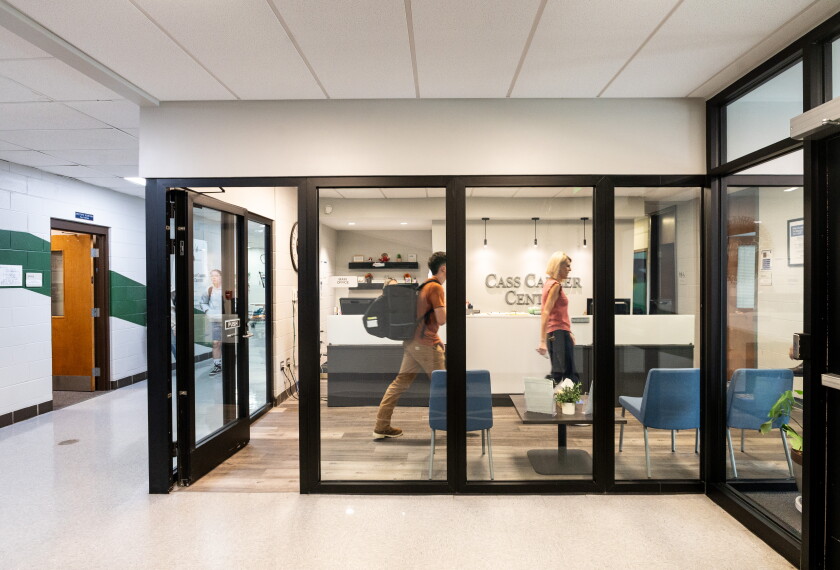
Assistant Director, Nicole Tews, walks a student through the administration office at the Cass Career Center in Harrisonville, Mo., on September 29, 2026. The center has a math and an English teacher who are integrated into students' industry-specific career programs.
Melissa Lukenbaugh for Education Week
College & Workforce Readiness Q&A Dual Enrollment Is Surging. Here's How High Schools Can Get it Right
More than 3 million high school students took a college course last year.
3 min read
Macomb Community College's South Campus in Warren, Mich. off of 12 Mile Road on Oct. 15, 2026.
Macomb Community College's South Campus in Warren, Mich., is shown on Oct. 15, 2026. In Michigan, 16 percent of community college students are high schoolers. Nationwide, dual enrollment now tops 3 million students.
Miles Oates/mlive.com via TNS
College & Workforce Readiness The CTE Program Answering the Question ‘Why Do I Need Math to Be a Firefighter?’
Integrating academic learning into career and technical education comes with challenges.
13 min read
Cass Career Center
Layton Heaper, a senior in the welding program at the Cass Career Center in Harrisonville, Mo., works on a project on Sept. 29, 2026. Through the school's integrated academics program, students learn and apply English and math skills related to future careers.
Melissa Lukenbaugh for Education Week
College & Workforce Readiness As Students Explore Alternatives to College, Are Counselors Ready to Help Them?
A new survey finds growing interest in non-degree pathways post-graduation, but schools are struggling to keep up.
3 min read
Kendall Gray (left) and Gala Davis (right), both guidance counselors, catch up and talk in Davisí office at South Oak Cliff High School in Dallas on March 6, 2025.
Kendall Gray, left, and Gala Davis, both school counselors, talk in Davis' office at South Oak Cliff High School in Dallas on March 6, 2025. A new survey polls school counselors about student career readiness.
Liz Rymarev/The Dallas Morning News via TNS