Reading & Literacy

All Write Now

By Ashtar Analeed Marcus — February 17, 2006 1 min read
  • Save to favorites
  • Print

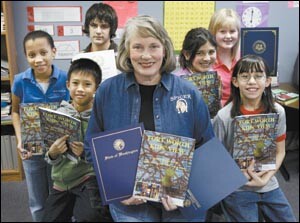
Texas law requires all elementary school students to learn about their community, but when 2nd grade teacher Marilyn Phillips looked for a book to anchor her lessons on Fort Worth, there was none. So she wrote her own.
BRIC ARCHIVE

The John D. Spicer ElementarySchool teacher recruited six former students and spent a recent summer touring more than 25 sites that reflect Fort Worth’s character, taking notes and photos at places such as the stockyards, the National Cowgirl and Cattle Raisers museums, a vintage railroad, and local theaters and art museums. The resulting book, published last year, is an illustrated, 63-page guide to the city titled Fort Worth Kids’ View. The descriptions and explanations of the sites are supplemented by asides from the 3rd and 5th graders themselves.

The volume, which resulted in local television appearances for the young authors, letters of praise from several elected officials, and a request from first lady Laura Bush for a copy, has also raised more than $300 for the school’s library through book sales. And it’s apparently filled a yawning curriculum gap: At least six of Phillips’ colleagues have begun using the book to help children learn about local history, art, and social studies.

“The purpose of this book was to help me, as an educator, teach about my community,” Phillips says. “I couldn’t find a book about Fort Worth that was appealing to elementary students.” She adds that the project has also boosted the student scribes’ composition skills. “Children are writers, and it’s just opened the door for them to do that. We hope that this book will encourage students across the nation to write books together.”

The experience has already whetted the publishing appetite of one collaborator. Phillips “put the writing bug in me,” reports 9-year-old Natalie Flores, a book coauthor and now an aspiring autobiographer. “She said we had to write every day, and that just made us better at it. That made me feel really confident.”

“It’s just been an incredible opportunity for all of them,” adds principal Mike Dukes. “They’ve gotten a taste of what it’s like to write, to edit, to publish. [Phillips] has got an incredible ability to find something they enjoy working with.”
Related Tags:

Events

This content is provided by our sponsor. It is not written by and does not necessarily reflect the views of Education Week's editorial staff.
Sponsor
Classroom Technology Webinar
Screen Time and AI: An Evidence Playbook for School Leaders
Get a clearer picture of the current policy landscape, a framework for evaluating new tools, plus language to use in the next board meeting.
Content provided by Instructure
This content is provided by our sponsor. It is not written by and does not necessarily reflect the views of Education Week's editorial staff.
Sponsor
School & District Management Webinar
The Principal's Role in Collective Efficacy and Student Outcomes
Learn practical strategies that help principals translate their confidence into stronger collective teacher efficacy and student outcomes.
Content provided by Otus
This content is provided by our sponsor. It is not written by and does not necessarily reflect the views of Education Week's editorial staff.
Sponsor
Education Funding Webinar
What Schools Need to Know About the Federal Education Freedom Tax Credit
What schools need to know about the federal Education Freedom Tax Credit: A practical guide from a licensed teacher and policy expert.
Content provided by LearningSpring

EdWeek Top School Jobs

Teacher Jobs
Search over ten thousand teaching jobs nationwide — elementary, middle, high school and more.
View Jobs
Principal Jobs
Find hundreds of jobs for principals, assistant principals, and other school leadership roles.
View Jobs
Administrator Jobs
Over a thousand district-level jobs: superintendents, directors, more.
View Jobs
Support Staff Jobs
Search thousands of jobs, from paraprofessionals to counselors and more.
View Jobs

Read Next

Reading & Literacy Q&A The Science of Reading Has an Implementation Problem. Could Engineering Help?
Researchers suggest that an "engineering of reading" could better translate evidence into practice.
11 min read
Natalia Gutierrez, age 10 (5th grade), Garrett Christian, age 10 (5th grade), William Robinson, age 8 (3rd grade), wait to begin reading time in the afternoon at Creative Minds School in Wichita, Kansas on September 15, 2026.
Fifth graders Natalia Gutierrez, 10, and Garrett Christian, 10, and 3rd grader William Robinson, 8, wait to begin reading time in the afternoon at Creative Minds School in Wichita, Kan., on Sept. 15, 2026. Applying reading research to the classroom can be challenging, and engineering principles could help, some researchers say.
Melissa Lukenbaugh for Education Week
Reading & Literacy Quiz Quiz Yourself: Helping Older Readers Catch Up—What Really Works?
Test your knowledge of how schools can better support older struggling readers with targeted, effective literacy instruction.
Reading & Literacy How Dolly Parton's Imagination Library Will Still Aim to Nurture a 'Love of Reading'
A literacy expert and librarian discuss how access books can stir a lifelong passion among children.
4 min read
This photo taken on August 26, 2026, shows a book from the late music icon Dolly Parton's Imagination Library charitable program among flowers left at a memorial to the singer-songwriter, in her hometown of Sevierville, Tennessee. Parton's successful children's book donation project was borne of personal anguish: her own father grew up illiterate in rural Tennessee. The program sends books to children by mail for free, from birth until age five.
A book from the late music icon Dolly Parton's Imagination Library's charitable program is shown at a memorial in her hometown of Sevierville, Tenn., on Aug. 26, 2026. Her organization has donated over 300 million reading materials to children in the United States and internationally since the program started.
Michael Mathes / AFP via Getty Images
Reading & Literacy More Kids Are Learning to Read on AI-Generated Text. What Are the Pros and Cons?
AI tools can easily create practice passages. Are they comparable to those written by humans?
8 min read
COLORADO SPRINGS, CO- NOVEMBER 17: Teacher Adam Gravenor uses AI technology to assist his instruction at Coronado High School in Colorado Springs, Colo., on Nov. 17, 2025.
Teacher Adam Gravenor uses AI technology to assist his instruction at Coronado High School in Colorado Springs, Colo., on Nov. 17, 2025. As AI continues to enter the classroom, some teachers are using both general tools and those provided by educational publishers to generate "decodable" text to supplement phonics lessons, or texts of varying complexity.
RJ Sangosti/MediaNews Group/The Denver Post via Getty Images
