

Benja Luke knew she needed a job that would be flexible as she completed student teaching—and she wanted one that would help her be even better prepared when she stepped into a classroom.
It brought her to an AmeriCorps position through Communities In Schools of Georgia, a nonprofit focused on dropout prevention. For 20 hours a week, she tutored children who needed additional help with reading.
That was almost two decades ago. Now, Luke is the principal of Ben Hill Elementary School in rural south-central Georgia, in the district where she started out as an AmeriCorps-funded volunteer. But the program that helped students in her community succeed for years—with some students who benefited from it eventually returning to teach alongside her—had a hole blown in its budget by federal cuts to AmeriCorps.
President Donald Trump’s administration in April severed $400 million in AmeriCorps grants that funded more than 1,000 programs and 30,000 volunteers, and placed most of the national service agency’s staff on administrative leave.
Though a federal judge ordered that the cuts be reversed this week in roughly two dozen states in response to a court challenge, the president is still proposing to eliminate the program entirely in his 2026 budget proposal as part of what his administration characterizes as an effort to “enhance accountability, reduce waste, and reduce unnecessary governmental entities.”
Just as the Trump administration in recent months has slashed U.S. Department of Education programs that schools rely on, deep cuts to programs run by other agencies have similarly left students and schools without services and programming on which they have come to rely.
With AmeriCorps, the cuts have halted before- and after-school programs. They’ve torpedoed funding for preschool programs. They’ve sent program administrators scrambling to fill budget holes in what is now a competitive market for replacement funding as organizations appeal for backup dollars.
In Georgia, where the Communities In Schools chapter was among 14 AmeriCorps programs to be cut, Luke is disappointed to see the erosion of a service that helped bolster her school’s grade-level reading proficiency.
“There’s so many things that we get to do here for our kids that we wouldn’t be able to if it weren’t for Communities In Schools, and some of the grants that they received that they put straight back into our school,” Luke said.
Cuts to programs affects the whole community, advocates say
Communities in Schools of Georgia got its first AmeriCorps grant in 1999 and its second the following year. Both funded tutoring services with the idea that they would help prevent students from dropping out, as one of the key indicators of whether a student is on track to graduate is whether they’re reading on grade level by 3rd grade.
In the more than 20 years since, the program has shown its worth in the rural communities it supported: elementary students who once learned from AmeriCorps tutors are now teaching themselves. AmeriCorps volunteers have stayed in the schools to which they were assigned, now working as speech pathologists, teachers, school counselors, and nurses.
Nora Roldan found support through Communities In Schools as she navigated high school as a teen mother. The organization provided day care, along with a bus with car seats so she could bring her daughter along. She was surprised that an organization would do so much to help her for nothing in return. It inspired her to work with the group.
When she graduated from high school in the Ben Hill district, she became an AmeriCorps member, tutoring children in the school system. Being bilingual helped her support English learners, and her work with students eventually led to her current position: serving as a bilingual liaison in the school system for the past 18 years.
Roldan recently completed her teaching degree and is ready to continue her career by stepping into the classroom. Her daughter, who also received mentorship and support from Communities In Schools and AmeriCorps, is a teacher, too.
It’s hard to see funding cut to a program that children and teenagers depend on, Roldan said.
“I just hate that some kids may not have the opportunity to have someone that they can call to help them if needed,” she said.
AmeriCorps cuts mark a dramatic reversal from post-pandemic years
Stories like Roldan’s give Linda Kelley, the chief administrative officer for the Communities In Schools of Georgia, goosebumps.
“You see it changing lives,” she said.
Under former President Joe Biden’s administration, the U.S. Department of Education encouraged schools to use pandemic relief funds as matching dollars for AmeriCorps grants, emphasizing that the volunteers often worked in underserved districts and provided high-quality tutoring, mentoring, or coaching.
AmeriCorps’ work was “particularly important for helping students recover from the impact of the pandemic and addressing their social, emotional, mental health, and academic needs,” wrote Roberto Rodriguez, who served as assistant secretary of planning, evaluation, and policy development in the department, in a 2022 letter to school leaders.
But the Trump administration—led at first by Elon Musk’s Department of Government Efficiency—has sought to shave the government’s bottom line, haphazardly cutting off funding for thousands of programs, often with little notice or explanation. The Education Department swiftly severed teacher-training grants and scores of education research contracts in the Trump administration’s first weeks.
Outside of Education Department initiatives, Trump’s cuts have affected thousands of other programs from which students benefit.
Drastic slashes to the Institute of Museum and Library Services, the National Park Service, the National Endowment for the Humanities, and the National Science Foundation have jeopardized federally funded efforts to, respectively, restore school librarians, help schools offer field trips, provide professional development for social studies teachers, and advance STEM education. The recent pause to the U.S. Department of Labor’s Job Corps program halted free job training for teenagers from low-income households.

It’s destabilizing, said Jane Hodgdon, who until recently served as the team lead for the Full-Service Community Schools Program at the U.S. Department of Education, which funded efforts to make schools service hubs for their communities and is now on the chopping block in Trump’s 2026 budget proposal.
The people who are employed through such grants have bills to pay. If their grants have so far been spared, they start thinking about finding other jobs out of fear their grant could be next, Hodgdon said.
School districts that have embraced those grant-funded programs are scared to use the funding to hire staff in case they immediately have to stop operations. So they don’t.
“That’s just one of the things I see as just an immense tragedy to all of this,” Hodgdon said.
AmeriCorps cuts harm tutoring, after-school programs, prekindergarten
Anya Warner knew a driving force for her was working with young people.
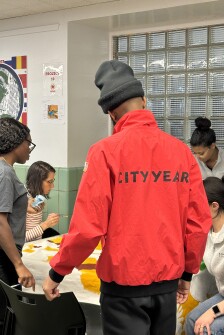
While in college, she found City Year, a national nonprofit that places AmeriCorps members ages 18 to 25 in historically underserved schools. Working in a New York City middle school, Warner found herself enjoying her work: She liked listening to students and helping them find solutions to their problems. It drove her to pursue a career in social work.
Warner and her City Year peers lead one-on-one and small-group tutoring in English/language arts and math. They call home if students don’t show up, and talk with parents about the barriers that might keep students from showing up consistently. They run clubs during lunch, and after-school programs that provide homework help and enrichment activities.
They’ve built trust with the students, who feel comfortable telling them about things they might not tell a teacher. And their work supports the teachers, who are stretched thin.
But then came the funding cuts.
Where it used to be an 11- or 12-hour day for Warner, who arrived before the students in the morning and stayed with them after classes had ended, City Year truncated program schedules to keep them running in some capacity. City Year coordinated with principals to identify the highest priorities—like after-school programming.
Warner continues her work, but no longer as a corps member—she and others are stripped of the benefits that came with participating in such a program, like loan forbearance while serving, child care benefits for those with children, and a financial award at the end of their service they can put toward loans, college, graduate school, or career training.
But Warner has been most worried about the students she serves.
“That means we lose time with our students, which really sucks, and students have realized that. We’re not there for morning support. We’re not there to greet them in the morning. We come in at 9 o’clock; to them it’s, ‘You’ve missed half the day. What happened? Where were you?’” Warner said. “I know a lot of our students feel slighted by that.”
For City Year New York, there’s a lot of uncertainty, said Annie Kessler, the organization’s executive director and once an AmeriCorps member herself.
“It’s definitely a difficult moment,” Kessler said. “There are so many reasons why the work is so important and why it is so much more than just a nice volunteer opportunity.”

At Jumpstart for Young Children, a national early education organization, AmeriCorps funding was reaching the youngest learners, helping students arrive in kindergarten better prepared. AmeriCorps funded literacy tutoring as part of early childhood programming in more than 15 states and the District of Columbia, said Crystal Rountree, the chief executive officer.
As Rountree watched federal funding sources grow more unstable, she began seeking alternative funding. Grants were ultimately terminated in three of the states where Jumpstart operates, forcing the closure of university-based program sites, she said.
“It’s deeply disappointing, and our volunteers had really worked to build trust in relationships with those little children who were expecting them to show up the next day,” Rountree said, “and so not being able to finish the school year, or say goodbye, is really hard for the preschool students and for the volunteers as well.”
As organizations scramble to find different funding sources to replace federal funding, the competition is only going to grow more intense, said Carol Lewis, the president of Communities In Schools of Georgia.
She’s had funders ask her to prioritize programming, because they can’t cover everything.
“I don’t see us being able to replace it 100%,” she said.


