Federal

Treasury Dept. Takes Over Student Loans as Ed. Dept. Hands Off More Programs

By The Associated Press — March 19, 2026 3 min read
The Treasury Department building is seen, on March 13, 2025, in Washington.
  • Save to favorites
  • Print

The U.S. Department of Education is handing off a portion of its student loan portfolio to the Treasury Department, a first step toward shedding management of all student loans as Trump administration officials dismantle the federal education agency.

Under an agreement announced Thursday, the Treasury Department will take over management of student loans whose borrowers are in default, meaning they are months behind on payments. Those loans add up to about $180 billion, or 11% of the government’s $1.7 trillion student loan portfolio.

The Treasury Department will take over debt collection on defaulted loans in the first of three phases that eventually aim to give the agency full responsibility for student loans, according to the agreement. A second phase with no timeframe says Treasury will “assume operational responsibility” over non-defaulted loans, “to the extent practicable.”

See Also

The United States Capitol building as a bookcase filled with red, white, and blue policy books in a Washington DC landscape.
Luca D'Urbino for Education Week

Borrowers do not need to do anything as the change goes through, the administration says. They will continue to work with the same loan servicer and repay their loans the same way.

The 17-page agreement outlines a stunning realignment of the nation’s federal student loan programs, which have been overseen by the Education Department since it was created more than 40 years ago.

In justifying the change, Trump officials said the Education Department is “ill-equipped” to handle such a big loan portfolio. They blamed the Biden administration for focusing on efforts to cancel student loans rather then help borrowers get back on track with payments. Officials cited recent data showing that fewer than half of all borrowers are currently making payments on their loans, with almost a quarter in default.

The move is part of President Donald Trump’s campaign to shutter the Education Department, an agency he says was overrun by liberal thinking. Only Congress has authority to close the department, but Trump officials are picking it apart through a series of inter-government agreements that relocate the department’s operations to other federal offices.

See Also

Illustration of office chairs moving into different spaces.
Laura Baker/Education Week + Getty

The future of the government’s enormous student loan portfolio has been one of the biggest unanswered questions. At her Senate confirmation hearing, Education Secretary Linda McMahon called Treasury a “natural” place for student loans. Trump later said they would be overseen by the Small Business Administration.

Conservatives have tried in the past to move federal student loans. During Trump’s first term, his education chief talked about setting up a semi-private bank to manage student debt. The conservative Heritage Foundation promoted something similar in its Project 2025 plan, calling for a new “government corporation with professional governance and management.”

The Treasury Department often has been discussed as an option, yet student loans are seen as a particularly complex form of debt and some question whether the agency has the right technical expertise. In a 2015 pilot, Treasury tried to collect payments from a sample of thousands of borrowers in default. Its success rate was lower than that of the private collection agencies contracted by the Education Department.

Federal student loan borrowers are typically considered in default if they haven’t made a payment in more than 270 days. About 9.2 million Americans are in default on student loans, according to Education Department data released this month. Going into default can bring a heavy hit to credit scores, and the government can withhold pay and Social Security benefits.

The latest deal from the administration indicates a willingness to open up the hood of student loan operations at a perilous moment. About 12 million Americans are behind on federal student loan payments in some way, and the industry is bracing for a potentially historic surge in loan defaults as pandemic-era protections come to an end.

Earlier this year, Trump officials postponed their plans to restart involuntary collections on defaulted loans, which could have meant withheld earnings for millions of Americans. It’s seen as a politically volatile issue during a tough midterm year where affordability is already on voters’ minds.
Copyright 2026 The Associated Press. All rights reserved. This material may not be published, broadcast, rewritten, or redistributed without permission.

Events

This content is provided by our sponsor. It is not written by and does not necessarily reflect the views of Education Week's editorial staff.
Sponsor
Artificial Intelligence Webinar
Managing AI in Schools: Practical Strategies for Districts
How should districts govern AI in schools? Learn practical strategies for policies, safety, transparency, and responsible adoption.
Content provided by Lightspeed Systems
This content is provided by our sponsor. It is not written by and does not necessarily reflect the views of Education Week's editorial staff.
Sponsor
Reading & Literacy Webinar
Two Jobs, One Classroom: Strengthening Decoding While Teaching Grade-Level Text
Discover practical, research-informed practices that drive real reading growth without sacrificing grade-level learning.
Content provided by EPS Learning
Jobs Virtual Career Fair for Teachers and K-12 Staff
Find teaching jobs and K-12 education jubs at the EdWeek Top School Jobs virtual career fair.

EdWeek Top School Jobs

Teacher Jobs
Search over ten thousand teaching jobs nationwide — elementary, middle, high school and more.
View Jobs
Principal Jobs
Find hundreds of jobs for principals, assistant principals, and other school leadership roles.
View Jobs
Administrator Jobs
Over a thousand district-level jobs: superintendents, directors, more.
View Jobs
Support Staff Jobs
Search thousands of jobs, from paraprofessionals to counselors and more.
View Jobs

Read Next

Federal Ed. Dept. Wants to Revamp Assistance Program It Calls 'Duplicative,' 'Confusing'
The department's Comprehensive Centers have already been through a year of shakeups.
3 min read
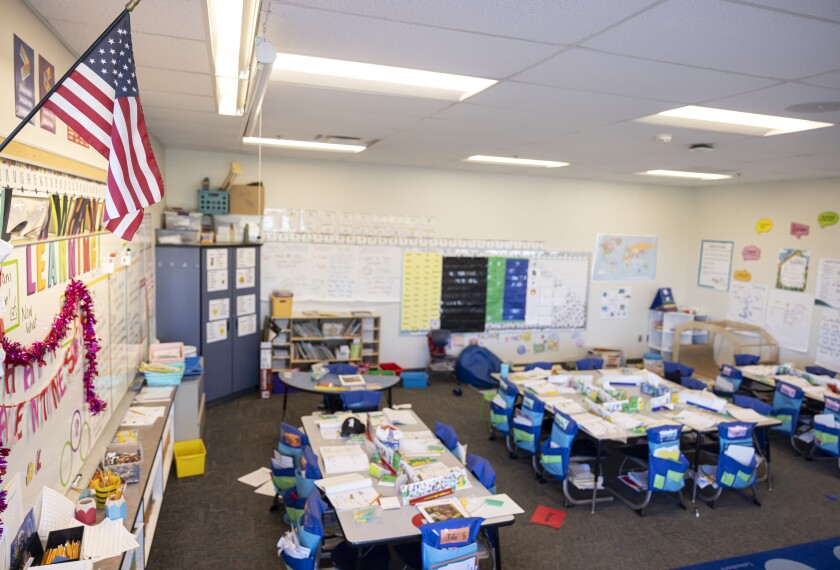
A first grade classroom at a school in Colorado Springs, on Feb. 12, 2026.
A 1st grade classroom at a school in Colorado Springs, Colo., on Feb. 12, 2026. The U.S. Department of Education released a proposal to rework a decades-old program charged with helping states and school districts problem-solve and deploy new initiatives, calling the current structure “duplicative” and “confusing.”
Kevin Mohatt for Education Week
Federal Will the Ed. Dept. Act on Recommendations to Overhaul Its Research Arm?
An adviser's report called for more coherence and sped-up research awards at the Institute of Education Sciences.
6 min read
The U.S. Department of Education building is pictured on Oct. 24, 2025, in Washington, D.C.
The U.S. Department of Education building in Washington is pictured on Oct. 24, 2025. A new report from a department adviser calls for major overhauls to the agency's research arm to facilitate timely research and easier-to-use guides for educators and state leaders.
Maansi Srivastava for Education Week
Federal Trump Talks Up AI in State of the Union, But Not Much Else About Education
The president didn't mention two of his cornerstone education policies from the past year.
4 min read
President Donald Trump enters to deliver the State of the Union address to a joint session of Congress in the House chamber at the U.S. Capitol in Washington, Tuesday, Feb. 24, 2026.
President Donald Trump enters to deliver the State of the Union address to a joint session of Congress in the House chamber at the U.S. Capitol in Washington, Tuesday, Feb. 24, 2026. The president devoted little time in the speech to discussing his education policies.
Kenny Holston/The New York Times via AP, Pool
Federal Education Department Will Send More of Its Programs to Other Agencies
Education grants for school safety, community schools, and family engagement will shift to Health and Human Services.
4 min read
Various school representatives and parent liaisons attend a family and community engagement think tank discussion at Lowery Conference Center on March 13, 2024 in Denver. One of the goals of the meeting was to discuss how schools can better integrate new students and families into the district. Denver Public Schools has six community hubs across the district that have serviced 3,000 new students since October 2023. Each community hub has different resources for families and students catering to what the community needs.
A program that helps state education departments and schools improve family engagement policies is among those the Trump administration will transfer from the U.S. Department of Education to the U.S. Department of Health and Human Services. In this photo, school representatives and parent liaisons attend a family and community engagement discussion on March 13, 2024, in Denver to discuss how schools can better integrate new students and families into the district.
Rebecca Slezak For Education Week

