Law & Courts

Supreme Court Sides With Student in Sex-Bias Case

By Mark Walsh — January 21, 2009 3 min read
  • Save to favorites
  • Print

The U.S. Supreme Court ruled unanimously today that Title IX does not bar victims of sex discrimination in schools from pursuing claims under an older federal civil rights law.

The decision is a victory for the parents of a Massachusetts student who claimed that school officials failed to adequately respond to sexual harassment of their daughter—then in kindergarten—by a 3rd-grade boy on her bus.

The parents may now pursue a claim under the federal statute known as Section 1983, a Reconstruction-era law that allows plaintiffs to sue any individual who violates their civil rights under color of law. In some cases, the statute may offer wider protections than Title IX of the Education Amendments of 1972, which bars sex discrimination in federally funded education programs.

“We conclude that Title IX was not meant to be an exclusive mechanism for addressing gender discrimination in schools, or as a substitute for Section 1983 suits as a means of enforcing constitutional rights,” Justice Samuel A. Alito Jr. wrote for the court today in Fitzgerald v. Barnstable School Committee (Case No. 07-1125).

The case arose from claims that the kindergarten girl was subjected to sexual harassment by a 3rd-grade boy while riding the bus to school in the 2000-01 academic year. Each time the girl wore a dress to school, the boy allegedly forced her to lift her skirt, pull down her pants, and spread her legs, according to court papers.

The 4,460-student Barnstable, Mass., district and local police investigated the parents’ complaints, but the police found there was insufficient evidence to proceed with any criminal charges against the 3rd grader, court papers say.

The school district offered to place the girl on another bus—a proposal that dissatisfied her parents, because they felt it was a form of punishing the victim. They requested that the alleged harasser be removed from their daughter’s bus or that an adult monitor ride the bus.

The school district said that because it had trouble substantiating the kindergartner’s allegations, offering to place her on another bus was a reasonable response to the alleged peer harassment.

Difference in Coverage

The parents sued the district under both Title IX and Section 1983. Both a federal district court and the U.S. Court of Appeals for the 1st Circuit, in Boston, ruled that the family could not prevail under Title IX because the school district did not act with “deliberate indifference” to the complaints, which is the standard under the Supreme Court’s decisions on district liability for sexual harassment of students. The lower courts went on to rule that the Section 1983 claim, which alleged that the girl’s 14th Amendment equal-protection rights were violated, was foreclosed by Title IX.

The federal appeals courts were divided on the question of whether Title IX was the only statute under which sex-discrimination claims in education could be pursued, and the Supreme Court accepted the case the resolve the conflict.

In his opinion for the Supreme Court, Justice Alito rejected the conclusion of the appeals court that Congress meant to bar Section 1983 claims for sex discrimination in schools when it passed Title IX.

The School Law Blog

A comparison of the two statutes shows that in some circumstances they cover different potential legal targets or offer different remedies, he said. Title IX is aimed at educational institutions that receive federal funds, but it has been interpreted as not authorizing lawsuits against teachers, school officials, or other individuals, Justice Alito said. Section 1983, meanwhile, may be used to sue individuals, as long as they are acting with government authority, the justice noted.

Furthermore, Justice Alito said, Title IX exempts from its coverage certain institutions, such as military-service schools and traditionally single-sex public colleges, that may be subject to suits under Section 1983.

Justice Alito said that even though the parents in the case were not able to show that school officials were deliberately indifferent to their complaints under Title IX, they should be allowed the opportunity in federal district court to pursue their claims that school officials discriminated in their investigation of student misbehavior and in the treatment of student complaints.

Events

This content is provided by our sponsor. It is not written by and does not necessarily reflect the views of Education Week's editorial staff.
Sponsor
College & Workforce Readiness Webinar
Smarter Tools, Stronger Outcomes: Empowering CTE Educators With Future-Ready Solutions
Open doors to meaningful, hands-on careers with research-backed insights, ideas, and examples of successful CTE programs.
Content provided by Pearson
This content is provided by our sponsor. It is not written by and does not necessarily reflect the views of Education Week's editorial staff.
Sponsor
Reading & Literacy Webinar
Improve Reading Comprehension: Three Tools for Working Memory Challenges
Discover three working memory workarounds to help your students improve reading comprehension and empower them on their reading journey.
Content provided by Solution Tree
Recruitment & Retention Webinar EdRecruiter 2026 Survey Results: How School Districts are Finding and Keeping Talent
Discover the latest K-12 hiring trends from EdWeek’s nationwide survey of job seekers and district HR professionals.

EdWeek Top School Jobs

Teacher Jobs
Search over ten thousand teaching jobs nationwide — elementary, middle, high school and more.
View Jobs
Principal Jobs
Find hundreds of jobs for principals, assistant principals, and other school leadership roles.
View Jobs
Administrator Jobs
Over a thousand district-level jobs: superintendents, directors, more.
View Jobs
Support Staff Jobs
Search thousands of jobs, from paraprofessionals to counselors and more.
View Jobs

Read Next

Law & Courts Appeals Court Halts Ruling Letting Teachers Disclose Students' Gender Identity
A federal appeals court has temporarily paused enforcement of the ruling but has not yet decided whether to grant a longer-term stay.
Kristen Taketa, The San Diego Union-Tribune
3 min read
Students carrying pride and transgender flags leave Great Oak High School in Temecula, Calif., on Sept. 22, 2023, after walking out of the school in protest of the Temecula school district policy requiring parents to be notified if their child identifies as transgender.
Anjali Sharif-Paul/The Orange County Register via AP
Law & Courts Schools Can’t Bar Teachers From Telling Parents If Kids Are Transgender, Judge Rules
The injunction bans any public school employee from misleading parents about their child’s gender presentation at school.
Kristen Taketa, The San Diego Union-Tribune
5 min read
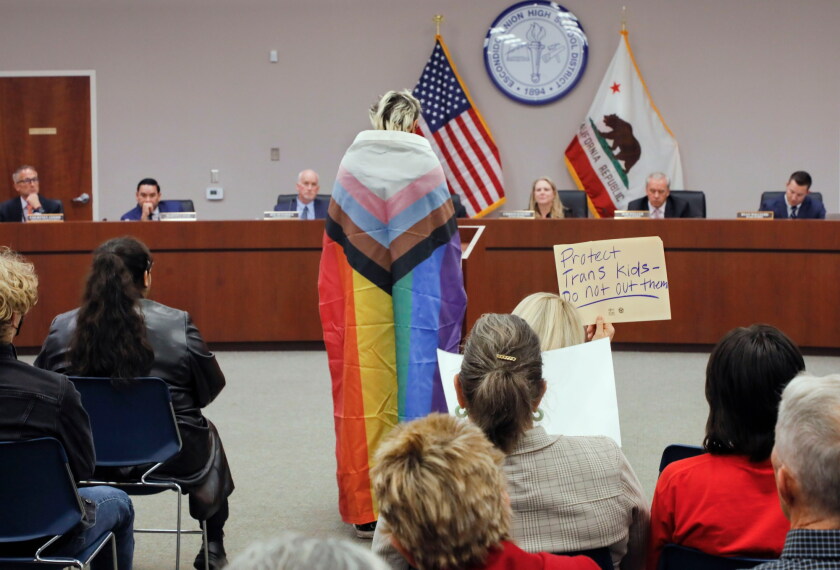
Teacher’s aide Amelia Mester, wrapped in a Pride flag, urges Escondido Union High School District not to have employees notify parents if they believe a student may be transgender in November 2025. A policy on the issue in the city’s elementary school district is the subject of a federal class-action lawsuit in which a judge just sided against the district.
Teacher’s aide Amelia Mester, wrapped in a Pride flag, urges Escondido Union High School District not to have employees notify parents if they believe a student may be transgender. A policy on the issue in the city’s elementary school district is the subject of a federal class-action lawsuit in which a judge just ruled against the district.
Charlie Neuman for The San Diego Union-Tribune/TNS
Law & Courts Federal Appeals Court Upholds 8th Grader's Expulsion Over Gun Comments in Class
Shortly after a nearby mass school shooting, a student allegedly discussed bringing a gun to school.
3 min read
Photo of stone columns.
E+
Law & Courts Trump's Education Policies Spurred 72 Lawsuits in 2025. How Many Is He Winning?
The legal challenges show which policies have had a big impact and how 2026 could go.
5 min read
President Donald Trump holds up an executive order after signing it at an indoor Presidential Inauguration parade event in Washington, Jan. 20, 2025.
President Donald Trump holds up an executive order after signing it at an indoor presidential inauguration parade event in Washington on Jan. 20, 2025. Trump's executive actions prompted legal challenges virtually from the moment he took office, and education-related policies were not immune.
Matt Rourke/AP
