Law & Courts

Senate Confirms Kagan as U.S. Supreme Court Justice

By The Associated Press — August 05, 2010 3 min read
  • Save to favorites
  • Print

The U.S. Senate on Thursday confirmed Elena Kagan as the 112th justice and fourth woman to serve on the Supreme Court.

The vote was 63-37 for President Barack Obama’s nominee to succeed retired Justice John Paul Stevens. Five Republicans joined all but one Democrat and the Senate’s two independents to support Kagan. In a rarely practiced ritual reserved for the most historic votes, senators sat at their desks and stood to cast their votes with “ayes” and “nays.”

Kagan has extensive experience in education policy, both as dean of Harvard Law School and through work on numerous K-12 issues as a domestic policy aide to President Bill Clinton. Those issues surfaced during her confirmation hearings, as senators asked about memos she had written on education-related documents during her time in the Clinton White House and while she was a law clerk for Supreme Court Justice Thurgood Marshall in the late 1980s. (“Kagan Vows to Shun ‘Political Hat’ on High Court,” July 13, 2010.)

The Kagan papers released by the Clinton Presidential Library in Little Rock, Ark., revealed little about her own views on such issues as education funding, testing, social promotion, and school violence. What was clear from the hundreds of pages of documents, however, was that the White House domestic-policy office, where Kagan worked from 1997 to 1999, was deeply involved in education issues, often coordinating with the U.S. Department of Education. Clinton aides viewed education initiatives—whether ambitious, such as an effort to reauthorize the Elementary and Secondary Education Act, or modest, such as a proposal to promote school uniforms—as something that connected with voters and helped cement the president’s legacy. (“Papers Show Kagan in Loop on Clinton K-12 Policy,” School Law Blog, June 6, 2010.)

During the confirmation hearings, Sen. Jeff Sessions, R-Ala., also challenged Kagan about her handling of military recruiters while she was dean of Harvard Law School, asking whether she was hostile to recruiters in applying Harvard’s non-discrimination policy.

“I respect, indeed, I revere the military,” Kagan told him. “My father was veteran. ... I always tried to make sure I conveyed my honor to the military. In the short period the recruiters had that access through the veterans organization, recruiting actually went up. But I also felt the need to protect the students meant to be protected by [Harvard’s non-discrimination policy], the gay and lesbian students who might want to join the military.” (“Kagan, Sessions Spar on Harvard Recruiting Issue,” School Law Blog, June 29, 2010.)

Kagan isn’t expected to alter the ideological balance of the court, where Stevens was considered a leader of the liberals. But the two parties clashed over her nomination. Republicans argued that Kagan was a political liberal who would be unable to be impartial. Democrats defended her as a highly qualified legal scholar.

She is the first Supreme Court nominee in nearly 40 years with no experience as a judge, and her swearing-in will mark the first time in history that three women will serve on the nine-member court together.

Her lack of judicial experience was the stated reason for one fence-sitting Republican, Sen. Scott Brown of Massachusetts, to announce his opposition to her confirmation Thursday, just hours before the vote. Though calling her “brilliant,” Brown — who had been seen as a potential GOP supporter — said she was missing the necessary background to serve as a justice.

“The best umpires, to use the popular analogy, must not only call balls and strikes, but also have spent enough time on the playing field to know the strike zone,” Brown said.

Related Tags:

Events

This content is provided by our sponsor. It is not written by and does not necessarily reflect the views of Education Week's editorial staff.
Sponsor
Artificial Intelligence Webinar
Managing AI in Schools: Practical Strategies for Districts
How should districts govern AI in schools? Learn practical strategies for policies, safety, transparency, and responsible adoption.
Content provided by Lightspeed Systems
This content is provided by our sponsor. It is not written by and does not necessarily reflect the views of Education Week's editorial staff.
Sponsor
Student Absenteeism Webinar
Removing Transportation and Attendance Barriers for Homeless Youth
Join us to see how districts around the country are supporting vulnerable students, including those covered under the McKinney–Vento Act.
Content provided by HopSkipDrive
This content is provided by our sponsor. It is not written by and does not necessarily reflect the views of Education Week's editorial staff.
Sponsor
Reading & Literacy Webinar
Two Jobs, One Classroom: Strengthening Decoding While Teaching Grade-Level Text
Discover practical, research-informed practices that drive real reading growth without sacrificing grade-level learning.
Content provided by EPS Learning

EdWeek Top School Jobs

Teacher Jobs
Search over ten thousand teaching jobs nationwide — elementary, middle, high school and more.
View Jobs
Principal Jobs
Find hundreds of jobs for principals, assistant principals, and other school leadership roles.
View Jobs
Administrator Jobs
Over a thousand district-level jobs: superintendents, directors, more.
View Jobs
Support Staff Jobs
Search thousands of jobs, from paraprofessionals to counselors and more.
View Jobs

Read Next

Law & Courts Supreme Court’s Gender Identity Ruling Leaves Schools Seeking Clarity
Advocates say they would welcome more from the Supreme Court on gender-notification policies.
7 min read
The Supreme Court is photographed, Friday, Feb. 27, 2026, in Washington.
The Supreme Court is photographed, Friday, Feb. 27, 2026, in Washington. The high court recently ruled that California policies that sometimes limit or discourage schools from disclosing information to parents about children’s gender transitions and expressions at school likely violate parents’ constitutional rights
Rahmat Gul/AP
Law & Courts Supreme Court Backs Parents in School Gender Disclosure Fight
The Supreme Court restored an injunction blocking California policies on student gender transitions
8 min read
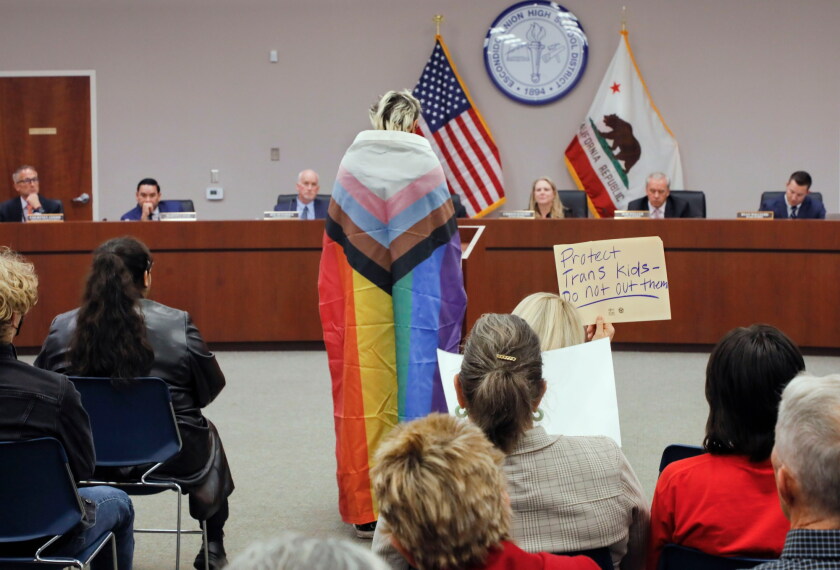
Teacher’s aide Amelia Mester, wrapped in a Pride flag, urges Escondido Union High School District not to have employees notify parents if they believe a student may be transgender in November 2025. A policy on the issue in the city’s elementary school district is the subject of a federal class-action lawsuit in which a judge just sided against the district.
Teacher’s aide Amelia Mester, wrapped in a Pride flag, urges Escondido Union High School District not to have employees notify parents if they believe a student may be transgender at a meeting in November 2025. Two parents and two teachers from the district sued in 2023, challenging California state guidance concerning student gender transitions and parental notification. The U.S. Supreme Court has now reinstated a lower-court decision overturning those state policies.
Charlie Neuman for The San Diego Union-Tribune/TNS
Law & Courts Appeals Court Allows Louisiana Ten Commandments Displays to Proceed
The court said it was premature to rule on the constitutionality of La. Ten Commandments displays.
3 min read
Students work under Ten Commandments and Bill of Rights posters on display in a classroom at Lehman High School in Kyle, Texas, Thursday, Oct. 16, 2025.
Students work under Ten Commandments and Bill of Rights posters on display in a classroom at Lehman High School in Kyle, Texas, Oct. 16, 2025. A federal appeals court has lifted a lower-court injunction blocking a Louisiana law that requires Ten Commandments displays, clearing the way for the law to take effect.
Eric Gay/AP
Law & Courts Social Media Companies Face Legal Reckoning Over Mental Health Harms to Children
Some of the biggest players from Meta to TikTok are getting a chance to make their case in courtrooms around the country.
6 min read
Social Media Kids Trial 26050035983057
Meta CEO Mark Zuckerberg leaves court after testifying in a landmark trial over whether social media platforms deliberately addict and harm children, on Feb. 18, 2026, in Los Angeles.
AP Photo/Damian Dovarganes
