Law & Courts

Ruling Could Put Brakes On School Drug Testing, Some Law Experts Say

By Mark Walsh — April 23, 1997 2 min read
  • Save to favorites
  • Print

Washington

The U.S. Supreme Court struck down a drug-testing program for the first time last week, ruling that a Georgia law requiring such tests of candidates for high state office runs afoul of the Fourth Amendment’s prohibition against unreasonable searches.

The 8-1 ruling could dampen the enthusiasm with which some school districts have proposed the expansion of drug testing, legal experts said.

“This says that government agencies, including school boards, do not have carte blanche to engage in any drug-testing programs that they can devise,” said Steven R. Shapiro, a lawyer with the national office of the American Civil Liberties Union, which opposed the Georgia law.

The April 15 ruling in Chandler v. Miller (Case No. 96-126) came less than two years after the high court upheld an Oregon district’s policy of random drug testing of student athletes. (“Court Upholds Drug Tests for Student Athletes,” July 12, 1995.)

But that 6-3 ruling, in Vernonia School District v. Acton, was based in large measure on evidence that drug use had been a problem among the athletes at Vernonia (Ore.) High School.

In the Georgia case, Justice Ruth Bader Ginsburg wrote for the majority that the law was not designed to address any evidence of actual drug use by candidates for state office.

“However well-meant, the candidate drug test Georgia has devised diminishes personal privacy for a symbol’s sake,” Justice Ginsburg wrote.

The 1990 law covered such offices as governor, lieutenant governor, attorney general, and state schools superintendent. It was challenged in 1994 by three Libertarian Party candidates for state office.

Chief Justice William H. Rehnquist was the lone dissenter, stating that the law was a reasonable response to the major problem of illegal drugs.

“Surely the state need not wait for a drug addict, or one inclined to use drugs illegally, to run for or actually become governor before” adopting a preventive drug-testing program, he said.

Drawing a Line

If the Supreme Court had upheld the Georgia law, some civil liberties advocates had feared that government agencies would seek a major expansion of drug testing of employees and perhaps students.

Georgia passed a separate measure in 1990 requiring drug testing of all applicants for state employment, including school teachers. That law was struck down by a federal district court that year but was not at issue before the Supreme Court.

Justice Ginsburg had joined the majority that upheld drug testing of student-athletes in the Vernonia case. But in the Georgia case, she emphasized that to pass constitutional muster, drug-testing programs must address a genuine problem with drugs among the targeted group.

In the wake of the Vernonia ruling, a growing number of districts have adopted drug-testing programs for athletes, and some have subjected students involved in all extracurricular activities to random testing. At least one such policy, in Tulia, Texas, has been challenged in court. (“Drug-Test Policy Spurs Student To Sue Board,” Feb. 19, 1997.)

Mr. Shapiro said the Chandler ruling sends the message that the Supreme Court “will not sustain a drug-testing program in the absence of a documented and severe problem.”

Related Tags:

Events

This content is provided by our sponsor. It is not written by and does not necessarily reflect the views of Education Week's editorial staff.
Sponsor
Artificial Intelligence Webinar
Managing AI in Schools: Practical Strategies for Districts
How should districts govern AI in schools? Learn practical strategies for policies, safety, transparency, and responsible adoption.
Content provided by Lightspeed Systems
This content is provided by our sponsor. It is not written by and does not necessarily reflect the views of Education Week's editorial staff.
Sponsor
Student Absenteeism Webinar
Removing Transportation and Attendance Barriers for Homeless Youth
Join us to see how districts around the country are supporting vulnerable students, including those covered under the McKinney–Vento Act.
Content provided by HopSkipDrive
This content is provided by our sponsor. It is not written by and does not necessarily reflect the views of Education Week's editorial staff.
Sponsor
Reading & Literacy Webinar
Two Jobs, One Classroom: Strengthening Decoding While Teaching Grade-Level Text
Discover practical, research-informed practices that drive real reading growth without sacrificing grade-level learning.
Content provided by EPS Learning

EdWeek Top School Jobs

Teacher Jobs
Search over ten thousand teaching jobs nationwide — elementary, middle, high school and more.
View Jobs
Principal Jobs
Find hundreds of jobs for principals, assistant principals, and other school leadership roles.
View Jobs
Administrator Jobs
Over a thousand district-level jobs: superintendents, directors, more.
View Jobs
Support Staff Jobs
Search thousands of jobs, from paraprofessionals to counselors and more.
View Jobs

Read Next

Law & Courts Supreme Court’s Gender Identity Ruling Leaves Schools Seeking Clarity
Advocates say they would welcome more from the Supreme Court on gender-notification policies.
7 min read
The Supreme Court is photographed, Friday, Feb. 27, 2026, in Washington.
The Supreme Court is photographed, Friday, Feb. 27, 2026, in Washington. The high court recently ruled that California policies that sometimes limit or discourage schools from disclosing information to parents about children’s gender transitions and expressions at school likely violate parents’ constitutional rights
Rahmat Gul/AP
Law & Courts Supreme Court Backs Parents in School Gender Disclosure Fight
The Supreme Court restored an injunction blocking California policies on student gender transitions
8 min read
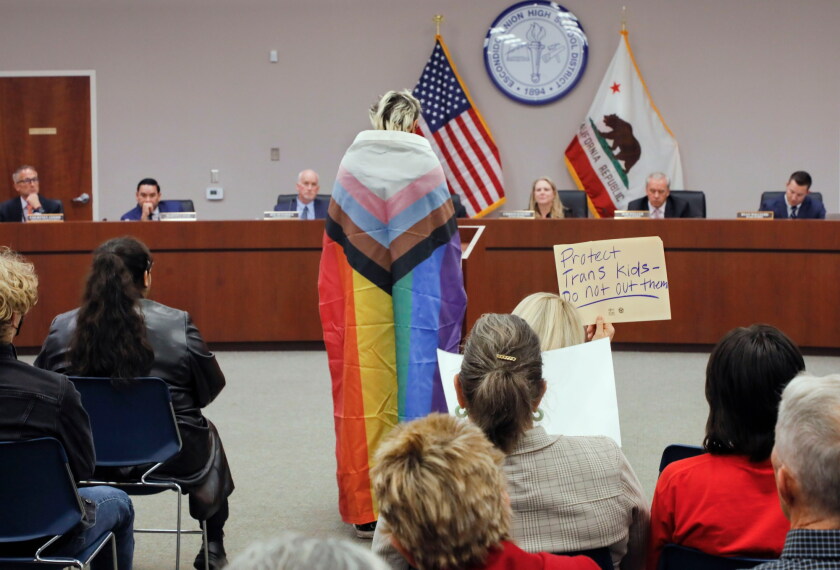
Teacher’s aide Amelia Mester, wrapped in a Pride flag, urges Escondido Union High School District not to have employees notify parents if they believe a student may be transgender in November 2025. A policy on the issue in the city’s elementary school district is the subject of a federal class-action lawsuit in which a judge just sided against the district.
Teacher’s aide Amelia Mester, wrapped in a Pride flag, urges Escondido Union High School District not to have employees notify parents if they believe a student may be transgender at a meeting in November 2025. Two parents and two teachers from the district sued in 2023, challenging California state guidance concerning student gender transitions and parental notification. The U.S. Supreme Court has now reinstated a lower-court decision overturning those state policies.
Charlie Neuman for The San Diego Union-Tribune/TNS
Law & Courts Appeals Court Allows Louisiana Ten Commandments Displays to Proceed
The court said it was premature to rule on the constitutionality of La. Ten Commandments displays.
3 min read
Students work under Ten Commandments and Bill of Rights posters on display in a classroom at Lehman High School in Kyle, Texas, Thursday, Oct. 16, 2025.
Students work under Ten Commandments and Bill of Rights posters on display in a classroom at Lehman High School in Kyle, Texas, Oct. 16, 2025. A federal appeals court has lifted a lower-court injunction blocking a Louisiana law that requires Ten Commandments displays, clearing the way for the law to take effect.
Eric Gay/AP
Law & Courts Social Media Companies Face Legal Reckoning Over Mental Health Harms to Children
Some of the biggest players from Meta to TikTok are getting a chance to make their case in courtrooms around the country.
6 min read
Social Media Kids Trial 26050035983057
Meta CEO Mark Zuckerberg leaves court after testifying in a landmark trial over whether social media platforms deliberately addict and harm children, on Feb. 18, 2026, in Los Angeles.
AP Photo/Damian Dovarganes
