Opinion
School Choice & Charters Letter to the Editor

Center for Education Reform ‘Skeptical’ of Charter Study

August 05, 2013 1 min read
  • Save to favorites
  • Print

To the Editor:

While it’s gratifying to read the headline “Charters Show ‘Slow and Steady Progress,’ Multistate Study Finds” (Charters & Choice blog, edweek.org, June 25, 2013), it’s also a bit disconcerting since the study—from Stanford University’s Center for Research on Education Outcomes, or CREDO—is anything but charter-school-performance gospel.

We at the Center for Education Reform have been advocating for nearly two decades on behalf of substantive, structural change in K-12 education. We know that, like education itself, research can be complicated. Although the article cites “slow and steady progress,” we’re also skeptical about another flawed report that makes spurious comparisons of student achievement in charter schools across state lines.

We believe all schools, including charter schools, must be held accountable. The path to accountability must start with strong charter school laws and must be laid with gold-standard research. Such research uses randomized control trials to measure progress. Students deserve nothing less, in classrooms and in research.

The CREDO report, upon which the article is based, fails to use such methods. Rather it employs statistical gymnastics to compare student achievement in charter schools across state lines while adjusting data to ensure that all students “start” at the same level.

Highly criticized by leading researchers and economists for failing the test of good research, the CREDO results do not accurately convey the results of charters or other public schools. State-by-state and community-by-community analyses are the only true measures that offer validity for parents and policymakers.

Jeanne Allen

President

The Center for Education Reform

Washington, D.C.

Related Tags:

A version of this article appeared in the August 07, 2013 edition of Education Week as Center for Education Reform ‘Skeptical’ of Charter Study

Events

This content is provided by our sponsor. It is not written by and does not necessarily reflect the views of Education Week's editorial staff.
Sponsor
School Climate & Safety Webinar
There But Not Present: Rethinking Student Engagement
Learn how to recognize the early signs of disengagement and what the behavioral science reveals about which interventions actually work.
Content provided by Frontline Education
Teacher Preparation Webinar What Teacher Education Should Look Like in the Age of AI
Explore the current trends around the use of AI in teacher preparation and continuing education with data from the EdWeek Research Center.
English Learners Webinar How Can School Districts Better Support English Learners With Disabilities?
Join this webinar to hear recent findings from the EdWeek Research Center and discover practical strategies for improvement.

EdWeek Top School Jobs

Teacher Jobs
Search over ten thousand teaching jobs nationwide — elementary, middle, high school and more.
View Jobs
Principal Jobs
Find hundreds of jobs for principals, assistant principals, and other school leadership roles.
View Jobs
Administrator Jobs
Over a thousand district-level jobs: superintendents, directors, more.
View Jobs
Support Staff Jobs
Search thousands of jobs, from paraprofessionals to counselors and more.
View Jobs

Read Next

School Choice & Charters Explainer New Rules for Federal School Choice: What You Need to Know
Proposed rules from the IRS offer some details on how the first nationwide school choice program will work.
MINNEAPOLIS, MN, January 22, 2026: Students move through the halls at Washburn High School in Minneapolis, MN.
The Trump administration has released proposed regulations outlining how the first nationwide school choice program will operate when it launches next year. The regulations leave some major questions unaddressed but clarify other aspects for the tax-credit scholarship program.
Caroline Yang for Education Week
School Choice & Charters Federal Education Tax Credit Rules Are Finally Here. What We Know So Far
The Treasury Department unveiled regulations governing a massive infusion of education funding nationwide.
5 min read
The tax credit program would allow individuals who donate up to $1,700 to a scholarship granting organization to receive a dollar-for-dollar federal income tax credit in exchange. Pictured are students at Northeast Elementary located at 1024 Fleming Ave. in Jackson on Aug. 20, 2025.
Students at Northeast Elementary School in Jackson, Mich., on Aug. 20, 2025. A tax-credit scholarship program launching in January will allow individuals who donate up to $1,700 to a scholarship granting organization to receive a dollar-for-dollar federal income tax credit. Those SGOs can give out awards to cover private school tuition as well as some expenses for public school students.
Abra Richardson/mlive.com via TNS
School Choice & Charters Opinion What Do Parents Look for in a School?
Test scores aren’t the whole story. The CEO of GreatSchools talks about what parents want.
•
5 min read
The United States Capitol building as a bookcase filled with red, white, and blue policy books in a Washington DC landscape.
Luca D'Urbino for Education Week
School Choice & Charters Microschools Are Spreading. Some School Districts Have Opened Their Own
Districts see the small learning communities as an alternative for families that may otherwise leave.
8 min read
MLP 5851 2
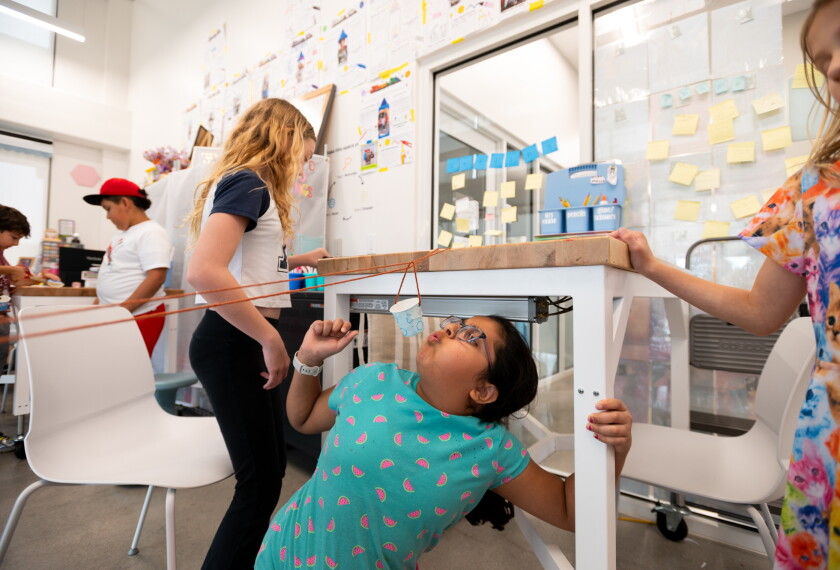
Daisy Wisbey, 11, and Eleanor Mukiri, 10, work on an engineering challenge at Creative Minds in Wichita, Kan., on Sept. 15, 2026. The Wichita public schools runs Creative Minds as a microschool, in which students from multiple grades learn together in a project-based learning format. Wichita is among a handful of public school districts that have begun their own microschools.
Melissa Lukenbaugh for Education Week