
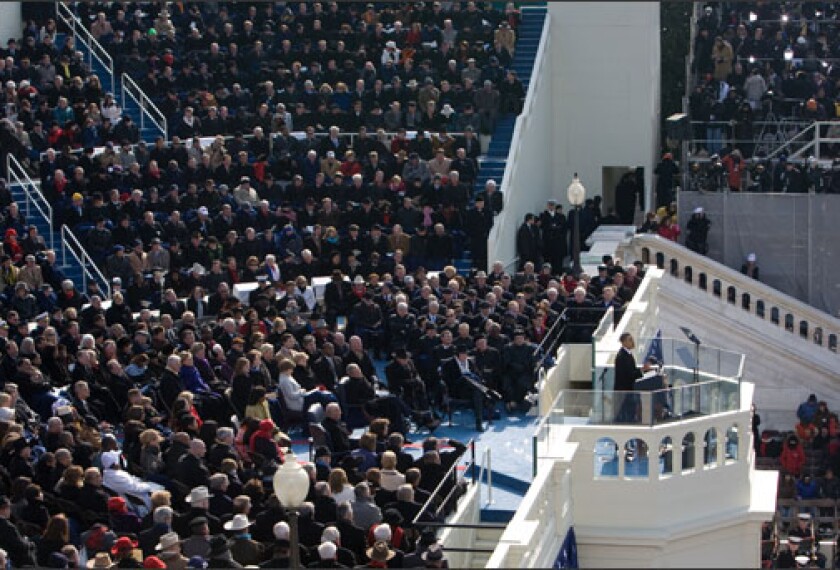
President Barack Obama today cited the shortcomings of the nation’s schools as one part of the broader economic crisis and called on Americans to come together to tackle the country’s challenges in a spirit of public service and personal accountability.
“Homes have been lost; jobs shed; businesses shuttered. Our health care is too costly; our schools fail too many,” Mr. Obama said in his inaugural address as the 44th president of the United States. “Everywhere we look, there is work to be done. ...We will transform our schools and colleges and universities to meet the demands of a new age.”
The president did not offer details, but the fact that schools made such an early appearance in the speech suggests that he sees education as a policy priority, said Paul Manna, a professor at the College of William and Mary who has studied the role of politics in education.
“It was headlined right at the beginning along with the economy and energy,” he said. Still, Mr. Manna acknowledged that the economy and health care, not the reauthorization of the No Child Left Behind Act, are pressing priorities for the new administration.
“What is required of us now,” President Obama told the nation, “is a new era of responsibility—a recognition, on the part of every American, that we have duties to ourselves, our nation, and the world, duties that we do not grudgingly accept but rather seize gladly, firm in the knowledge that there is nothing so satisfying to the spirit, so defining of our character, than giving our all to a difficult task.”
Lines like those showed that the new president is keenly aware of the significant effort and cooperation needed to steady the faltering economy and cope with other urgent problems, Mr. Manna said.
“He strikes me as someone who realizes there’s a lot of work to do,” Mr. Manna said, “and he’s very serious about getting together to do it.”
In the days leading up the inauguration, superintendents, academics, and others in the education policy world descended on Washington to celebrate the occasion. Many have emphasized the need for lawmakers and organizations along the policy spectrum to work collaboratively on the issues facing America’s schools, particularly the achievement gaps between poor and minority students and their more advantaged peers.
For instance, Joel I. Klein, the sometimes-pugnacious chancellor of the New York City public schools, struck a conciliatory note during a reception Sunday in honor of Linda Darling-Hammond, a Stanford University education professor who has headed President Obama’s transition team on education.

“They say there’s one camp here and another camp here,” Mr. Klein said, referring to a perceived split in the Democratic Party on education issues that is seen as pitting some civil rights groups and urban school reformers against teachers’ unions and advocates of stronger social supports for children. “Well let me tell you, in education sometimes people don’t even agree with what they [themselves] are saying,” he said.
Ms. Darling-Hammond, who has called for increased investment in teacher training and is viewed by some observers as closely aligned with the unions, said she agreed with Mr. Klein’s assessment.
“All of us talk to each other” after stories on such a split appear in the press, she said.
And bipartisan cooperation was a major theme of an event Monday hosted by the Education Equality Project, an organization that Mr. Klein founded with the Rev. Al Sharpton, the New York City-based civil rights activist, that advocates a “no excuses” approach to education redesign.
Mr. Klein and Mr. Sharpton, both Democrats, headlined the pre-inauguration event, but it featured appearances by such prominent Republican figures as Sen. John McCain of Arizona, President Obama’s opponent in the general election, and outgoing U.S. Secretary of Education Margaret Spellings.
“Friends, this issue must unite us,” Sen. McCain told the crowd gathered at Washington’s Cardozo High School, many of whom were wearing Obama buttons. “This issue is the uniting factor that should drive us in the twenty-first century and in the next four years. We must join together.”
Still, during the Education Equality Project event, many speakers, including Cory Booker, the Democratic mayor of Newark, N.J., referred to what they said was a need to stand up to special interests within the Democratic Party, an apparent reference to the unions.

The Obama Education Plan: An Education Week Guide
A compilation of Obama speeches and policy statements and stories from the Education Week archives on issues he highlighted on the campaign trail.
For now, many education groups and lobbyists are looking past those policy debates and focusing on the prospect of more than $120 billion in new money for education programs, as outlined in an economic-stimulus package released Jan. 15 by Democrats in the House of Representatives. The proposed legislation was crafted with significant input from the incoming administration.
“There’s a lot of enthusiasm, a lot of energy,” said James Kohlmoos, the president of the Knowledge Alliance, a Washington-based coalition of education research organizations. “It’s really amazing how much focus there was on education” in the stimulus plan. That optimism was shared by educators who heard President Obama’s Jan. 20 speech.
Resources for some school systems have been scarce, and “kids have gotten the message loud and clear that their education is not a priority,” said Sara Fox, who taught high school English in California and now works as the development and curriculum director for Sojourn to the Past, a nonprofit organization that promotes education about the civil rights movement. But she thinks Mr. Obama’s passion for education—and willingness to provide greatly increased funding—will “inspire a new generation” of students.


