States

Medicaid Threatens K-12 Share of State Budgets

October 19, 2004 3 min read
  • Save to favorites
  • Print

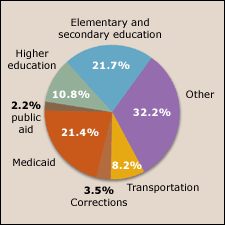
For the first time, state spending on Medicaid soon may grow larger than state spending on K-12 education, says a report released last week by the nation’s state budget officers.

Primary and secondary education accounted for the largest category of overall state spending in fiscal 2003, according to the annual expenditure report from the Washington-based National Association of State Budget Officers.

Medicaid spending totaled 21.4 percent of all state spending in fiscal 2003, including federal funds, compared with 21.7 percent for K-12 education. But Medicaid costs were expected to overtake K-12 education in fiscal 2004, according to the budget officers’ projections.

The growth in state spending for Medicaid shows the tremendous pressure on states in that area, and threatens their ability to spend money on other important areas such as education, several observers said last week.

Medicaid spending by states was up 8 percent nationally in fiscal 2003, compared with 6.4 percent in spending growth for K-12 education, and 3.2 percent for higher education.

The “2003 State Expenditure Report” is available online from the National Association of State Budget Officers. (Requires Adobe’s Acrobat Reader.)

“It’s the 800-pound gorilla of state budgets,” said Nick Samuels, a fiscal analyst for the state budget officers and the chief author of the group’s annual report. “That wedge of the pie that is Medicaid has just become larger faster than anything else.”

Increased costs for long-term care in nursing homes and other health-related facilities, higher costs for medicine, and a growing awareness of Medicaid eligibility among poor families are some of the reasons for the increase in Medicaid costs, experts said.

Medicaid costs have already hindered some states from approving new education programs and contributed to major overall budget cuts in recent years, observers added.

“While states have gone to great lengths to hold harmless K-12 education, the fact is that if K-12 is going to grow . . . other pieces of the pie” must shrink, Mr. Samuels said.

Raymond C. Scheppach, the executive director of the Washington-based National Governors Association, said many governors want Congress to help states pay for two of the most costly groups covered by Medicaid: the elderly and poor who qualify for both federal and state health reimbursements.

“It’s scary,” said Mr. Scheppach, who is an economist. “This is seen as an entitlement, and education is discretionary. And so going forward, you’re going to find Medicaid is going to trump education.”

Tough Choices

The state budget officers’ projections for fiscal 2004 spending show that 21 states likely will have spent a higher percentage of their overall budgets on Medicaid than on K-12 schools. The overall spending includes federal dollars, which usually pay slightly more than half of Medicaid expenses.

According to estimates for fiscal 2004, which ended June 30 for most states, Tennessee spent 33 percent of its overall budget on Medicaid—the highest percentage of any state. Maine, Missouri, and Pennsylvania are also among the states that spent higher-than-average percentages of state budgets on Medicaid in fiscal 2004, according to the report’s estimates.

Budget Trends

SOURCE: National Association of State Budget Offices
BRIC ARCHIVE

State Medicaid costs vary greatly depending on the size of the senior population, immigrant groups, and levels of poverty in rural and urban areas.

Some states are trying to curb the increasing Medicaid costs, said Arturo Perez, a fiscal analyst for the Denver-based National Conference of State Legislatures.

Colorado, for example, has cut legal immigrants from Medicaid rolls, Mr. Perez said. States are also retracting some extra benefits that were expanded for Medicaid recipients when the economy boom ed in the 1990s, he said.

Cutting back services, however, is rarely attractive to state lawmakers, he added.

Scott Pattison, the executive director of the state budget officers’ group, said K-12 education has been protected from cuts resulting directly from Medicaid in most states. But education and other areas could bear the brunt of future budget limitations caused, at least in part, from rising Medicaid costs. “What happens to other areas of state government, whether it’s mental-health care or state parks?” Mr. Pattison asked.

Events

This content is provided by our sponsor. It is not written by and does not necessarily reflect the views of Education Week's editorial staff.
Sponsor
Reading & Literacy Webinar
Unlocking Success for Struggling Adolescent Readers
The Science of Reading transformed K-3 literacy. Now it's time to extend that focus to students in grades 6 through 12.
Content provided by STARI
Jobs Regional K-12 Virtual Career Fair: DMV
Find teaching jobs and K-12 education jubs at the EdWeek Top School Jobs virtual career fair.
This content is provided by our sponsor. It is not written by and does not necessarily reflect the views of Education Week's editorial staff.
Sponsor
Professional Development Webinar
Mentorship That Matters: Strengthening Educator Growth & Retention
Learn how to design mentorship programs that go beyond onboarding to create meaningful professional growth opportunities.
Content provided by Frontline Education

EdWeek Top School Jobs

Teacher Jobs
Search over ten thousand teaching jobs nationwide — elementary, middle, high school and more.
View Jobs
Principal Jobs
Find hundreds of jobs for principals, assistant principals, and other school leadership roles.
View Jobs
Administrator Jobs
Over a thousand district-level jobs: superintendents, directors, more.
View Jobs
Support Staff Jobs
Search thousands of jobs, from paraprofessionals to counselors and more.
View Jobs

Read Next

States With Federal Commitment Shaky, States Move to Codify Protections for Homeless Students
Washington and Oregon have taken action, and others states are considering moves of their own.
4 min read
Image of a student sitting on a stoop with a school bus in the distance. Ghosted in the background is the Capitol building.
Illustration by Laura Baker/Education Week + Getty + Canva
States Federal Appeals Court Upholds Texas Ten Commandments Law
The 9-8 decision delivered a boost to backers of similar laws in Arkansas and Louisiana.
3 min read
Students work under Ten Commandments and Bill of Rights posters on display in a classroom at Lehman High School in Kyle, Texas, Thursday, Oct. 16, 2025.
Students work beneath Ten Commandments and Bill of Rights posters displayed in a classroom at Lehman High School in Kyle, Texas, on Oct. 16, 2025. A federal appeals court ruling now allows Texas to require such displays in public school classrooms.
Eric Gay/AP
States 'Not Our Job': Principals Decry a Proposal to Track Student Immigration Status
A principals group has publicly opposed efforts to require schools to track immigration status.
5 min read
Democratic Senator Raumesh Akbari hugs a young demonstrator as people gather to protest an immigration bill outside the Senate chamber at the state Capitol Thursday, in Nashville, Tenn. The bill would allow public school systems in Tennessee to require K-12 students without legal status in the country to pay tuition or face denial of enrollment, which is a challenge to the federal law requiring all children be provided a free public education regardless of legal immigration status.
Democratic state Sen. Raumesh Akbari hugs a young demonstrator as people protest an immigration bill outside the Senate chamber at the state Capitol on April 10, 2025, in Nashville, Tenn. The legislation is part of a broader push in Tennessee to require schools to collect students’ immigration status, raising concerns among educators about trust, access, and compliance with federal law.
John Amis/AP
States A State With a Short School Year Wants to Stop the 'Bleeding' of Classroom Time
A new order aims to discourage districts from reducing instructional hours to fill budget gaps.
4 min read
A teacher and rising kindergarten students at Vose Elementary in Beaverton during story time on April 16, 2026. Gov. Tina Kotek asked the State Board of Education on Thursday to prohibit school districts from using student-contact days as furlough days to balance budgets, in order to preserve instructional time.
Story time in a kindergarten class at Vose Elementary School in Beaverton, Ore., on April 16, 2026. Oregon Gov. Tina Kotek has issued an executive order in hopes of blocking any further erosion of instructional time in a state that has one of the shortest school years in the country.
Mark Graves/The Oregonian via TNS
