Special Report
Federal

Losing Global Ground

By Lynn Olson — December 29, 2006 1 min read
  • Save to favorites
  • Print

For decades, a highly qualified workforce has helped fuel economic prosperity in the United States. But now other countries are catching up with and even surpassing America’s performance.

On a variety of measures, “the U.S. has been joined by a number of other countries,” says Alan P. Wagner, a professor of educational administration at the State University of New York at Albany, “and particularly in the younger age groups, there is evidence of higher levels of performance elsewhere.”

For example:

  • Although the achievement gap opens before children even reach school, U.S. support for early-childhood education lags well behind that of other developed nations.
  • While U.S. children in elementary school perform relatively well on international tests of achievement, particularly in reading, American 15-year-olds perform in the middle of the pack on tests of science and mathematics, with one-quarter performing at the lowest achievement levels.
  • At a time when a high school diploma is typically the minimum requirement for a decent job, the United States has slipped to 11th among 30 Organization for Economic Cooperation and Development countries in the proportion of 25- to 34-year-olds with that credential.

Data Download
International Perspective IndicatorsPDFExcel

  • Long a leader in higher education, the United States has dropped to seventh in the proportion of 25- to 34-year-olds with a college degree.

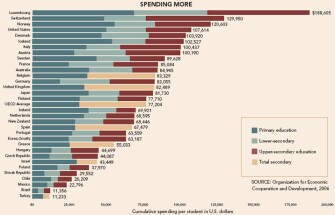
“These results cannot simply be tied to money,” says Barbara Ischinger, who heads the education directorate for the OECD. “ Only Luxembourg, Switzerland, and Norway spend more per student in the primary through secondary grades than the United States does, according to OECD data.

Accompanying Charts

  • Mathematically Lagging On international tests of performance, 15-year-olds in the United States, on average, trail behind their peers in many other developed nations. Out of the 30 countries taking part in the 2003 Program for International Student Assessment, or PISA, the average mathematics achievement of U.S. students was higher than that of students in only five countries.
BRIC ARCHIVE

  • Spending More Spending levels in the United States are some of the highest among those countries belonging to the Organization for Economic Cooperation and Development. Only Luxembourg, Switzerland, and Norway spend more per student in the primary through secondary grades than the United States does.
BRIC ARCHIVE


The United States, however, devotes only half of its expenditures to teacher compensation, a share that is below those of all but five OECD countries.

Perhaps most troubling, America’s older adults, ages 35 to 64, have higher rates of college completion than its younger generation—a trend opposite the direction in other industrialized nations.

“Are we going to react in a way that’s too little, too late?” asks Thomas J. Tierney, the president of the Bridgespan Group, a nonprofit management-consulting organization based in Boston. “I think the choice is ours.”

In March 2024, Education Week announced the end of the Quality Counts report after 25 years of serving as a comprehensive K-12 education scorecard. In response to new challenges and a shifting landscape, we are refocusing our efforts on research and analysis to better serve the K-12 community. For more information, please go here for the full context or learn more about the EdWeek Research Center.

Events

Reading & Literacy K-12 Essentials Forum Supporting Struggling Readers in Middle and High School
Join this free virtual event to learn more about policy, data, research, and experiences around supporting older students who struggle to read.
School & District Management Webinar Squeeze More Learning Time Out of the School Day
Learn how to increase learning time for your students by identifying and minimizing classroom disruptions.
Recruitment & Retention Webinar EdRecruiter 2026 Survey Results: How School Districts are Finding and Keeping Talent
Discover the latest K-12 hiring trends from EdWeek’s nationwide survey of job seekers and district HR professionals.

EdWeek Top School Jobs

Teacher Jobs
Search over ten thousand teaching jobs nationwide — elementary, middle, high school and more.
View Jobs
Principal Jobs
Find hundreds of jobs for principals, assistant principals, and other school leadership roles.
View Jobs
Administrator Jobs
Over a thousand district-level jobs: superintendents, directors, more.
View Jobs
Support Staff Jobs
Search thousands of jobs, from paraprofessionals to counselors and more.
View Jobs

Read Next

Federal From Our Research Center Trump Shifted CTE to the Labor Dept. What Has That Meant for Schools?
What educators think of shifting CTE to another federal agency could preview how they'll view a bigger shuffle.
3 min read
Collage style illustration showing a large hand pointing to the right, while a small male pulls up an arrow filled with money and pushes with both hands to reverse it toward the right side of the frame.
DigitalVision Vectors + Getty
Federal Video Here’s What the Ed. Dept. Upheaval Will Mean for Schools
The Trump administration took significant steps this week toward eliminating the U.S. Department of Education.
1 min read
The U.S. Department of Education building is pictured in a double exposure on Oct. 24, 2025, in Washington, D.C.
Maansi Srivastava for Education Week
Federal What State Education Chiefs Think as Trump Moves Programs Out of the Ed. Dept.
The department's announcement this week represents a consequential structural change for states.
6 min read
The U.S. Department of Education building is seen behind the Dwight D. Eisenhower Memorial on Oct. 24, 2025 in Washington, D.C.
The U.S. Department of Education building is seen behind the Dwight D. Eisenhower Memorial on Oct. 24, 2025 in Washington, D.C. The department is shifting many of its functions to four other federal agencies as the Trump administration tries to downsize it. State education chiefs stand to be most directly affected.
Maansi Srivastava for Education Week
Federal See Where the Ed. Dept.'s Programs Will Move as the Trump Admin. Downsizes
Programs overseen by the Ed. Dept. will move to agencies including the Department of Labor.
President Donald Trump signs an executive order regarding education in the Oval Office of the White House, Wednesday, April 23, 2025, in Washington, as Commerce Secretary Howard Lutnick, Labor Secretary Lori Chavez-DeRemer, and Education Secretary Linda McMahon watch.
President Donald Trump signs an executive order regarding education in the Oval Office of the White House on April 23, 2025, as Commerce Secretary Howard Lutnick, Labor Secretary Lori Chavez-DeRemer, and Education Secretary Linda McMahon watch. The Trump administration on Tuesday announced that it's sending many of the Department of Education's K-12 and higher education programs to other federal agencies.
Alex Brandon/AP
