Law & Courts

Lawsuit Over a Transgender School Sports Policy Revived by Federal Appeals Court

By Mark Walsh — December 15, 2023 3 min read
Bloomfield High School transgender athlete Terry Miller, second from left, wins the final of the 55-meter dash over transgender athlete Andraya Yearwood, far left, and other runners in the Connecticut girls Class S indoor track meet at Hillhouse High School in New Haven, Conn on Feb. 7, 2019.
  • Save to favorites
  • Print

A federal appeals court has revived a lawsuit challenging the Connecticut high school sports association’s policy of allowing transgender girls to compete in girls’ sports, issuing a limited ruling that several cisgender female athletes had standing to erase certain track and field records they had lost to transgender female competitors.

But the full U.S. Court of Appeals for the 2nd Circuit, in New York City, emphasized that it was not deciding the key underlying issue in the case—whether the cisgender girls have a valid claim that they faced sex discrimination in violation of Title IX, the federal law that bars such bias in federally funded educational programs.

The decision in Soule v. Connecticut Association of Schools appeared to be unanimous in at least one respect—that the cisgender challengers of the transgender-inclusive policy could go back to a federal district court to pursue their claims. Otherwise, the case yielded a fractured array of opinions.

“The splintered nature of the court’s opinions should not in any way suggest that its holding encompasses a determination on [the] highly contested underlying merits question” of whether the Connecticut policy violates Title IX, said the majority opinion by Judge Alison J. Nathan. “It does not.”

Seeking to adjust state track and field records

The case involves the policy of the Connecticut Interscholastic Athletics Association, which was challenged by four cisgender female athletes after they lost some but not all of their races to two transgender females, during the 2017, 2018, and 2019 seasons.

After the students graduated high school, the plaintiffs focused their claims on adjusting state athletic records to remove victories by the transgender females. In the new ruling, the 2nd Circuit said that was enough for them to continue pursuing their challenge to the policy.

In the current posture of the case, “we must assume plaintiffs are correct that permitting transgender girls to compete in those races violated federal law and that plaintiffs’ current records are therefore impacted by an unlawful policy,” Nathan wrote for the majority. “It is plausible that altering certain public athletic records—for example, indicating that [one] plaintiff ... finished 1st rather than 3rd in the 2019 state open indoor 55m[eter] final—would at least partially redress the alleged denial of equal athletic opportunity by giving plaintiffs the higher placements and titles they would have received without the CIAC policy in place, albeit belatedly.”

The appeals court said the district court should consider whether the plaintiffs also had standing based on a claim for money damages. The 15 members of the court issued a range of separate opinions on that issue.

In a separate concurrence with her own majority opinion, joined by just one other judge, Nathan said that for the cisgender students to prevail on their claim that the Connecticut policy violates Title IX, they must prove that the federal statute “requires schools to exclude transgender girls from competing on girls’ sports teams consistent with their established gender identity. This is an interpretation of Title IX that no court has ever adopted—a fact that remains true after our decision today.”

In a dissent joined in whole or in part by seven other members of the court, Judge Denny Chin said the cisgender female plaintiffs had not adequately shown that their alleged injuries from losing to transgender females could be redressed by altering the athletic records. The plaintiffs argue at this point that the challenged records could harm their employment opportunities. The majority said that however remote that prospect was, it did help establish their standing, while Chin said in dissent it was “entirely speculative” that the outcome of a high school race would have an impact on their future employment.

“Here, where the injunction seeks merely to remedy a past injury by giving credit where credit’s due and the claim is principally for plaintiffs’ moral or emotional satisfaction, it is not sufficient,” Chin said.

The case will now return to a federal district court in Connecticut.

Events

This content is provided by our sponsor. It is not written by and does not necessarily reflect the views of Education Week's editorial staff.
Sponsor
Artificial Intelligence Webinar
Managing AI in Schools: Practical Strategies for Districts
How should districts govern AI in schools? Learn practical strategies for policies, safety, transparency, as well as responsible adoption.
Content provided by Lightspeed Systems
This content is provided by our sponsor. It is not written by and does not necessarily reflect the views of Education Week's editorial staff.
Sponsor
Reading & Literacy Webinar
Unlocking Success for Struggling Adolescent Readers
The Science of Reading transformed K-3 literacy. Now it's time to extend that focus to students in grades 6 through 12.
Content provided by STARI
Jobs Virtual Career Fair for Teachers and K-12 Staff
Find teaching jobs and K-12 education jubs at the EdWeek Top School Jobs virtual career fair.

EdWeek Top School Jobs

Teacher Jobs
Search over ten thousand teaching jobs nationwide — elementary, middle, high school and more.
View Jobs
Principal Jobs
Find hundreds of jobs for principals, assistant principals, and other school leadership roles.
View Jobs
Administrator Jobs
Over a thousand district-level jobs: superintendents, directors, more.
View Jobs
Support Staff Jobs
Search thousands of jobs, from paraprofessionals to counselors and more.
View Jobs

Read Next

Law & Courts Appeals Court Halts Ruling Letting Teachers Disclose Students' Gender Identity
A federal appeals court has temporarily paused enforcement of the ruling but has not yet decided whether to grant a longer-term stay.
Kristen Taketa, The San Diego Union-Tribune
3 min read
Students carrying pride and transgender flags leave Great Oak High School in Temecula, Calif., on Sept. 22, 2023, after walking out of the school in protest of the Temecula school district policy requiring parents to be notified if their child identifies as transgender.
Anjali Sharif-Paul/The Orange County Register via AP
Law & Courts Schools Can’t Bar Teachers From Telling Parents If Kids Are Transgender, Judge Rules
The injunction bans any public school employee from misleading parents about their child’s gender presentation at school.
Kristen Taketa, The San Diego Union-Tribune
5 min read
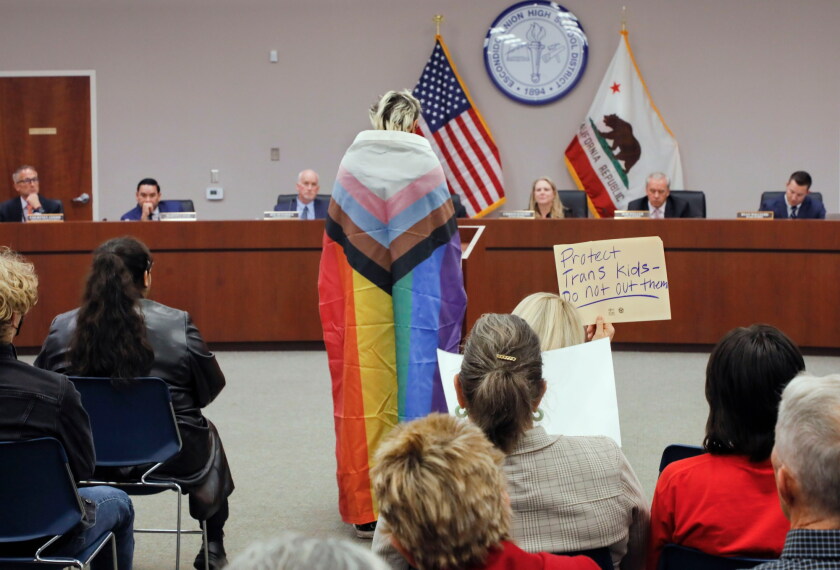
Teacher’s aide Amelia Mester, wrapped in a Pride flag, urges Escondido Union High School District not to have employees notify parents if they believe a student may be transgender in November 2025. A policy on the issue in the city’s elementary school district is the subject of a federal class-action lawsuit in which a judge just sided against the district.
Teacher’s aide Amelia Mester, wrapped in a Pride flag, urges Escondido Union High School District not to have employees notify parents if they believe a student may be transgender. A policy on the issue in the city’s elementary school district is the subject of a federal class-action lawsuit in which a judge just ruled against the district.
Charlie Neuman for The San Diego Union-Tribune/TNS
Law & Courts Federal Appeals Court Upholds 8th Grader's Expulsion Over Gun Comments in Class
Shortly after a nearby mass school shooting, a student allegedly discussed bringing a gun to school.
3 min read
Photo of stone columns.
E+
Law & Courts Trump's Education Policies Spurred 72 Lawsuits in 2025. How Many Is He Winning?
The legal challenges show which policies have had a big impact and how 2026 could go.
5 min read
President Donald Trump holds up an executive order after signing it at an indoor Presidential Inauguration parade event in Washington, Jan. 20, 2025.
President Donald Trump holds up an executive order after signing it at an indoor presidential inauguration parade event in Washington on Jan. 20, 2025. Trump's executive actions prompted legal challenges virtually from the moment he took office, and education-related policies were not immune.
Matt Rourke/AP