Law & Courts

Justices Decline to Hear Nevada Case on Taxes for Schools

By Caroline Hendrie — March 31, 2004 3 min read
  • Save to favorites
  • Print

The U.S. Supreme Court declined last week to get involved in a hard-fought legal battle in Nevada stemming from a protracted legislative deadlock last year over tax increases to pay for public schools.

In a ruling last July that sparked a political furor in the state, the Nevada Supreme Court held that the legislature’s duty to finance public schools overrode a voter-approved amendment to the state constitution that requires legislative supermajorities to increase taxes.

Asking the justices in Washington to reverse the Nevada court, lawyers for two dozen Republican state legislators had argued that the ruling represented “an egregious disregard of the people’s will.” Voters gave final approval in 1996 to a ballot initiative requiring the two-thirds votes.

“The decision stands as an unvarnished usurpation of the authority of the Nevada Constitution, a shameful violation of the judicial oath, and a repudiation of the principle that Nevada’s is a government of laws rather than men,” lawyers for the GOP legislators wrote in papers asking the federal high court to accept their appeal in Angle v. Guinn (Case No. 03-1037).

But lawyers for the state legislature told the justices that the case was moot and therefore unworthy of the court’s attention.

They noted that the disputed tax legislation ultimately passed each chamber with two-thirds support on July 21—despite the ruling 11 days earlier saying those supermajorities were unnecessary. Those votes ended a lengthy impasse over the education budget. The battle had dragged on through two special legislative sessions after tax measures to finance the schools repeatedly failed to reach the two-thirds threshold in the Assembly, the lower chamber, by a single vote.

That chain of events, lawyers for the legislature wrote in papers urging the high court not to take the case, “leaves this court with nothing to do but provide an advisory opinion on an abstract political question in a case with no actual, live controversy.”

The Nevada court fight erupted a minute past midnight on the first day of the current fiscal year, when Gov. Kenny Guinn, a Republican, asked the state supreme court to order the legislature to pass an education budget for the two- year period starting July 1.

In a 6-1 ruling on July 10, the state court held that funding for public education was simply too important to fall prey to a “procedural requirement” for a two-thirds majority. It ordered the legislature to “proceed expeditiously” to hammer out a tax plan to finance public education “under simple majority rule.”

“When a procedural requirement that is general in nature prevents funding for a basic, substantive right, the procedure must yield,” state Chief Justice Deborah Agosti wrote in the majority opinion, adding that “education is a basic constitutional right in Nevada.”

Return to Court

Shortly after the ruling, lawmakers did approve a tax bill by simple majorities. But the bill was never signed into law, and on July 21, after intense negotiations, legislative leaders mustered two-thirds majorities in both chambers for sizable tax increases to pay for a two-year, $1.65 billion school spending plan. (“States Open Fiscal Year on Shaky Ground,” Aug. 6, 2003.)

Meanwhile, the group of Republican legislators went back to the Nevada Supreme Court and asked it to reconsider the July 10 ruling. They contended that the ruling and its aftermath had violated the U.S. Constitution by running roughshod over their voting rights and those of Nevada voters at large, and by infringing the right of state citizens to choose their own form of representative government.

Last September, the state high court rejected the lawmakers’ arguments and reaffirmed its earlier opinion. On March 22, the U.S. Supreme Court declined without comment to accept the lawmakers’ appeal.

Still, the dispute over last summer’s budget showdown is not over. A separate legal challenge to the Nevada Supreme Court’s ruling is now pending before the U.S. Court of Appeals for the 9th Circuit, in San Francisco, where it is slated for a hearing the middle of next month.
Related Tags:

Events

This content is provided by our sponsor. It is not written by and does not necessarily reflect the views of Education Week's editorial staff.
Sponsor
School & District Management Webinar
Too Many Initiatives, Not Enough Alignment: A Change Management Playbook for Leaders
Learn how leadership teams can increase alignment and evaluate every program, practice, and purchase against a clear strategic plan.
Content provided by Otus
This content is provided by our sponsor. It is not written by and does not necessarily reflect the views of Education Week's editorial staff.
Sponsor
Artificial Intelligence Webinar
Beyond Teacher Tools: Exploring AI for Student Success
Teacher AI tools only show assigned work. See how TrekAi's student-facing approach reveals authentic learning needs and drives real success.
Content provided by TrekAi
This content is provided by our sponsor. It is not written by and does not necessarily reflect the views of Education Week's editorial staff.
Sponsor
College & Workforce Readiness Webinar
Building for the Future: Igniting Middle Schoolers’ Interest in Skilled Trades & Future-Ready Skills
Ignite middle schoolers’ interest in skilled trades with hands-on learning and real-world projects that build future-ready skills.
Content provided by Project Lead The Way

EdWeek Top School Jobs

Teacher Jobs
Search over ten thousand teaching jobs nationwide — elementary, middle, high school and more.
View Jobs
Principal Jobs
Find hundreds of jobs for principals, assistant principals, and other school leadership roles.
View Jobs
Administrator Jobs
Over a thousand district-level jobs: superintendents, directors, more.
View Jobs
Support Staff Jobs
Search thousands of jobs, from paraprofessionals to counselors and more.
View Jobs

Read Next

Law & Courts Supreme Court Backs Parents in School Gender Disclosure Fight
The Supreme Court restored an injunction blocking California policies on student gender transitions
8 min read
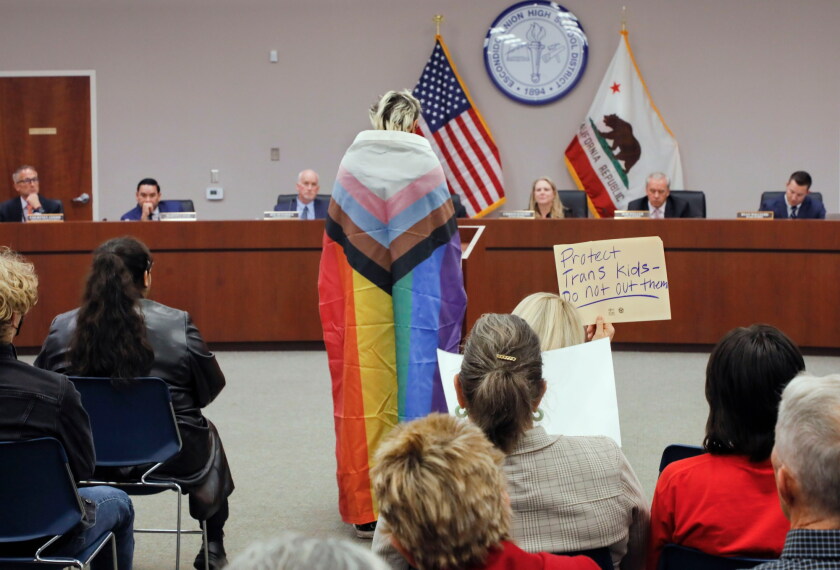
Teacher’s aide Amelia Mester, wrapped in a Pride flag, urges Escondido Union High School District not to have employees notify parents if they believe a student may be transgender in November 2025. A policy on the issue in the city’s elementary school district is the subject of a federal class-action lawsuit in which a judge just sided against the district.
Teacher’s aide Amelia Mester, wrapped in a Pride flag, urges Escondido Union High School District not to have employees notify parents if they believe a student may be transgender at a meeting in November 2025. Two parents and two teachers from the district sued in 2023, challenging California state guidance concerning student gender transitions and parental notification. The U.S. Supreme Court has now reinstated a lower-court decision overturning those state policies.
Charlie Neuman for The San Diego Union-Tribune/TNS
Law & Courts Appeals Court Allows Louisiana Ten Commandments Displays to Proceed
The court said it was premature to rule on the constitutionality of La. Ten Commandments displays.
3 min read
Students work under Ten Commandments and Bill of Rights posters on display in a classroom at Lehman High School in Kyle, Texas, Thursday, Oct. 16, 2025.
Students work under Ten Commandments and Bill of Rights posters on display in a classroom at Lehman High School in Kyle, Texas, Oct. 16, 2025. A federal appeals court has lifted a lower-court injunction blocking a Louisiana law that requires Ten Commandments displays, clearing the way for the law to take effect.
Eric Gay/AP
Law & Courts Social Media Companies Face Legal Reckoning Over Mental Health Harms to Children
Some of the biggest players from Meta to TikTok are getting a chance to make their case in courtrooms around the country.
6 min read
Social Media Kids Trial 26050035983057
Meta CEO Mark Zuckerberg leaves court after testifying in a landmark trial over whether social media platforms deliberately addict and harm children, on Feb. 18, 2026, in Los Angeles.
AP Photo/Damian Dovarganes
Law & Courts Supreme Court Strikes Trump Tariffs in Case Brought by Educational Toy Companies
Two educational toy companies were among the leading challengers to the president's tariff policies
3 min read
Members of the Supreme Court sit for a new group portrait following the addition of Associate Justice Ketanji Brown Jackson, at the Supreme Court building in Washington, Oct. 7, 2022. Bottom row, from left, Associate Justice Sonia Sotomayor, Associate Justice Clarence Thomas, Chief Justice of the United States John Roberts, Associate Justice Samuel Alito, and Associate Justice Elena Kagan. Top row, from left, Associate Justice Amy Coney Barrett, Associate Justice Neil Gorsuch, Associate Justice Brett Kavanaugh, and Associate Justice Ketanji Brown Jackson.
Members of the U.S. Supreme Court sit for a new group portrait following the addition of Justice Ketanji Brown Jackson, at the court building in Washington, Oct. 7, 2022. On Feb. 20, 2026, the court ruled 6-3 to strike down President Donald Trump's broad tariff policies, ruling that they were not authorized by the federal statute that he cited for them.
J. Scott Applewhite/AP
