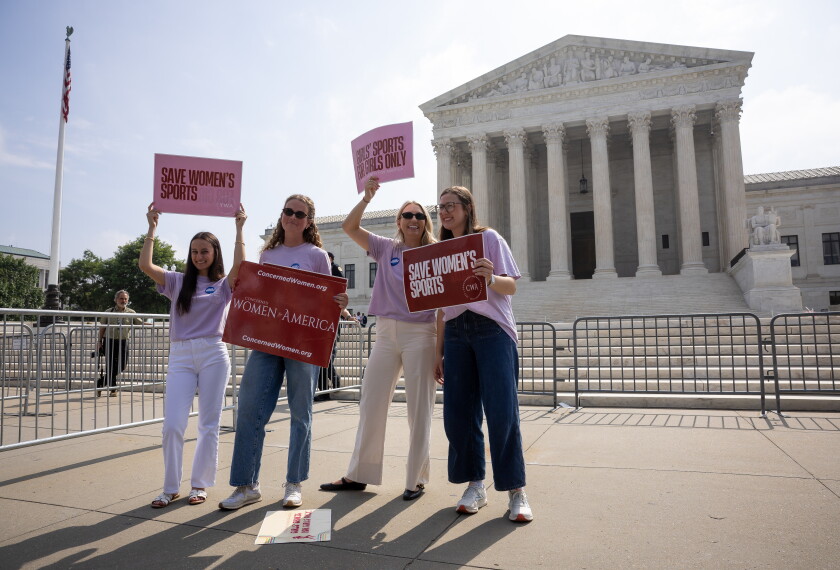
The U.S. Supreme Court heard oral arguments last week in a case that will decide the fate of Virginia Military Institute’s 157-year-old all-male tradition. Several justices appeared skeptical of Virginia’s legal defense of a public educational program that excludes women.
The stakes in the closely watched case of U.S. v. Virginia (Case No. 94-1941) are highest for VMI, a state-supported military institution in Lexington, Va., and the Citadel in Charleston, S.C., the nation’s only other remaining all-male public college.
But the case also has potential implications for other forms of single-sex education. Private women’s colleges have split over the possible impact on their institutions of a high court decision requiring VMI to open its ranks to women.
And single-sex programs in public elementary and secondary schools could be affected by the outcome at a time when more educators and policymakers are advocating their adoption. Just this month, Gov. Pete Wilson of California proposed a pilot program of single-sex magnet schools throughout his state. (See Education Week, Jan. 17, 1996.)
Even the justices seemed interested in the ramifications of the VMI case on single-sex programs in K-12 education.
The Department of Justice, which sued Virginia in 1990 seeking to open up VMI to women, argued last week that the high court should apply the highest level of judicial scrutiny to government classifications based on sex. Currently, only race-based classifications receive “strict scrutiny,” which means they must serve a compelling governmental interest and be narrowly tailored to meet that interest in order to pass constitutional muster.
K-12 Impact
Several justices wondered whether the adoption of a strict-scrutiny standard for sex-based classifications would make it impossible for public schools to offer single-sex programs.
“How can single-sex high schools comply with the rule of strict scrutiny?” asked Justice Anthony M. Kennedy. “I just don’t see how they can.”
The Justice Department’s lawyer, Paul Bender, said that such a high standard of review would not invalidate all single-sex programs in public schools. “A compensatory program could be a single-sex program,” he said.
However, Justice David H. Souter asked whether allowable single-sex programs would all have to be compensatory efforts designed to remedy past discrimination--and thus, presumably, limited to girls.
“What if you have a school system where everybody says the results are terrible?” he asked. Could that school district implement single-sex classrooms for boys and girls if it believed it would raise overall academic achievement?
Mr. Bender, the deputy U.S. solicitor general, replied that such a program could pass muster under the highest judicial test.
The state of Virginia, meanwhile, argued that all publicly supported single-sex education--including private colleges where students receive federal financial aid--could be imperiled if the high court issues a broad ruling that opens up VMI to women.
It cited efforts in Detroit, California, and Maryland to offer single-sex classrooms without offering comparable programs to the opposite sex. At least one such program, classrooms tailored for African-American males in Detroit, has been struck down by a federal district court. (See Education Week, Sept. 4, 1991.)
“Educators and policymakers are turning more and more frequently to single-sex education as one solution for some of the ills that beset the nation’s public education system,” the state said in its main brief before the high court. But such efforts “could well be precluded or hindered” by the logic of the Justice Department’s arguments in this case, the state said.
Justices Skeptical
The justices did not appear eager to accept the Clinton administration’s suggestion to use the case to subject sex-based discrimination to the strict-scrutiny standard.
But they appeared doubtful that they could accept Virginia’s justifications for excluding women from VMI even under the prevailing legal standard known as “intermediate scrutiny.” Under that more lenient standard, classifications based on sex must serve important governmental objectives and be substantially related to achieving those objectives.
Of the eight members of the court hearing the case, only Chief Justice William H. Rehnquist and Justice Antonin Scalia appeared strongly sympathetic to the state’s arguments for keeping VMI all male. Justice Clarence Thomas excused himself from the case because his son attends VMI.
“It would destroy the nature of the institution” to admit women, Justice Scalia said at one point.
VMI is renowned for its “adversative” method of developing character and leadership characteristics in young men, who are meant to become “citizen-soldiers.” For students, that method includes a complete lack of privacy among classmates in barracks, rigorous physical requirements, and the “rat line,” in which younger students face humiliation and hazing from older ones.
At issue before the Supreme Court are two rulings by the U.S. Court of Appeals for the 4th Circuit. The first, in 1992, found that VMI’s exclusion of women violated the equal-protection clause of the 14th Amendment. Virginia is seeking a reversal of that ruling.
The second came last year, when the 4th Circuit court ruled that the state could correct the constitutional violation by establishing a separate military-style program for women. That program, the Virginia Women’s Institute for Leadership, opened last summer at Mary Baldwin College, a private women’s institution in Staunton, Va. The women’s program, which is serving 42 students this year, is not nearly as rigorous as VMI and does not use an “adversative” approach.
Several justices appeared skeptical that this separate program was enough to remedy an equal-protection violation. And some wondered what was so important about an all-male VMI that justified the exclusion of women.
“What is it that is so important about this hard-to-grasp, adversative kind of thing that enables you to say to women who want to go there, ‘You can’t come’?” Justice Stephen G. Breyer asked Virginia’s lawyer, Theodore B. Olson.
“The answer is, it works,” Mr. Olson replied.
Justice Ruth Bader Ginsburg asked, “Wouldn’t something else work almost as well, without denying opportunities to women?”
Mr. Olson replied that “unless we are all to be educated the same way,” states should be able to provide different kinds of educational options.