Law & Courts

High Court Declines to Hear School Board Challenge to Scope of Transgender Student Rights

By Mark Walsh — June 28, 2021 3 min read
Gavin Grimm, who has become a national face for transgender students, speaks during a news conference held by The ACLU and the ACLU of Virginia at Slover Library in Norfolk, Va on July 23, 2019.
  • Save to favorites
  • Print

The U.S. Supreme Court, over the dissent of two justices on Monday, declined to take up the appeal of a Virginia school district in a long-running case about the right of a transgender student to use restrooms consistent with his gender identity.

The court’s action in the case involving transgender student Gavin Grimm was not a ruling on the merits of the case. But it does bring a long legal battle to a close and leaves in place a federal appeals court decision that the Gloucester County, Va., district violated both the equal protection clause and Title IX by adopting a policy that barred Grimm from the boys restroom.

“I am glad that my years-long fight to have my school see me for who I am is over,” Grimm, who graduated from Gloucester County High School in 2017, said in a statement released by the American Civil Liberties Union, which represents him. “Being forced to use the nurse’s room, a private bathroom, and the girl’s room was humiliating for me, and having to go to out-of-the-way bathrooms severely interfered with my education. Trans youth deserve to use the bathroom in peace without being humiliated and stigmatized by their own school boards and elected officials.”

A panel of the U.S. Court of Appeals for the 4th Circuit, in Richmond, Va., had ruled 2-1 in 2020 that both the 14th Amendment’s equal-protection clause and Title IX of the Education Amendments of 1972, the federal law that bars sex discrimination in federally funded schools, protect transgender students from school restroom policies that prevent the students from affirming their gender identity.

The 4th Circuit court majority took account of the then-recent Supreme Court decision in Bostock v. Clayton County, Ga., which held that the prohibition against discrimination “on the basis of sex” including in Title VII of the Civil Rights Act of 1964 protected employees based on sexual orientation and gender identity. The appellate court said the logic of the Bostock decision applied to Title IX.

The school district, in appealing to the high court in Gloucester County School Board v. Grimm (Case No. 20-1163), said the 4th Circuit’s reliance on Bostock was misplaced because Title IX is a “vastly different statute” than Title VII. Title IX allows for sex-separated living facilities on school campuses and its regulations allow for sex-separated restrooms, the district argued.

“A teenager who identifies with the opposite biological sex … deserves and needs everyone’s compassion,” the district said in its brief. But allowing such a teenager “to use multi-user restrooms, locker rooms and shower facilities reserved for the opposite sex raises what this court has acknowledged to be serious concerns about bodily privacy—for the teenager and others,” the brief said.

David P. Corrigan, the Gloucester County district’s longtime lawyer, said the district had no comment about the high court’s action.

Justices Clarence Thomas and Samuel A. Alito Jr. said they would have granted review of the case. Alito wrote the main dissent in the Bostock case last term, joined by Thomas, that discussed with dismay what the Title VII ruling might mean for interpreting Title IX’s protection against sex discrimination, particularly in the area of transgender female students’ participation in girls’ and women’s school sports.

Given how much is percolating around the country with transgender student rights in contexts beyond school restrooms, including locker rooms and athletic competitions, some Supreme Court justices may believe that the Gloucester County case was not the best vehicle to address whether Title IX’s bar on sex discrimination works the same way as the court interpreted the sex-bias clause in Title VII.

Josh Block, who represents Grimm for the ACLU, noted that Monday’s action was the third time in recent years that the Supreme Court has declined to review federal appeals court rulings in favor of transgender students.

“This is an incredible victory for Gavin and for transgender students around the country,” Block said in a statement. “Our work is not yet done, and the ACLU is continuing to fight against anti-trans laws targeting trans youth in states around the country.”

Events

This content is provided by our sponsor. It is not written by and does not necessarily reflect the views of Education Week's editorial staff.
Sponsor
Artificial Intelligence Webinar
Managing AI in Schools: Practical Strategies for Districts
How should districts govern AI in schools? Learn practical strategies for policies, safety, transparency, as well as responsible adoption.
Content provided by Lightspeed Systems
This content is provided by our sponsor. It is not written by and does not necessarily reflect the views of Education Week's editorial staff.
Sponsor
Reading & Literacy Webinar
Unlocking Success for Struggling Adolescent Readers
The Science of Reading transformed K-3 literacy. Now it's time to extend that focus to students in grades 6 through 12.
Content provided by STARI
Jobs Virtual Career Fair for Teachers and K-12 Staff
Find teaching jobs and K-12 education jubs at the EdWeek Top School Jobs virtual career fair.

EdWeek Top School Jobs

Teacher Jobs
Search over ten thousand teaching jobs nationwide — elementary, middle, high school and more.
View Jobs
Principal Jobs
Find hundreds of jobs for principals, assistant principals, and other school leadership roles.
View Jobs
Administrator Jobs
Over a thousand district-level jobs: superintendents, directors, more.
View Jobs
Support Staff Jobs
Search thousands of jobs, from paraprofessionals to counselors and more.
View Jobs

Read Next

Law & Courts Appeals Court Halts Ruling Letting Teachers Disclose Students' Gender Identity
A federal appeals court has temporarily paused enforcement of the ruling but has not yet decided whether to grant a longer-term stay.
Kristen Taketa, The San Diego Union-Tribune
3 min read
Students carrying pride and transgender flags leave Great Oak High School in Temecula, Calif., on Sept. 22, 2023, after walking out of the school in protest of the Temecula school district policy requiring parents to be notified if their child identifies as transgender.
Anjali Sharif-Paul/The Orange County Register via AP
Law & Courts Schools Can’t Bar Teachers From Telling Parents If Kids Are Transgender, Judge Rules
The injunction bans any public school employee from misleading parents about their child’s gender presentation at school.
Kristen Taketa, The San Diego Union-Tribune
5 min read
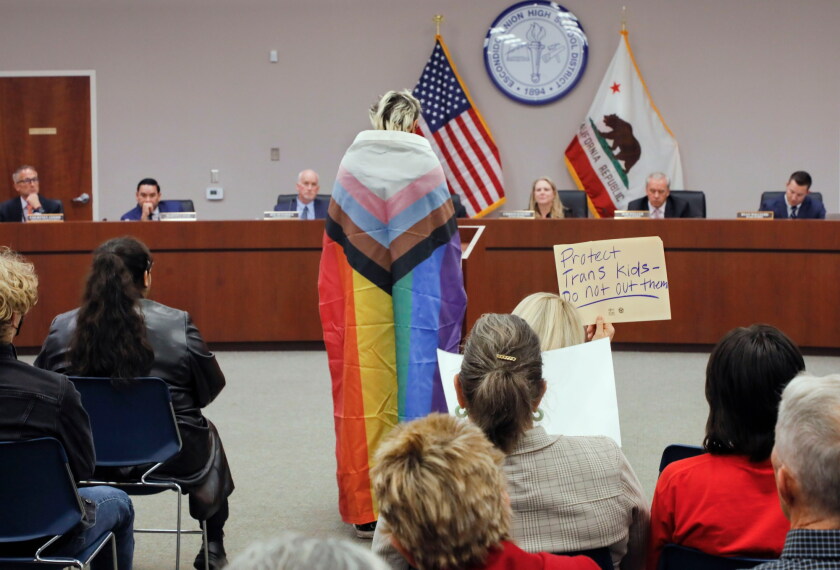
Teacher’s aide Amelia Mester, wrapped in a Pride flag, urges Escondido Union High School District not to have employees notify parents if they believe a student may be transgender in November 2025. A policy on the issue in the city’s elementary school district is the subject of a federal class-action lawsuit in which a judge just sided against the district.
Teacher’s aide Amelia Mester, wrapped in a Pride flag, urges Escondido Union High School District not to have employees notify parents if they believe a student may be transgender. A policy on the issue in the city’s elementary school district is the subject of a federal class-action lawsuit in which a judge just ruled against the district.
Charlie Neuman for The San Diego Union-Tribune/TNS
Law & Courts Federal Appeals Court Upholds 8th Grader's Expulsion Over Gun Comments in Class
Shortly after a nearby mass school shooting, a student allegedly discussed bringing a gun to school.
3 min read
Photo of stone columns.
E+
Law & Courts Trump's Education Policies Spurred 72 Lawsuits in 2025. How Many Is He Winning?
The legal challenges show which policies have had a big impact and how 2026 could go.
5 min read
President Donald Trump holds up an executive order after signing it at an indoor Presidential Inauguration parade event in Washington, Jan. 20, 2025.
President Donald Trump holds up an executive order after signing it at an indoor presidential inauguration parade event in Washington on Jan. 20, 2025. Trump's executive actions prompted legal challenges virtually from the moment he took office, and education-related policies were not immune.
Matt Rourke/AP
