Federal

England Pushes for Cellphone Bans in Schools. Could the U.S. Be Next? 

By Elizabeth Heubeck — October 16, 2023 3 min read
Tight crop photo of a student looking at their cellphone during class. The background is blurred, but shows students wearing uniforms.
  • Save to favorites
  • Print

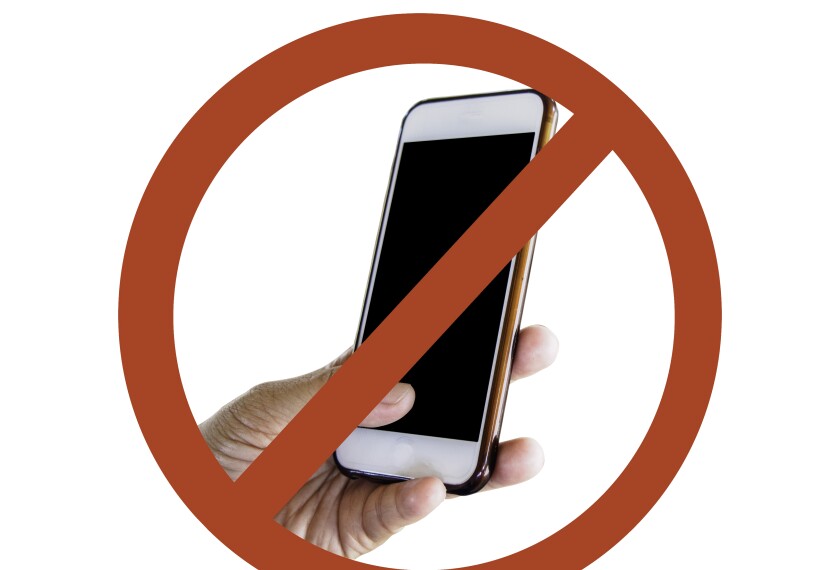
Earlier this month, England’s Education Secretary Gillian Keegan made an announcement recommending that schools prohibit students’ cellphone use during the school day, including recess and break times, in an effort to to reduce disruptive behavior during class time and student-driven online bullying.

England’s response to the growing frustration with students’ cellphone use during school time would not be unprecedented. Even before the United Nations this past summer published a report issuing a strong warning regarding technology use in schools around the globe, some countries had implemented strict “no-cellphone” policies. China in 2021 banned students from using cellphones at school; in 2018, France prohibited students in elementary and middle schools from using cellphones while on campus.

Common Sense Media, a U.S.-based organization that tracks media usage among children, voiced its support of cellphone restrictions at schools.

“Most teens use their phones for an average of 43 minutes during school hours, with some students reaching six hours of usage on the high end. These addictive devices are a constant companion in kids’ lives, and often lead to distraction and social anxiety during a part of the day that is crucial for the social, emotional, and cognitive development of young people,” said James P. Steyer, the organization’s founder and CEO. “Under this lens, it’s no wonder countries like the U.K., France, and Portugal are banning smartphones from schools.”

So, will the United States follow suit? Experts say it’s doubtful, for several reasons.

The U.S. education system is more decentralized

“With 50 different state education policies that govern portions of a child’s education, it’s unlikely we will institute a federal policy,” Steyer said.

International data show just how decentralized public school governance is in this country compared to others.

Researchers at The American Enterprise Institute, a free enterprise-oriented think tank, sought to determine whether national mandates typically dictate these key components of education: curriculum, exams, and teacher pay scale. Among the 50 countries included in the study, the U.S. proved to be the only one that does not typically prescribe what is taught or tested in schools and how much teachers earn.

And, within the United States, states vary widely in the degree to which education decisions are made at the state or local level and the extent to which the public participates in education policy-making process.

Parent pushback

Parent pushback also has impacted some schools’ decisions about students’ cellphone use. Specifically, parents’ desire to be able to reach their children at a moment’s notice has prevented some schools from instituting complete cellphone bans.

“They feel that it’s a safety issue if they don’t have 24/7 access to their kids. They want to connect with kids during the day,” said Brooke Olsen-Farrell, the superintendent of Slate Valley Unified School District in Fair Haven, Vt.
The district has resisted a complete cellphone ban, instead restricting student use of cellphones to lunchtime and between classes, Olsen-Farrell said.
See Also

Photo illustration of cell phone with red circle and slash.
iStock / Getty Images Plus

Many teachers don’t want to police cellphone use

To teachers, cellphone use restrictions represent the proverbial double-edged sword. While they overwhelmingly acknowledge the temptations and related distractions cellphones pose to children and teens, teachers don’t necessarily want to be responsible for enforcing school or district mandates around cellphone use.

This was made clear when a bill proposing a ban on cellphone and smartwatch use in public school classrooms was introduced to the Utah legislature earlier this year. The bill, which failed in the state House Education Committee, was not unanimously popular among the state’s teachers.

Rita Heagren, a spokesperson for the American Federation of Teachers Utah, called Lee’s bill “unenforceable.”

“This requires teachers in the classrooms to enforce these policies,” Heagren told the Salt Lake Tribune. “You want me to try and take a cellphone away from a 220-pound lineman? I don’t think so.”

Events

This content is provided by our sponsor. It is not written by and does not necessarily reflect the views of Education Week's editorial staff.
Sponsor
Artificial Intelligence Webinar
Managing AI in Schools: Practical Strategies for Districts
How should districts govern AI in schools? Learn practical strategies for policies, safety, transparency, and responsible adoption.
Content provided by Lightspeed Systems
This content is provided by our sponsor. It is not written by and does not necessarily reflect the views of Education Week's editorial staff.
Sponsor
Reading & Literacy Webinar
Two Jobs, One Classroom: Strengthening Decoding While Teaching Grade-Level Text
Discover practical, research-informed practices that drive real reading growth without sacrificing grade-level learning.
Content provided by EPS Learning
Jobs Virtual Career Fair for Teachers and K-12 Staff
Find teaching jobs and K-12 education jubs at the EdWeek Top School Jobs virtual career fair.

EdWeek Top School Jobs

Teacher Jobs
Search over ten thousand teaching jobs nationwide — elementary, middle, high school and more.
View Jobs
Principal Jobs
Find hundreds of jobs for principals, assistant principals, and other school leadership roles.
View Jobs
Administrator Jobs
Over a thousand district-level jobs: superintendents, directors, more.
View Jobs
Support Staff Jobs
Search thousands of jobs, from paraprofessionals to counselors and more.
View Jobs

Read Next

Federal Will the Ed. Dept. Act on Recommendations to Overhaul Its Research Arm?
An adviser's report called for more coherence and sped-up research awards at the Institute of Education Sciences.
6 min read
The U.S. Department of Education building is pictured on Oct. 24, 2025, in Washington, D.C.
The U.S. Department of Education building in Washington is pictured on Oct. 24, 2025. A new report from a department adviser calls for major overhauls to the agency's research arm to facilitate timely research and easier-to-use guides for educators and state leaders.
Maansi Srivastava for Education Week
Federal Trump Talks Up AI in State of the Union, But Not Much Else About Education
The president didn't mention two of his cornerstone education policies from the past year.
4 min read
President Donald Trump enters to deliver the State of the Union address to a joint session of Congress in the House chamber at the U.S. Capitol in Washington, Tuesday, Feb. 24, 2026.
President Donald Trump enters to deliver the State of the Union address to a joint session of Congress in the House chamber at the U.S. Capitol in Washington, Tuesday, Feb. 24, 2026. The president devoted little time in the speech to discussing his education policies.
Kenny Holston/The New York Times via AP, Pool
Federal Education Department Will Send More of Its Programs to Other Agencies
Education grants for school safety, community schools, and family engagement will shift to Health and Human Services.
4 min read
Various school representatives and parent liaisons attend a family and community engagement think tank discussion at Lowery Conference Center on March 13, 2024 in Denver. One of the goals of the meeting was to discuss how schools can better integrate new students and families into the district. Denver Public Schools has six community hubs across the district that have serviced 3,000 new students since October 2023. Each community hub has different resources for families and students catering to what the community needs.
A program that helps state education departments and schools improve family engagement policies is among those the Trump administration will transfer from the U.S. Department of Education to the U.S. Department of Health and Human Services. In this photo, school representatives and parent liaisons attend a family and community engagement discussion on March 13, 2024, in Denver to discuss how schools can better integrate new students and families into the district.
Rebecca Slezak For Education Week
Federal New Trump Admin. Guidance Says Teachers Can Pray With Students
The president said the guidance for public schools would ensure "total protection" for school prayer.
3 min read
MADISON, AL - MARCH 29: Bob Jones High School football players touch the people near them during a prayer after morning workouts and before the rest of the school day on March 29, 2024, in Madison, AL. Head football coach Kelvis White and his brother follow in the footsteps of their father, who was also a football coach. As sports in the United States deals with polarization, Coach White and Bob Jones High School form a classic tale of team, unity, and brotherhood. (Photo by Jahi Chikwendiu/The Washington Post via Getty Images)
Football players at Bob Jones High School in Madison, Ala., pray after morning workouts before the rest of the school day on March 29, 2024. New guidance from the U.S. Department of Education says students and educators can pray at school, as long as the prayer isn't school-sponsored and disruptive to school and classroom activities, and students aren't coerced to participate.
Jahi Chikwendiu/Washington Post via Getty Images
