

The U.S. Department of Education is immediately increasing funding for a charter school grant program after it gained extra leeway through the budget process to allocate funds for the rest of this fiscal year and as the Trump administration looks to expand school choice.
The department will free up $60 million immediately, it announced Friday, increasing funding for the Charter School Programs grant to $500 million for the budget year that lasts until Sept. 30. The grant funds the creation of new charter schools, pays for construction and maintenance for existing schools, and supports the scaling up of successful programs.
The $60 million increase mirrors what President Donald Trump, a longtime school choice supporter, proposed in his budget for fiscal 2026, which starts on Oct. 1. But allocating the funds now allows the administration to devote more funding to the program without relying on congressional action.

The Education Department did not respond to a message Friday asking how it was able to make the funding available within its current budget.
Beyond the additional funding, the department rolled out a new grant program to “showcase and share” strategies that help charter schools succeed nationwide, and it began inviting applications.
Education Secretary Linda McMahon said in a statement the funding will “pave the way for more choices, better outcomes, and life-changing opportunities for students and families.” For the new grant program, McMahon said in a video posted to the department website that the agency will focus on charter schools that emphasize civics, STEM, career-focused education, and classical education—a model that’s been growing in popularity in recent years, especially among conservatives, and emphasizes traditional liberal arts and classic texts.
Charter schools are publicly funded, independently operated schools. Forty-seven states now allow them, with North Dakota the most recent to pass a charter school law.
The bump in federal funding for charter schools comes after the Education Department gained increased leeway to spend its budget after Congress passed a continuing resolution in March to keep the government funded through Sept. 30. The abbreviated budget, in some cases, doesn’t spell out how the government should divide up money allocated for broad categories into discrete grant programs—which has left school leaders worried about whether Trump’s administration will fund certain programs at all.
“This is one of the things that people worried would give the administration flexibility to not fund certain programs they don’t like, or to move money around,” said Sarah Abernathy, executive director of the Committee for Education Funding, a nonprofit advocacy group. “I think that’s what they’re doing, but I think that they are using more flexibility than the law allows if they are taking it from one sub-account to another.”
That could land the department in court—again, said Paul Manna, a government professor at William & Mary. The Trump administration’s education policy-related actions and other executive actions that affect education have drawn at least 37 lawsuits since late January, according to an Education Week tracker.
“If they are trying to take funds from another source or another line item, technically, they would need to actually get Congress’s approval to do that,” Manna said.

The department has unspent funds after it terminated grant awards made under three teacher-training programs in the opening weeks of the second Trump term. Those lingering dollars sit in a shared overall account but in separate buckets of money. The agency in recent months has also terminated scores of other grants and contracts.
Regardless of the mechanism it used to devote the funding to the charter school program, the much leaner Education Department that has shed nearly half its staff in recent months could face another hurdle as it awards additional charter school grant funds and sets up a new grant program: capacity.
“I don’t know how many people and how much capacity they have to push this out the door and make sure it’s not just a leaky bucket—where money doesn’t go where it’s supposed to go, or goes to low-quality charter programs, because we know there’s a lot of variation in them,” Manna said.
The quick action comes as Trump already moved to expand school choice from the federal level since returning to the White House.
As one of his first K-12 actions, the president in late January signed an executive order telling federal agencies to investigate how they could use taxpayer dollars to support school choice within the parameters of a historically limited federal role in education, and directed the Education Department to prioritize school choice programs in discretionary grant programs. The department has begun issuing guidance on the limited latitude states have to use federal dollars—such as Title I, which supports students from low-income communities—for school choice and on how states can identify “persistently dangerous” schools under a provision of the No Child Left Behind Act to trigger a school choice option.
Under Trump’s proposed budget for the budget year that starts in October, charter school funding would be the only K-12 program to see a bump—raising the existing annual funding of $440 million to $500 million.
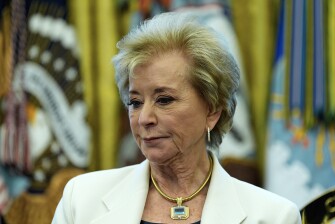
“The president is very supportive of charter schools,” McMahon told an audience during an interview with the Cato Institute this week, highlighting the additional funding, “ … so the president is very much on board with making sure that the funding is in place for charter schools.”
The National Alliance for Public Charter Schools, an advocacy organization, applauded the new funding and grant program. Starlee Coleman, the group’s president and CEO, said in a statement that the moves “demonstrate a real commitment to expanding high-quality public charter school options and supporting the innovators working to deliver them.”
The Education Department’s announcement came at the end of a week during which Republicans in the U.S. House of Representatives and Senate held hearings championing charter schools.
The Education Department in recent months also withdrew two notices from former President Joe Biden’s administration inviting applications for awards from two charter school grant programs, saying the criteria in those notices included “excessive regulatory burdens and promoted discriminatory practices.” In January, the agency also released $33 million in grant funds for charter school management organizations that it said the Biden administration had stalled.
In addition, a number of McMahon’s school visits as education secretary so far have been to charter schools.


