Special Report
Federal

Debate Brews on Federal Aid for Florida Schools

By Erik W. Robelen — March 10, 2009 2 min read
BRIC ARCHIVE
  • Save to favorites
  • Print

As lawmakers in cash-strapped Florida move into a legislative session likely to be dominated by budget issues, Gov. Charlie Crist is urging them to embrace his plan to spend federal stimulus aid on schools and other initiatives, and to increase per-pupil spending for education.

At the same time, the Republican governor used his March 3 State of the State address to repeat his call for legislation requiring school districts to spend 70 percent of their budgets directly “in the classroom for our students and teachers.”

“The federal stimulus bill is not perfect; I’ve never seen a bill that is,” the governor told the GOP-controlled legislature in his speech in Tallahassee. “But this package will provide much-needed tax relief, as well as immediate assistance in education, transportation, unemployment compensation, renewable energy, and other aid and is expected to save or create as many as 206,000 jobs.”

See Also

Read more from our updated coverage of the governors’ speeches.

The governor’s $21.5 billion K-12 budget request for the fiscal year that begins July 1 includes $1.5 billion of federal funds through the stimulus package President Barack Obama signed last month. The plan would raise per-pupil spending on average to $7,044, up 2.7 percent. It would raise K-12 spending from the current fiscal year by about $1 billion, or nearly 5 percent.

But Mark Pudlow, a spokesman for the Florida Education Association, an affiliate of both the American Federation of Teachers and the National Education Association that has more than 250,000 members, said his union had some concerns about the governor’s approach to the stimulus.

“He’s using it to paper over a problem this year, and that problem is still going to exist and will resurface unless we look at a permanent source for funding,” he said. “There absolutely needs to be some revenue added to the budget in Florida, not only for schools but for other social programs.”

Republicans Wary
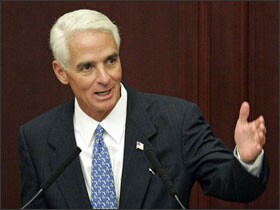
Florida Gov. Charlie Crist.

But some Republicans remained cautious about even using the federal stimulus dollars.

“We’ll have to work with the governor, with his staff over the next 59 days [of the legislative session] to come up with the decisions on what, if any, portions of the stimulus package we actually do take,” said Rep. Dean Cannon, a Republican who chairs the House Select Policy Council on Strategic and Economic Planning.

“The governor’s obviously favoring taking all of it,” Rep. Cannon said. “I have some concern that taking all of it may leave us in a worse position two or three years from now than if we maybe take only targeted portions of it.”

Indeed, some analysts have cautioned that a revised state revenue forecast expected this month may reveal a decline in tax collections, which could compel cuts to the current $65.5 billion state budget as well as next year’s. The state’s projected deficit for next year is about $5.5 billion.

Mr. Crist said his proposal for school systems to spend 70 percent of their budgets in the classroom would also seek to “instill transparency” by requiring districts to provide “dollar-by-dollar details online” of their spending.

“Floridians deserve to know how their hard-earned dollars are being spent,” he said, “and parents have a right to demand accountability.”

The Associated Press contributed to this story.

A version of this article appeared in the March 11, 2009 edition of Education Week as Debate Brews on Federal Aid for Florida Schools

Events

Teaching Profession K-12 Essentials Forum Supporting the New K-12 Workforce: What Teachers Need to Stay at School
 Join this free virtual event to discover what teachers say they need to feel supported to stay in classrooms for the long haul.
College & Workforce Readiness K-12 Essentials Forum Career and Technical Education Takes Its Next Big Step
Join this free virtual event to hear creative approaches to modernize CTE programs and navigate the shift away from a near-exclusive focus on "college preparedness."

EdWeek Top School Jobs

Teacher Jobs
Search over ten thousand teaching jobs nationwide — elementary, middle, high school and more.
View Jobs
Principal Jobs
Find hundreds of jobs for principals, assistant principals, and other school leadership roles.
View Jobs
Administrator Jobs
Over a thousand district-level jobs: superintendents, directors, more.
View Jobs
Support Staff Jobs
Search thousands of jobs, from paraprofessionals to counselors and more.
View Jobs

Read Next

Federal Opinion The Ed. Dept.'s Civil Rights and Special Ed. Offices Are Moving. Here's What That Means
Short-term changes are unlikely to be noticeable. Longer term, they may be consequential.
9 min read
The United States Capitol building as a bookcase filled with red, white, and blue policy books in a Washington DC landscape.
Luca D'Urbino for Education Week
Federal Opinion ‘None of This Is Abstract’: The Real Harm of Trump’s Ed. Dept. Civil Rights Move
Here’s why families will feel it when student civil rights enforcement moves to the Justice Dept.
Alumni Collective of the U.S. Dept. of Ed., Office for Civil Rights
4 min read
Image of a box of files
Laura Baker/Education Week + Getty
Federal Special Ed. and Civil Rights: What We Know About the Ed. Dept.'s Latest Moves
Special education is moving to HHS, and civil rights enforcement is moving to DOJ.
6 min read
Letters on the Department of Education building are missing after removal of America 250 banners, which included those of Booker T. Washington, Catharine Beecher and Charlie Kirk, March 18, 2026, in Washington.
Letters on the U.S. Department of Education building are missing in this March 18, 2026, photo in Washington. The agency last week announced it's transferring day-to-day management of special education and civil rights enforcement to different Cabinet agencies, the latest push by the Trump administration to dismantle the Education Department.
Allison Robbert/AP Photo
Federal Trump's Justice Dept. Investigates Dozens of Districts Over LGBTQ+ Curricula
The investigations target how schools discuss sexuality and gender identity and whether parents can opt their children out of lessons.
8 min read
The U.S. Department of Justice is investigating how 43 school districts in three states teach about sexuality and gender identity and whether they give parents the opportunity to opt their children out of lessons that conflict with their religious beliefs on June 16, 2026.PICTURED, Protesters gather outside the Glendale Unified School District headquarters in Glendale, California, on June 20, 2023. Over 300 people gathered outside the Glendale Unified School District headquarters, as protests continued over the issue of teaching children about same-sex parents and queer issues.
Protesters gather outside the Glendale school district in Glendale, California, on June 20, 2023 over the issue of teaching children about same-sex parents and queer issues. The U.S. Department of Justice is now investigating three other school districts over LGBTQ+ themes in sex ed. and beyond. (The Glendale district is not one of them.)
DAVID SWANSON / AFP via Getty Images
