States

Data Group Turning to Use of Information

By Dakarai I. Aarons — February 03, 2010 4 min read
  • Save to favorites
  • Print

States have made progress in building data systems that track student performance over time, but are behind the curve in sharing the information in a way that leads to meaningful decisionmaking, a national survey released last week suggests.

The Data Quality Campaign, a foundation-funded organization in Washington that promotes and tracks the use of data in education, has been focused since 2005 on identifying the key components of state data systems and pushing for their development. Now that much of that work is under way, the group is shifting its focus to describe and promote the use of the data.

“The education sector is on the cusp of becoming an information-based enterprise,” the survey report from the group says. “But reaching this goal depends on states taking actions that change the historically entrenched culture of using data for compliance reporting into one that values analysis of data and prioritizes constant communication to all stakeholders of the education system.”

The movement to create state data systems got a boost from the American Recovery and Reinvestment Act, because states had to agree to complete their data systems by 2011 in order to receive money from the stimulus act’s State Fiscal Stabilization Fund.

This year’s survey marks the first time the DQC has released information on states’ efforts in 10 areas the group believes will make data use more prevalent.

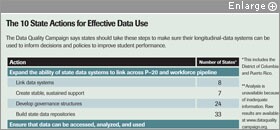
The 10 State Actions for Effective Data Use

The Data Quality Campaign says states should take these steps to make sure their longitudinal-data systems can be used to inform decisions and policies to improve student performance.
BRIC ARCHIVE

SOURCE: Data Quality Campaign

“While it is a monumental task to build the infrastructure to do this, it is an even more monumental task to help people understand how to access this information, how to use the information, and to change the education culture to teach people how to take this information into account on a daily basis,” said Aimee R. Guidera, the executive director of the Data Quality Campaign.

With federal stimulus money driving the construction of the systems, Ms. Guidera said, state policymakers need to seize the opportunity to make them so useful that education leaders will be willing to fight for sustaining the data infrastructure in coming years, when state budgets will be cash-strapped and funding will be harder to maintain.

More Work to Do

In a November survey, the DQC reported that 44 states collect data that can identify the schools producing the strongest academic growth for students, up from 21 states in 2005. In addition, 47 states now have the components needed to calculate a longitudinal graduation rate using the method agreed upon in a National Governors Association compact in 2005. (“Report Finds States on Course to Build Pupil-Data Systems,” Dec. 2, 2009.)

The new report specifies 10 state actions necessary for effective data use. But 43 states have taken three or fewer of the actions, which call for states to expand their data systems to include higher education and workforce information; ensure that the data can be accessed, analyzed, and used; and build the capacity of stakeholders to use the data.

Just eight states had linked their K-12 data systems with others in the state, for example, including postsecondary education, workforce information, and social-service agencies, the survey found. They are required to create such linkages to receive money from the second phase of the State Fiscal Stabilization Fund, the report notes.

The group will offer technical assistance to states for the development of policy frameworks that allow for easier integration of data collected across state agencies into a useful format, Ms. Guidera said.

To help highlight the type of leadership the DQC believes is necessary, it last week honored policymakers and educators who have made substantial progress in promoting data use.

Mickey Garrison, the school improvement director for Oregon’s Education Enterprise Steering Committee, was named as state data director of the year for her work as the training director for the Oregon Direct Access to Achievement, or DATA, project, which has brought together the state’s education department, universities, school districts, and others to focus on making sure teachers are trained in how to use data in a way that helps them improve instruction.

Ms. Garrison said the project set out to bridge a critical gap for educators in the state’s 198 districts.

“Data is in the forefront in education,” she said in an interview. “Teachers and administrators are being told to use data to do program evaluations, to align their curriculum, and to ensure they are meeting students’ needs. But often what we do in education is, we identify what people need to do, but we don’t help them understand how to do it.”

For his efforts in promoting the power of data in schools, Peter Gorman, the superintendent of the Charlotte-Mecklenburg, N.C., school district, was named data leader of the year.

A group of four Illinois policymakers won the award for state policymaker of the year for pulling together their state’s education community to get a bill passed guiding the construction and use of a longitudinal-data system. Enacted last year, the law requires the state to collect student records and integrate them with management tools.

“We wanted to celebrate the collaborative leadership of that work and the fact it was very public,” Ms. Guidera said.

Related Tags:

A version of this article appeared in the February 03, 2010 edition of Education Week as Data Group Turning to Use of Information

Events

This content is provided by our sponsor. It is not written by and does not necessarily reflect the views of Education Week's editorial staff.
Sponsor
Artificial Intelligence Webinar
Managing AI in Schools: Practical Strategies for Districts
How should districts govern AI in schools? Learn practical strategies for policies, safety, transparency, and responsible adoption.
Content provided by Lightspeed Systems
This content is provided by our sponsor. It is not written by and does not necessarily reflect the views of Education Week's editorial staff.
Sponsor
Student Absenteeism Webinar
Removing Transportation and Attendance Barriers for Homeless Youth
Join us to see how districts around the country are supporting vulnerable students, including those covered under the McKinney–Vento Act.
Content provided by HopSkipDrive
This content is provided by our sponsor. It is not written by and does not necessarily reflect the views of Education Week's editorial staff.
Sponsor
Reading & Literacy Webinar
Two Jobs, One Classroom: Strengthening Decoding While Teaching Grade-Level Text
Discover practical, research-informed practices that drive real reading growth without sacrificing grade-level learning.
Content provided by EPS Learning

EdWeek Top School Jobs

Teacher Jobs
Search over ten thousand teaching jobs nationwide — elementary, middle, high school and more.
View Jobs
Principal Jobs
Find hundreds of jobs for principals, assistant principals, and other school leadership roles.
View Jobs
Administrator Jobs
Over a thousand district-level jobs: superintendents, directors, more.
View Jobs
Support Staff Jobs
Search thousands of jobs, from paraprofessionals to counselors and more.
View Jobs

Read Next

States Q&A This State Stepped In When the Feds Stopped Honoring Schools' Environmental Work
The Trump administration last year ended the Green Ribbon Schools recognition program.
4 min read
West De Pere High School is committed to sustainability and environmental stewardship, focusing on reducing greenhouse gas emissions and enhancing environmental literacy through facility upgrades such as LED lighting, motion sensors and advanced HVAC systems. To further explore energy, students have opportunities to explore alternative energy, including participation in the annual Wisconsin Public Service Solar Olympics Challenge. Going the extra mile, West De Pere hosts recycling drives that successfully collected 117 pounds of batteries and Christmas lights last year alone. The school's physical education program fosters a deep appreciation for the natural world, offering diverse activities like biking, fishing, and archery that emphasize physical health and lifelong skills. Additionally, West De Pere's involvement in the Farm to Table program highlights the importance of local produce, complemented by a school greenhouse that enhances hands-on learning. Through these initiatives, West De Pere High School is empowering students to become proactive stewards of the environment and advocates for sustainability in their communities.
West De Pere High School in De Pere, Wis., was a 2025 honoree in the state's Green and Healthy Schools Wisconsin program. The state expanded that recognition program honoring schools' sustainability work after the U.S. Department of Education ended its Green Ribbon Schools program last year.
Courtesy of Wisconsin Department of Natural Resources
States What Happens to Students Who Join the Military? A New Effort Aims to Find Out
A pilot will allow states to use Pentagon data to track students from the classroom to the military.
3 min read
New military recruits take the Oath of Office during a swearing in ceremony at a Salute to Service event at an NFL football game between the Jacksonville Jaguars and the Minnesota Vikings, Sunday, Nov. 10, 2024, in Jacksonville.
New military recruits take the Oath of Office during a swearing-in ceremony on Nov. 10, 2024, in Jacksonville, Fla. States' education plans call for tracking students paths from the classroom to college, career, or the military, but they've struggled to access enlistment data from the U.S. Department of Defense. Through a new agreement, five states will pilot a data-sharing process with the Pentagon with hopes to expand to additional states.
Phelan M. Ebenhack/AP
States FBI Searches Los Angeles District's Headquarters and Superintendent Alberto Carvalho's Home
The FBI would not comment on the nature of the investigation.
2 min read
Media stage outside the home of Los Angeles Unified School District Superintendent Alberto Carvalho on Wednesday, Feb. 25, 2026, in San Pedro, Calif.
News media stage outside the home of Los Angeles Unified School District Superintendent Alberto Carvalho on Wednesday, Feb. 25, 2026, in San Pedro, Calif. The FBI searched his house and LAUSD headquarters but has not detailed what prompted the search.
William Liang/AP
States Heritage Foundation Targets Undocumented Students’ Access to Free Education
The conservative group put forward Project 2025, which has shaped Trump administration policy.
3 min read
An American flag is seen upside down at the conservative Heritage Foundation in Washington, May 31, 2024.
An American flag hangs upside down at the conservative Heritage Foundation in Washington, May 31, 2024. The think tank has called on states to enact legislation that would limit undocumented students' access to free, public education.
Jose Luis Magana/AP
