Law & Courts

Court Upholds Injunction on Arizona Transgender Sports Ban for Young Athletes

By Mark Walsh — September 09, 2024 3 min read
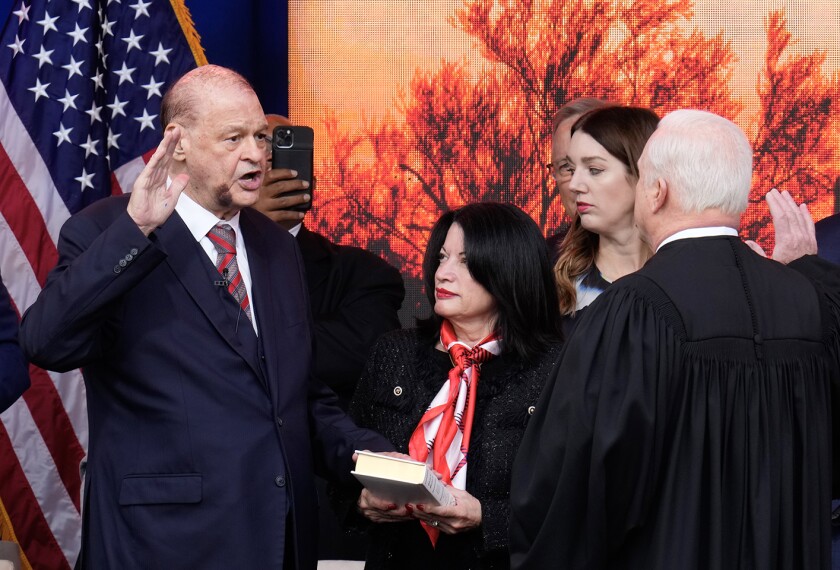
Arizona State Superintendent of Public Instruction Tom Horne, left, a Republican, takes the ceremonial oath of office from Arizona Supreme Court Chief Justice Robert Brutinel, right, as wife Carmen Horne, middle, holds the bible in the public inauguration ceremony at the state Capitol in Phoenix, Thursday, Jan. 5, 2023.
  • Save to favorites
  • Print

A federal appeals court on Monday ruled in favor of two prepubescent transgender female athletes seeking to play girls’ sports in school, agreeing with a lower court that there are no significant athletic differences between boys and girls before puberty.

The three-judge panel of the U.S. Court of Appeals for the 9th Circuit, in San Francisco, upheld an injunction that partially blocks an Arizona law barring transgender women and girls from college and school sports.

The injunction applies only to the two challengers as the case is litigated. One is identified in court papers as Jane Doe, an 11-year-old transgender girl who takes a puberty blocker and seeks to play on her middle school’s girls soccer and basketball teams as well as the coed cross-country team. The other is identified as Megan Roe, a 15-year-old who has taken puberty blockers for four years and seeks to play on her private high school’s girls volleyball team.

In Doe v. Horne, the 9th Circuit panel noted “that standards governing transgender participation in sports are evolving” but that the district court had found based on expert testimony that the “biological driver of average group differences in athletic performance between adolescent boys and girls is the difference in their respective levels of testosterone, which only begin to diverge significantly after the onset of puberty.”

Thus, the lower court found that transgender girls such as Doe and Roe, who begin puberty-blocking medication and hormone therapy at an early age, “do not have an athletic advantage over other girls.”

The district court’s findings were “firmly grounded in evidence,” and the judge “did not clearly err by finding that there are no significant differences in athletic performance between prepubescent boys and girls,” Judge Morgan Christen, an appointee of President Barack Obama, wrote for the panel.

(The other members of the panel were Senior Circuit Judge M. Margaret McKeown, an appointee of President Bill Clinton, and Senior District Judge David A. Ezra, an appointee of President Ronald Reagan.)

Appeals court backs injunction on basis of equal protection

At issue in the case is Arizona’s Save Women’s Sports Act, passed in 2022 and similar to numerous measures in other states. The law bars male and transgender female students from participating in women’s and girls’ sports, though state law had already barred men and boys from such participation.

The law was challenged by Doe and Roe and their parents under the 14th Amendment’s equal-protection clause and Title IX of the Education Amendments of 1972, which bars sex discrimination in federally funded educational programs.

The district court granted the injunction blocking the Arizona law with respect to the two challengers based on both equal protection and Title IX. The 9th Circuit upheld the injunction based only on the equal protection clause.

The appeals court said the state law does not afford transgender women and girls equal athletic opportunities because it permits cisgender women and girls to play on any teams, male or female, while transgender women and girls may play only on male teams. The law also permits all students other than transgender women and girls to play on teams consistent with their gender identities, the court said.

“Transgender women and girls alone are barred from doing so,” Christen said. “This is the essence of discrimination.”

Although the court did not rule on Title IX, it suggested the state defendants might have justifiable arguments on their claim that the state lacked clear notice from Congress that excluding transgender women and girls from female sports violates the statute. The defendants can press that argument as the full litigation over the state law proceeds, the court said.

The court also emphasized that its decision did not bar policymakers from adopting “appropriate regulations in this field.”

“States have important interests in inclusion, nondiscrimination, competitive fairness, student safety, and completing the still unfinished and important job of ensuring equal athletic opportunities for women and girls, who must have an equal opportunity not only to participate in sports but also to compete and win,” Christen said.

Events

This content is provided by our sponsor. It is not written by and does not necessarily reflect the views of Education Week's editorial staff.
Sponsor
Artificial Intelligence Webinar
Managing AI in Schools: Practical Strategies for Districts
How should districts govern AI in schools? Learn practical strategies for policies, safety, transparency, as well as responsible adoption.
Content provided by Lightspeed Systems
This content is provided by our sponsor. It is not written by and does not necessarily reflect the views of Education Week's editorial staff.
Sponsor
Reading & Literacy Webinar
Unlocking Success for Struggling Adolescent Readers
The Science of Reading transformed K-3 literacy. Now it's time to extend that focus to students in grades 6 through 12.
Content provided by STARI
Jobs Virtual Career Fair for Teachers and K-12 Staff
Find teaching jobs and K-12 education jubs at the EdWeek Top School Jobs virtual career fair.

EdWeek Top School Jobs

Teacher Jobs
Search over ten thousand teaching jobs nationwide — elementary, middle, high school and more.
View Jobs
Principal Jobs
Find hundreds of jobs for principals, assistant principals, and other school leadership roles.
View Jobs
Administrator Jobs
Over a thousand district-level jobs: superintendents, directors, more.
View Jobs
Support Staff Jobs
Search thousands of jobs, from paraprofessionals to counselors and more.
View Jobs

Read Next

Law & Courts Appeals Court Sides With School in ‘Come and Take It’ Gun Hat Dispute
A full federal appeals court declined to reconsider a panel's decision backing administrators who required a student to remove her gun hat.
4 min read
Seen is an image of the hat that was included in the complaint.
Seen is the “Come and take it” hat, featuring an image of an AR-15 style rifle, that was at the center of the First Amendment lawsuit <i>C.S.</i> v. <i>McCrumb</i>.
U.S. District Court Eastern District of Michigan Southern Division
Law & Courts Federal Appeals Court Ruling Allows DOGE Access to Education Department Data
A federal appeals court ruled for the Trump administration in a case brought by the American Federation of Teachers and other plaintiffs.
3 min read
The headquarters of the U.S. Department of Education pictured on March 12, 2025, in Washington.
The headquarters of the U.S. Department of Education pictured on March 12, 2025, in Washington. A federal appeals court has now cleared a White House efficiency unit to resume accessing the agency’s records as part of a disputed data-review effort.
Mark Schiefelbein/AP
Law & Courts Judge Blocks Arkansas Law Requiring Ten Commandments Displays in Schools
A federal judge blocked an Arkansas law requiring Ten Commandments displays in schools. The law is one of three being challenged nationwide.
6 min read
A copy of the Ten Commandments is posted along with other historical documents in a hallway of the Georgia Capitol, Thursday, June 20, 2024, in Atlanta. Civil liberties groups filed a lawsuit Monday, June 24, challenging Louisiana’s new law that requires the Ten Commandments to be displayed in every public school classroom.
A copy of the Ten Commandments is posted along with other historical documents in a hallway of the Georgia Capitol on June 20, 2024, in Atlanta. A judge on Aug. 4 blocked a new Arkansas law requiring a Ten Commandments display in public school classrooms in four districts in the state. Similar laws in Louisiana and Texas are also being challenged in courts.
John Bazemore/AP
Law & Courts Trump Admin. Pauses Ban on Undocumented Kids in Head Start in These States
The administration said July 10 that undocumented immigrants were newly ineligible for a range of federally funded services.
2 min read
Students help put away supplies at the end of a reading and writing lesson at the Head Start program run by Easterseals, an organization that gets about a third of its funding from the federal government on Jan. 29, 2025, in Miami.
Students put away supplies at the end of a lesson at the Head Start program run by Easterseals on Jan. 29, 2025, in Miami. The Trump administration reclassified Head Start as a "federal public benefit" similar to welfare so it can bar undocumented students from the early childhood program, but the policy is now on hold in 20 states and the District of Columbia.
Rebecca Blackwell/AP
