
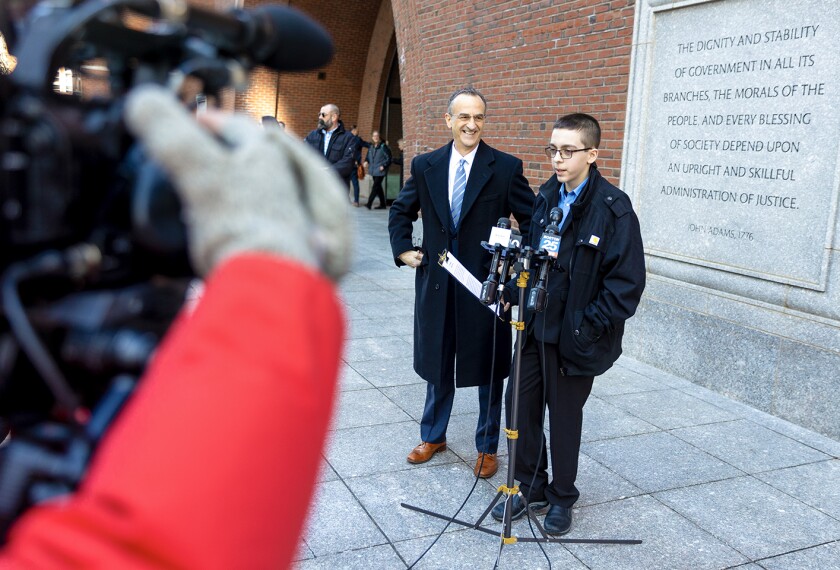
In an important ruling on student expression, a federal appeals court has upheld the authority of Massachusetts school administrators who barred a middle school student from wearing a T-shirt that said, “There Are Only Two Genders.”
A three-judge panel of the U.S. Court of Appeals for the 1st Circuit, in Boston, ruled unanimously that “precisely because the message was reasonably understood to be so demeaning of some other students’ gender identities, there was the potential for the back-and-forth of negative comments and slogans between factions of students” that could lead to “a deterioration in the school’s ability to educate its students.”
Liam Morrison was a 7th grader at Nichols Middle School in Middleborough, Mass., in April 2023 when he wore the shirt, which he and his father viewed as a comment on the hot political topic of gender identity and not a message aimed at any group or individual at his school, according to court papers.
School administrators were aware that several students at the middle school were transgender or gender nonconforming, and that some students were bullied and had suicidal ideation or had attempted suicide. They invoked a provision of the student dress code that barred “hate speech or imagery that target[s] groups based on race, ethnicity, gender, sexual orientation, gender identity, religious affiliation, or any other classification.”
Morrison was not disciplined, but his father came to school to take him home when he refused to remove the T-shirt. The father emailed an administrator to question why the shirt was barred when “it simply stated [his son’s] view on a subject that has become a political hot topic ... that is being discussed ... all across our country.” The school replied by citing the dress code’s prohibition of messages targeting a protected class, “namely in the area of gender identity.”
About a month later, in May 2023, Morrison again wore the shirt to school, this time with the words “Only Two” covered with a piece of tape with the word “Censored” written with a marker. Administrators decided that Morrison could not wear the altered shirt because it was so closely identified with his original message. The student removed the shirt. He later wore shirts with messages such as “Don’t Tread on Me” and “First Amendment Rights,” which he was not required to remove.
District and appeals courts rule for administrators, but with a different outlook on landmark Tinker case
Morrison and his parents sued the Middleborough school system and administrators under the First Amendment. A federal district judge ruled for the defendants, analyzing the case under the U.S. Supreme Court’s landmark 1969 decision in Tinker v. Des Moines Independent Community School District, which upheld the right of students to wear black armbands to protest the Vietnam War as long as school was not substantially disrupted.
The district judge cited a passage in Tinker that suggested student speech could not be in “collision with the rights of other students to be secure and to be let alone.”
In its June 9 decision in L.M. v. Town of Marlborough, the 1st Circuit panel upheld the district judge, but on different grounds from the Tinker decision. Instead of relying on the rights-of-others language, the appellate panel grounded its decision in Tinker’s substantial disruption test.
The court discussed a range of rulings by its sister federal circuit courts over the last two decades that generally, though not always, sided with school administrators in regulating student speech that was perceived as targeting minority groups. One was a 2006 ruling by the U.S. Court of Appeals for the 9th Circuit, in San Francisco, that upheld school officials who barred a student from wearing a T-shirt that said, “Homosexuality is Shameful.” (That ruling was later tossed out as moot by the Supreme Court.)
In 2008, however, the U.S. Court of Appeals for the 7th Circuit, in Chicago, ordered an Illinois school district to allow a student to wear a T-shirt proclaiming “Be Happy, Not Gay” to protest a high school event meant to promote tolerance of gay students.
“‘Be Happy, Not Gay’ is only tepidly negative,” that court said. “‘Derogatory’ or ‘demeaning’ seems too strong a characterization.”
However, several federal appeals courts have upheld school prohibitions on the display of the Confederate flag, the 1st Circuit noted.
Appeals courts addressing such student expression “appear to have converged on the shared understanding … that school officials may bar passive and silently expressed messages by students at school that target no specific student if: (1) the expression is reasonably interpreted to demean one of those characteristics of personal identity, … and (2) the demeaning message is reasonably forecasted to poison the educational atmosphere due to its serious negative psychological impact on students,” Judge David J. Barron wrote for the 1st Circuit panel.
The panel disagreed with Morrison’s argument that his shirt was akin to the black armbands in Tinker or the “Be Happy, Not Gay” shirt upheld by the 7th Circuit.
School administrators were not unreasonable in concluding that Morrison’s shirt “would be understood—in this middle school setting in which the children range from 10-to-14 years old—to demean the identity of transgender and gender-nonconforming NMS students,” Barron said.
Student’s lawyers are considering all legal options
David Cortman, senior counsel and vice president of Alliance Defending Freedom, said the organization was considering all its legal options, including whether to appeal the 1st Circuit ruling.
“Students don’t lose their free speech rights the moment they walk into a school building,” Cortman said in a statement. “This case isn’t about T-shirts; it’s about a public school telling a middle-schooler that he isn’t allowed to express a view that differs from their own.”
Bob Corn-Revere, the chief counsel of the Foundation for Individual Rights and Expression, which filed a friend-of-the-court brief in support of the student, said the 1st Circuit “got the decision wrong.”
He said Morrison’s shirt involved “the passive expression of an idea that some people may dislike or find uncomfortable,” but the appellate ruling restricts student speech rights by “expanding what it means to be targeted or bullied.”
Gary D. Buseck, a lawyer with GLBTQ Legal Advocates & Defenders, a Boston-based advocacy group that filed a friend-of-the-court brief in support of the school district, said the decision could be influential nationally.
“A shirt like this may not be inappropriate for adults to wear out in the world but may cross a line to wear before a captive audience of students who might have to sit and look at this shirt that demeans them,” he said. “In this case, a T-shirt that basically says trans and non-binary kids do not exist is too much. It just crosses a line.”


