The twin desires to pursue alternative visions of schooling and better serve students with special needs are driving an increase in charter schools across the country, according to a report released last week by the U.S. Department of Education.
For More Information |
Read “The State of Charter Schools,” from the U.S. Department of Education. (Requires Adobe’s Acrobat Reader.) The Center for Education Reform report is available for $19.95, plus $3 shipping and handling, by calling (800) 521-2118. |
The department estimates some 1,700 charter schools now serve at least a quarter-million students in the United States. The publicly funded but largely independent schools typically are freed from some state and local regulations in exchange for being held accountable for student achievement.
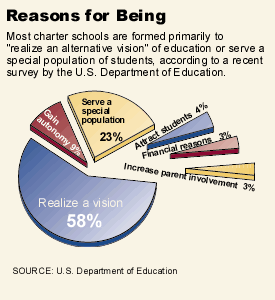
Of 946 schools that responded to a survey question from the department on the primary reason for their founding, 58 percent said they wanted to “realize an alternative vision” of education; 23 percent said they opened to serve a special population of students, such as those considered “at risk” for academic failure.
“The vast majority of people who started charter schools saw something lacking in the traditional school system,” said Jeanne Allen, the president of the Washington-based Center for Education Reform, which released its own report on charter schools last week. “And usually, if you’re going to go to the trouble of starting up a charter school, you want to help the kids who are the most under-served in the traditional system.”
Other reasons why some schools surveyed by the center said they had sought charter status were to gain more autonomy or to improve their financial situation. Traditional public schools that converted to charter status were particularly likely to cite the former goal; converted private schools were particularly likely to give the latter.
The Education Department’s report, called “The State of Charter Schools,” is the fourth and final installment in a four-year research program analyzing the charter school movement.
Several papers are also expected to be released this spring on topics ranging from student achievement in a sample of charter schools over time to the experiences of at-risk students in these new schools, said Gregory D. Henschel, a senior program analyst in the department’s office of educational research and improvement.
Department officials say the latest survey is focused on providing answers to frequently asked questions about charter schools. But it’s also being used to buttress the Clinton administration’s request for a $30 million increase in federal funding for charter schools in fiscal 2001, for a total of $175 million.
Funding Issues
Inadequate funding is still the most commonly cited barrier to success for charter schools, according to both the Education Department report and the Center for Education Reform’s study.
“We can see that there is a continued need for our support of these schools,” U.S. Education Secretary Richard W. Riley said in a prepared statement.
But the department’s report also notes there has been a marked decline over time in the percentage of schools facing problems with start-up funding. The change “likely reflects increased federal start-up funding for charter schools and that some states are providing charter school start-up funds,” the report says.
In 1996, 59 percent of charter schools surveyed cited lack of start-up funds as a problem, compared with 39 percent in the department’s 1999 survey.
Among other findings in the Education Department’s report:
- The percentage of nonwhite students in charter schools is larger than that of public schools overall in states with open-enrollment charter schools.
- Most charter school classrooms had computers for instruction, the student-to-computer ratios were low, and a majority of the computers could run advanced applications.
- Charter schools that served younger students were likely to have smaller class sizes than other public schools, while charter schools that taught high school students tended to have class sizes that were the same or larger than those in other public schools.
Gaining Momentum
While scant funds and other problems have forced a handful of charter schools to close their doors, the movement continues to grow at a remarkable pace, the new data show. Some 421 charter schools opened between September 1998 and September 1999, the biggest annual increase to date, according to the Education Department.
“People are more comfortable with the concept now, so we’re seeing more of them opening,” Ms. Allen said. “This is something that is absolutely a mainstream reform—there used to be skepticism about that statement, but not anymore.”
But as the charter school movement continues to pick up speed, the Center for Education Reform—which promotes greater choice in education—says that the opposition is also heating up.
In its report, “Charter Schools Today: Changing the Face of American Education,” the center says charter schools generally face opposition on three fronts: teachers’ unions, state boards and departments of education, and local school boards and districts.
“There’s more opposition because we’re getting to a critical mass,” Ms. Allen said.


