Law & Courts

Census Case Arguments Show High Court Divide

By Mark Walsh — April 30, 2019 4 min read
In a dispute being closely watched by educators, U.S. Solicitor General Noel G. Francisco argued to the U.S. Supreme Court in favor of a 2020 census question on citizenship.
  • Save to favorites
  • Print

The U.S. Supreme Court appeared divided last week over whether a citizenship question may be added to the 2020 census, in a case that is being watched by educators because of the potential impact that depressed response rates may have on the allocation of billions of dollars in federal education aid.

During arguments in Department of Commerce v. New York (Case No. 18-966), liberal justices were skeptical of U.S. Secretary of Commerce Wilbur L. Ross Jr.'s reasons for adding the citizenship question.

“This is a solution in search of a problem,” Justice Sonia Sotomayor told U.S. Solicitor General Noel J. Francisco, referring to the commerce secretary’s rationale that the citizenship question was requested by the Department of Justice to help enforce the Voting Rights Act of 1965.

But conservative members of the court did not provide much reason to suggest they were inclined to support the challengers. Several repeatedly pointed to the long history of the Census Bureau asking a citizenship question in various forms and the fact that many other countries ask about citizenship on their census forms.

Justice Neil M. Gorsuch observed that the census has asked about citizenship “for almost all of our history.”

‘A Long Pedigree’

The justices are reviewing a ruling by a federal district judge in New York City in January that adding a citizenship question to the census would lead to a decline in the response rate of at least 5.8 percent of households with at least one noncitizen and would also likely result in an undercount of Hispanic households.

The arguments did not delve into concerns raised in several friend-of-the-court briefs filed by education groups.

The Council of the Great City Schools, a coalition of 74 of the nation’s largest urban districts, says in its brief in support of the challengers that a 5.8 percent undercount of households with one noncitizen would—by itself—result in a “misallocation” nationwide of $151.7 million in federal Title I compensatory education funds.

The National School Boards Association and other education groups said in a brief that some 5.9 million children live in a household with at least one undocumented parent, and that it is important to achieve the most accurate count possible on the decennial census.

Justice Elena Kagan told Francisco that his briefs were well-written, but they provide “60 pages of rationalization” of Ross’ decision that the secretary himself did not provide at the time he announced the decision a year ago.

“You can’t really read this record without concluding this [voting-rights] need was a contrived one,” Kagan said.

Francisco said a citizenship question “has been part of the census in one form or another for a very long period of time. It has a long pedigree.”

Almost every decennial census from 1820 through 1950 asked about citizenship. Since then, the Census Bureau has only included the question on long forms that went to a sample of the full population or on the annual American Community Survey that also goes to a small segment of households.

“The secretary acted well within his discretion when he determined that reinstating the citizenship question would provide the best evidence of citizenship,” Francisco said.

Citing the United Nations

Barbara D. Underwood, the solicitor general of New York state, argued on behalf of the state challengers that “the secretary decided to add this question about citizenship to the 2020 census although the record before him contained uncontradicted and strong evidence that it will cause a decline in the response rate of noncitizens and Hispanics, to the detriment of the states and localities where they live.”

Dale E. Ho of the American Civil Liberties Union, representing immigration groups that also challenged the secretary’s decision, said, “There isn’t a shred of evidence in the administrative record that suggests that this question will not have the effect of harming response rates or will actually improve the citizenship data provided to the Department of Justice.”

But they met with skepticism from the conservative members of the court.

“The United Nations recommends asking about citizenship,” Justice Brett M. Kavanaugh told Underwood. “And a number of other countries do it. Spain, Germany, Canada, Australia, Ireland, Mexico ask a citizenship question.”

Chief Justice John G. Roberts Jr. suggested that the citizenship question would seem to help with voting-rights enforcement.

“The CVAP, Citizen Voting Age Population, is the critical element in voting-rights enforcement, and this is getting citizen information,” he said.

Demographic Questions

Roberts said demographic questions were “quite common” on the census.

“Sex, age, things like that,” the chief justice said. “You go back, and it [asks]: Do you own your house? Do you own a radio? I mean, the questions go quite beyond how many people there are.”

Underwood said there was no comparable evidence that those questions depressed response rates “in a substantial way,” while such evidence does exist for the citizenship question.

A decision in the case is expected by late June, which is also the target date for the Census Bureau to finalize and begin printing forms for the 2020 count.
A version of this article appeared in the May 01, 2019 edition of Education Week as Census Case Arguments Show High Court Divide

Events

This content is provided by our sponsor. It is not written by and does not necessarily reflect the views of Education Week's editorial staff.
Sponsor
School & District Management Webinar
Too Many Initiatives, Not Enough Alignment: A Change Management Playbook for Leaders
Learn how leadership teams can increase alignment and evaluate every program, practice, and purchase against a clear strategic plan.
Content provided by Otus
This content is provided by our sponsor. It is not written by and does not necessarily reflect the views of Education Week's editorial staff.
Sponsor
Artificial Intelligence Webinar
Beyond Teacher Tools: Exploring AI for Student Success
Teacher AI tools only show assigned work. See how TrekAi's student-facing approach reveals authentic learning needs and drives real success.
Content provided by TrekAi
This content is provided by our sponsor. It is not written by and does not necessarily reflect the views of Education Week's editorial staff.
Sponsor
College & Workforce Readiness Webinar
Building for the Future: Igniting Middle Schoolers’ Interest in Skilled Trades & Future-Ready Skills
Ignite middle schoolers’ interest in skilled trades with hands-on learning and real-world projects that build future-ready skills.
Content provided by Project Lead The Way

EdWeek Top School Jobs

Teacher Jobs
Search over ten thousand teaching jobs nationwide — elementary, middle, high school and more.
View Jobs
Principal Jobs
Find hundreds of jobs for principals, assistant principals, and other school leadership roles.
View Jobs
Administrator Jobs
Over a thousand district-level jobs: superintendents, directors, more.
View Jobs
Support Staff Jobs
Search thousands of jobs, from paraprofessionals to counselors and more.
View Jobs

Read Next

Law & Courts Supreme Court Backs Parents in School Gender Disclosure Fight
The Supreme Court restored an injunction blocking California policies on student gender transitions
8 min read
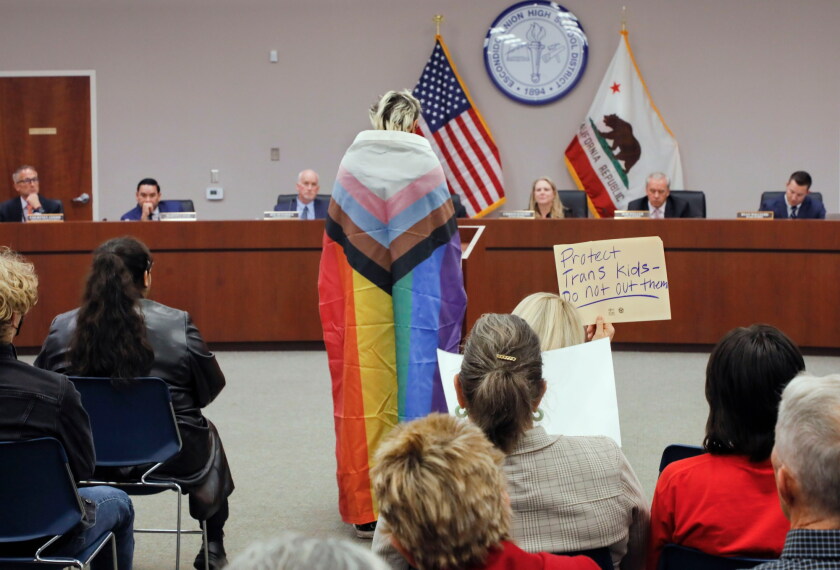
Teacher’s aide Amelia Mester, wrapped in a Pride flag, urges Escondido Union High School District not to have employees notify parents if they believe a student may be transgender in November 2025. A policy on the issue in the city’s elementary school district is the subject of a federal class-action lawsuit in which a judge just sided against the district.
Teacher’s aide Amelia Mester, wrapped in a Pride flag, urges Escondido Union High School District not to have employees notify parents if they believe a student may be transgender at a meeting in November 2025. Two parents and two teachers from the district sued in 2023, challenging California state guidance concerning student gender transitions and parental notification. The U.S. Supreme Court has now reinstated a lower-court decision overturning those state policies.
Charlie Neuman for The San Diego Union-Tribune/TNS
Law & Courts Appeals Court Allows Louisiana Ten Commandments Displays to Proceed
The court said it was premature to rule on the constitutionality of La. Ten Commandments displays.
3 min read
Students work under Ten Commandments and Bill of Rights posters on display in a classroom at Lehman High School in Kyle, Texas, Thursday, Oct. 16, 2025.
Students work under Ten Commandments and Bill of Rights posters on display in a classroom at Lehman High School in Kyle, Texas, Oct. 16, 2025. A federal appeals court has lifted a lower-court injunction blocking a Louisiana law that requires Ten Commandments displays, clearing the way for the law to take effect.
Eric Gay/AP
Law & Courts Social Media Companies Face Legal Reckoning Over Mental Health Harms to Children
Some of the biggest players from Meta to TikTok are getting a chance to make their case in courtrooms around the country.
6 min read
Social Media Kids Trial 26050035983057
Meta CEO Mark Zuckerberg leaves court after testifying in a landmark trial over whether social media platforms deliberately addict and harm children, on Feb. 18, 2026, in Los Angeles.
AP Photo/Damian Dovarganes
Law & Courts Supreme Court Strikes Trump Tariffs in Case Brought by Educational Toy Companies
Two educational toy companies were among the leading challengers to the president's tariff policies
3 min read
Members of the Supreme Court sit for a new group portrait following the addition of Associate Justice Ketanji Brown Jackson, at the Supreme Court building in Washington, Oct. 7, 2022. Bottom row, from left, Associate Justice Sonia Sotomayor, Associate Justice Clarence Thomas, Chief Justice of the United States John Roberts, Associate Justice Samuel Alito, and Associate Justice Elena Kagan. Top row, from left, Associate Justice Amy Coney Barrett, Associate Justice Neil Gorsuch, Associate Justice Brett Kavanaugh, and Associate Justice Ketanji Brown Jackson.
Members of the U.S. Supreme Court sit for a new group portrait following the addition of Justice Ketanji Brown Jackson, at the court building in Washington, Oct. 7, 2022. On Feb. 20, 2026, the court ruled 6-3 to strike down President Donald Trump's broad tariff policies, ruling that they were not authorized by the federal statute that he cited for them.
J. Scott Applewhite/AP
