Corrected: The print version of this article misstated Superintendent Clifford B. Janey’s remarks as reported in The Washington Post. He said his master education plan was an attempt to persuade more parents to keep their children in the public school system after the elementary grades, but he did not explicitly mention competition from charter schools.
An earlier version of this story cited an incorrect figure for the number of regular public schools in the District of Columbia that did not make adequate yearly progress under the No Child Left Behind Act for last school year.
A decade after the first charter schools opened in the nation’s capital, they have mushroomed into a major presence here, serving a larger segment of students than in almost any other city.
One in four public school students now lugs a book bag to a charter each weekday. If trends continue, a new report suggests, charters will serve more than half of Washington’s students by 2014.

But the massive charter experiment hasn’t exactly produced the sea change in the quality of public schooling that some advocates had hoped for. By many accounts, the charter landscape here is a mixed picture, and even advocates for the largely independent public schools are finding reasons to worry about low levels of student achievement in many charters.
“Currently, there are not enough high-quality public schools (district or charter) in the District of Columbia,” says the new study, issued this month by Fight for Children, a Washington advocacy group that has been supportive of charters. “Charter schools have produced a wide array of results: Some are among the highest-performing schools in the District, while too many others at the low end appear to be failing.”
“State of the District of Columbia Charter School Sector 2006: A Ten-Year Review” is available from the Washington-based group Fight for Children.
The study argues that charter authorizers should close more low-performing schools. At the same time, it calls for more supports to help struggling schools succeed.
“I think the D.C. charter industry—we’re beyond a movement now—has outgrown its infancy and is now in its awkward adolescence … with growth spurts and growing pains,” said Thomas A. Nida, the chairman of the District of Columbia’s Public Charter School Board, or PCSB, one of two charter authorizers in the city.
A ‘Strong’ Charter Law
The original District of Columbia charter law, passed by the Republican-controlled Congress, was signed in April 1996 by President Clinton. Charter proponents call the law one of the nation’s “strongest” because, for example, it hands the schools substantial operational and academic flexibility, provides local aid on an equitable basis with regular public schools, and allows multiple authorizers.
This school year, Washington has 55 charters on 69 campuses, the Fight for Children report says. The schools serve an estimated 19,000 students, compared with about 57,000 in regular public schools. Only New Orleans and Dayton, Ohio, have higher concentrations of charter schools.
The Public Charter School Board, an independent panel created under the charter law, oversees 37 schools, and the local board of education 18 schools. The latter recently, for the second time, voted to impose a moratorium on itself for approval of new charters. Board members said they need to study whether their charter duties detract from their ability to oversee the traditional school system.
The school board has faced criticism of the quality of its oversight. Matters haven’t been helped by an ongoing federal investigation into allegations of corruption involving the head of the school board’s charter office.
Diverse Group
Gauging charters’ academic performance is tricky. The District of Columbia lacks data to give a comprehensive picture of how well individual students are doing over time. Also, many experts suggest that lumping charters together for analysis has limited value, since the schools are so diverse. Some, for instance, target especially disadvantaged students, such as dropouts.
Overall, about three-quarters of the city’s charter students come from low-income families, compared with about 61 percent in the regular public schools.
A sample of average scale scores from the 2005 National Assessment of Educational Progress gives a snapshot of student performance in the District of Columbia.

SOURCE: Fight for Children
Results from the 2005 National Assessment of Educational Progress found District of Columbia charters scoring, on average, somewhat higher than the city’s regular public schools. Yet, charters fell well short of the nationwide average posted by public schools.
Data from the school district’s new Comprehensive Assessment System, first administered last spring, show that, on average, schools authorized by the Public Charter School Board had the highest levels of proficient students in reading and mathematics. The charters authorized by the district school board didn’t do as well, and fell short of students overall in the city’s regular public schools at the secondary level.
In secondary reading, 44 percent of students in PCSB charters were proficient or better, compared with 29 percent in regular public schools and 25 percent in charters overseen by the school board.
Meanwhile, the vast majority of the city’s charter schools did not make adequate yearly progress under the federal No Child Left Behind Act for last school year. Only four out of 34 eligible PCSB charters made AYP in reading and math, while one of 13 eligible schools authorized by the district school board made it. In the city’s regular public schools, 118 out of 146 did not make AYP.
Charter officials say those results were skewed by the use of the new assessment and other factors.
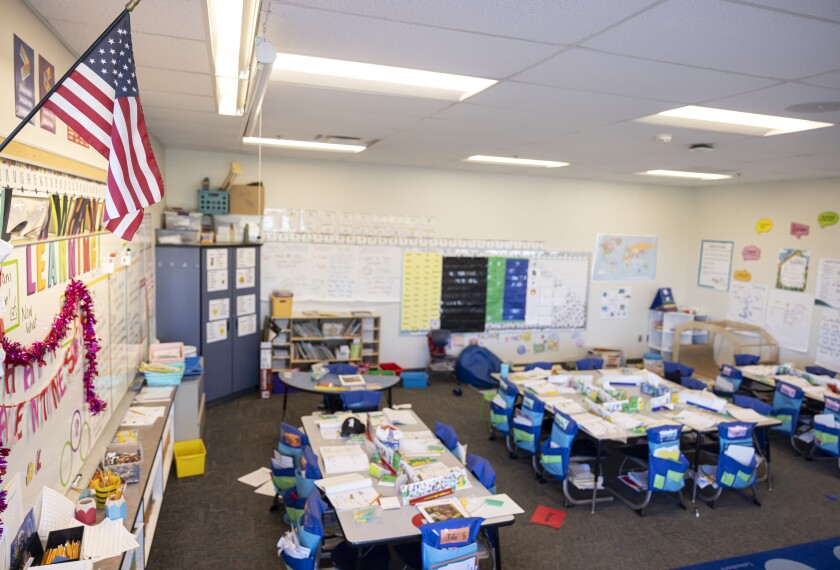
One local charter that’s seen as a high-quality school is D.C. Preparatory Academy, which opened in 2003. Operating out of a converted warehouse, it aims to ready its 250 students for college-preparatory high schools.
Almost all the students are African-American, and 58 percent come from low-income families. The school features an extended day, a strong focus on character education, and a rigorous, standards-driven curriculum. It also offers enrichment activities in such subjects as music, art, and dance.
Several parents offered enthusiastic reviews of their children’s experience at D.C. Prep.
A mother named Catina, who declined to provide her last name, said she likes the intensive focus on academics and discipline. Her daughter, an 8th grader, switched this year to D.C. Prep from a nearby regular public school.
“I think this is a better school for her,” she said. “The work is hard, but she’s getting the hang of it.”
Taloria P. Staples has two sons at D.C. Prep, one in his last year.
“I’m sad that he’s graduating this year,” Ms. Staples said. “I’m in the process of finding another competitive school [for high school].”
In one hallway, the school displays a board with literature about rigorous local high schools dedicated to helping students reach college, including some prestigious private schools. D.C. Prep recently hired a high school placement counselor to help families with their search, and with getting scholarship money.
Emily K. Lawson, the school’s founder and executive director, is worried that not enough charters in the city are doing well. “We as a movement have to show that we can create really high-quality schools,” she said.
Effect on System
To date, 12 Washington charters have been required to shut their doors, three this year. The Fight for Children report notes that most closure decisions have been based on nonacademic factors.
The D.C. Preparatory Academy emphasizes a strong academic program in addition to plenty of enrichment activities.

With charters now enjoying such a substantial market share here, the question of what impact they are having on the city school system is of growing interest. The most immediate is the loss of students, and school aid.
“Every child you lose is, frankly, money out the door for the children that remain in the traditional public schools,” said Iris J. Toyer, the chair of Parents United for D.C. Public Schools, an advocacy group.
Some see evidence that the District of Columbia system is responding to the competition.
“General Motors kept the fins on the Cadillac all the way to the point where the Japanese had 20 percent of the market share, then they redesigned,” said Malcolm E. Peabody, the founder and chairman of Friends of Choice in Urban Schools, a Washington advocacy group. “We are now at 24 percent of the market share, and the fins are coming off.”
He points to a new master education plan issued by Superintendent Clifford B. Janey earlier this year that outlines plans to provide new high school options, with five specialized schools. Mr. Peabody also noted that the superintendent recently negotiated with the local teachers’ union to gain added leeway in teacher hiring and pay rules for certain schools.
Mr. Janey could not be reached for this story, but The Washington Post recently reported that he said his plan was an attempt to persuade more parents to keep their children in the public school system after the elementary grades. At the same time, the paper has quoted him as calling for a moratorium on creating new charter schools. He has expressed alarm at the large number not making AYP, and suggested that the system should intervene.
Ultimately, a number of factors about the city’s charter realm “make it something of a bellweather in what does it actually look like to have charter schools at scale, what does it look like to have competition,” said Sara Mead, an analyst at Education Sector, a Washington think tank.
“It looks messy,” she said, “but it also looks exciting.”