Law & Courts

Ariz. Governor Signs Deal to Settle K-12 Suit

By The Associated Press — November 10, 2015 3 min read
  • Save to favorites
  • Print

Arizona Gov. Doug Ducey has signed legislation intended to pump $3.5 billion into K-12 education over the next decade to settle a long-running lawsuit stemming from the state’s decision to raid school spending during the Great Recession.

The deal still requires voter approval in a May 17 special election. Ducey said he will campaign to build public support.

Calling it a victory for Arizona schoolchildren, the Republican governor approved the legislation after it was passed Oct. 30 during a special legislative session that featured several emotionally charged exchanges over how to properly pay for public schools.

Recession-Era Cuts

Arizona is one of the most striking examples of states still dealing with the fallout from their decisions to slash education spending when the recession ravaged budgets during the last decade.

A voter-approved referendum in Arizona has long required lawmakers to provide annual inflation-based increases to K-12 education, but the legislature quit making the payments when the recession hit and decimated the housing and construction industries that had been the linchpin of the state economy.

Schools sued over the loss of the inflation funding, and the five-year legal case wound its way through the courts.

Schools say they are satisfied with the agreement, in which they are to receive about 70 percent of the cash they would have gotten if they had ultimately prevailed in the state supreme court.

The settlement cash would come from $1.4 billion in general fund money and $2 billion in state land trust proceeds.

“Together we’re sending a strong message about the value of public education in our state,” Ducey said before signing the bill as lawmakers, educators, and other supporters looked on. “To our teachers—we know your worth... With this plan, you’ll have the resources you’ve been asking for.”

Schools will receive $3.9 billion in the current budget year from the state general fund, including $3.4 billion in basic school aid. The bills approved Oct. 30 would add about $300 million a year to that total.

Democratic efforts to amend the bills in the Senate and the House, including removing language that will cap future school spending and changing how the plan was funded, were rejected by majority Republicans.

Ducey’s first-year budget left K-12 funding flat, and he and fellow Republicans faced vocal pressure in recent months from parents and voters who are becoming increasingly frustrated over education spending. A 2014 study by the Center for Budget and Policy Priorities found that Arizona’s per-student spending had fallen more than that of 47 other states since 2008, and funding remains 17 percent below pre-recession levels. The state is ranked 50th in per-student state funding for K-12 schools, according to U.S. Census Bureau figures from 2013.

Other states are dealing with similar situations.

In Washington state, the highest court ruled in 2012 that state funding for education was not adequate, and lawmakers there have been scrambling to come up with a solution ever since.

In August, state justices began fining the Washington legislature $100,000 a day. They said even though lawmakers had increased K-12 spending, they still weren’t setting aside enough money to educate the state’s 1 million schoolchildren—something they are required to do under the state constitution.

Washington state lawmakers have pledged to address the issue when the legislature convenes in January.

Funding Source

In Arizona, the deal would increase withdrawals from the state’s $5 billion permanent land trust from 2.5 percent a year to nearly 7 percent.

The land trust component that Ducey proposed in June as a separate way to get new money to schools became a key funding source for the settlement, providing 60 percent of the cash. The remaining $1.4 billion would come from the general fund.

Senate President Andy Biggs, a Republican, chided those who criticized the plan as insufficient.

“The reality is this is a sunny day, a day to be grateful to be an Arizonan,” he said.

School officials and Democratic lawmakers said the money marks a good start but much more needs to be done. They noted elections next month in which many school districts will ask voters to approve new bonds and budget-limit overrides.
A version of this article appeared in the November 11, 2015 edition of Education Week as Arizona Governor Signs Deal to Settle K-12 Funding Suit

Events

This content is provided by our sponsor. It is not written by and does not necessarily reflect the views of Education Week's editorial staff.
Sponsor
School Climate & Safety Webinar
Belonging as a Leadership Strategy for Today’s Schools
Belonging isn’t a slogan—it’s a leadership strategy. Learn what research shows actually works to improve attendance, culture, and learning.
Content provided by Harmony Academy
This content is provided by our sponsor. It is not written by and does not necessarily reflect the views of Education Week's editorial staff.
Sponsor
School & District Management Webinar
Too Many Initiatives, Not Enough Alignment: A Change Management Playbook for Leaders
Learn how leadership teams can increase alignment and evaluate every program, practice, and purchase against a clear strategic plan.
Content provided by Otus
This content is provided by our sponsor. It is not written by and does not necessarily reflect the views of Education Week's editorial staff.
Sponsor
Artificial Intelligence Webinar
Beyond Teacher Tools: Exploring AI for Student Success
Teacher AI tools only show assigned work. See how TrekAi's student-facing approach reveals authentic learning needs and drives real success.
Content provided by TrekAi

EdWeek Top School Jobs

Teacher Jobs
Search over ten thousand teaching jobs nationwide — elementary, middle, high school and more.
View Jobs
Principal Jobs
Find hundreds of jobs for principals, assistant principals, and other school leadership roles.
View Jobs
Administrator Jobs
Over a thousand district-level jobs: superintendents, directors, more.
View Jobs
Support Staff Jobs
Search thousands of jobs, from paraprofessionals to counselors and more.
View Jobs

Read Next

Law & Courts Supreme Court Backs Parents in School Gender Disclosure Fight
The Supreme Court restored an injunction blocking California policies on student gender transitions
8 min read
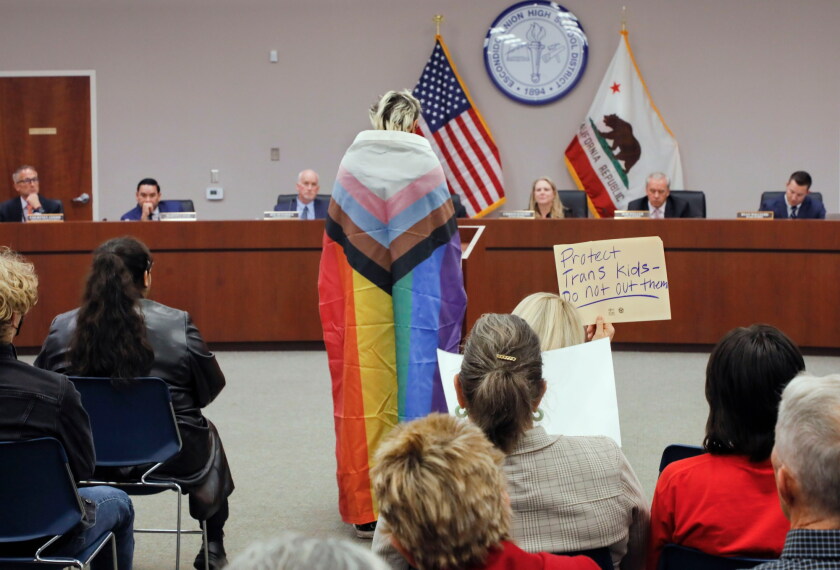
Teacher’s aide Amelia Mester, wrapped in a Pride flag, urges Escondido Union High School District not to have employees notify parents if they believe a student may be transgender in November 2025. A policy on the issue in the city’s elementary school district is the subject of a federal class-action lawsuit in which a judge just sided against the district.
Teacher’s aide Amelia Mester, wrapped in a Pride flag, urges Escondido Union High School District not to have employees notify parents if they believe a student may be transgender at a meeting in November 2025. Two parents and two teachers from the district sued in 2023, challenging California state guidance concerning student gender transitions and parental notification. The U.S. Supreme Court has now reinstated a lower-court decision overturning those state policies.
Charlie Neuman for The San Diego Union-Tribune/TNS
Law & Courts Appeals Court Allows Louisiana Ten Commandments Displays to Proceed
The court said it was premature to rule on the constitutionality of La. Ten Commandments displays.
3 min read
Students work under Ten Commandments and Bill of Rights posters on display in a classroom at Lehman High School in Kyle, Texas, Thursday, Oct. 16, 2025.
Students work under Ten Commandments and Bill of Rights posters on display in a classroom at Lehman High School in Kyle, Texas, Oct. 16, 2025. A federal appeals court has lifted a lower-court injunction blocking a Louisiana law that requires Ten Commandments displays, clearing the way for the law to take effect.
Eric Gay/AP
Law & Courts Social Media Companies Face Legal Reckoning Over Mental Health Harms to Children
Some of the biggest players from Meta to TikTok are getting a chance to make their case in courtrooms around the country.
6 min read
Social Media Kids Trial 26050035983057
Meta CEO Mark Zuckerberg leaves court after testifying in a landmark trial over whether social media platforms deliberately addict and harm children, on Feb. 18, 2026, in Los Angeles.
AP Photo/Damian Dovarganes
Law & Courts Supreme Court Strikes Trump Tariffs in Case Brought by Educational Toy Companies
Two educational toy companies were among the leading challengers to the president's tariff policies
3 min read
Members of the Supreme Court sit for a new group portrait following the addition of Associate Justice Ketanji Brown Jackson, at the Supreme Court building in Washington, Oct. 7, 2022. Bottom row, from left, Associate Justice Sonia Sotomayor, Associate Justice Clarence Thomas, Chief Justice of the United States John Roberts, Associate Justice Samuel Alito, and Associate Justice Elena Kagan. Top row, from left, Associate Justice Amy Coney Barrett, Associate Justice Neil Gorsuch, Associate Justice Brett Kavanaugh, and Associate Justice Ketanji Brown Jackson.
Members of the U.S. Supreme Court sit for a new group portrait following the addition of Justice Ketanji Brown Jackson, at the court building in Washington, Oct. 7, 2022. On Feb. 20, 2026, the court ruled 6-3 to strike down President Donald Trump's broad tariff policies, ruling that they were not authorized by the federal statute that he cited for them.
J. Scott Applewhite/AP
