Law & Courts

Alabama Court Refrains From Ordering Equity Remedy

By Erik W. Robelen — June 12, 2002 3 min read
  • Save to favorites
  • Print

Alabama students have a constitutional right to an adequate and equitable education. But don’t expect the state’s court system to make sure they get one.

That is the upshot of a recent ruling by the Alabama Supreme Court on a long- standing lawsuit brought by a coalition of poor school systems.

“Because the duty to fund Alabama’s public schools is a duty that—for over 125 years—the people of this state have rested squarely upon the shoulders of the legislature, it is the legislature, not the courts, from which any further redress should be sought,” the court declared in a 7-1 decision issued May 31.

Warren Craig Pouncey, the superintendent of the 2,400-student Crenshaw County school system, a party to the lawsuit, accused the court of avoiding its responsibility to take action.

“It’s going to mean that there will be a continued widening of the disparity of educational opportunity in this state,” he said. “Only those areas with taxing capacity can provide kids with the things they need to be competitive in this global economy.”

“The Alabama Supreme Court has in effect held that you’ve got an unconstitutional system, but the judges have no authority to order a remedy,” said C.C. “Bo” Torbert, who was the lead attorney when the lawsuit began but no longer is directly involved.

But Alabama Attorney General Bill Pryor praised the decision.

“I am pleased that a substantial majority of the Supreme Court of Alabama today adopted the entire argument I made in this case,” he said in a statement. “This ruling is both conservative and proper.”

‘Separation of Powers’

In 1993, Montgomery Circuit Judge Gene Reese ruled that the state’s constitution requires schools to be adequately and equitably funded. The supreme court, asked by the legislature to offer an advisory opinion on the circuit court decision, affirmed the ruling later in 1993 and never reversed that position in later rulings related to the case. The circuit court has since been working with the state on a plan to ensure state public schools provide an adequate education to all students.

But with a new set of justices, the state supreme court decided to revisit the case this year. While last month’s decision did not overturn the 1993 finding on Alabama’s education system, the court made clear that it cannot compel action.

“In Alabama, separation of powers is not merely an implicit ‘doctrine’ but rather an express command; a command stated with a forcefulness rivaled by few, if any, similar provisions in constitutions of other sovereigns,” the court said.

Justice Douglas Johnstone, the court’s lone Democrat, wrote the only dissent. He argued that as the high court had not been asked to review the equity-funding lawsuit since 1998, the time limit had expired for the court to reconsider the lower court’s efforts to seek a remedy.

Joe Morton, Alabama’s deputy superintendent of education, said the ruling would make it harder to enact a plan the department has developed to ensure an adequate education for all Alabama students. That plan, if fully implemented, would cost an additional $1.6 billion per year, he said.

Bad Timing

Tight fiscal times in Alabama have created a strain on public schools there. In fact, last school year, the state imposed across-the-board cuts on K-12 education. While no such cuts are expected this year, spending on K-12 education has remained about the same except for a 3 percent teacher pay raise approved this year. Total state spending on education in fiscal 2003 will be about $3 billion.

The state’s plan would not simply involve extra state money. “The [tax-generating] effort has to be raised in many locales, but once that’s done, we have to step in and finish the job,” Mr. Morton said. “There is an opportunity and a need for higher tax effort at the local level, but a very economically stagnant or poor county could raise its effort but still not have much new money, because there’s not much to tax.”

John G. Augenblick, a school finance expert in Denver, said that courts in many states have intervened to compel school finance changes.

“Most say, ‘We will not tell you what to do, but we will tell you to do something,’” Mr. Augenblick said. “Over the last 30 years, half the states in this country have modified the way they allocate money in part because they’ve been required to do that [by the courts].”

A version of this article appeared in the June 12, 2002 edition of Education Week as Alabama Court Refrains From Ordering Equity Remedy

Events

This content is provided by our sponsor. It is not written by and does not necessarily reflect the views of Education Week's editorial staff.
Sponsor
Artificial Intelligence Webinar
AI in Schools: What 1,000 Districts Reveal About Readiness and Risk
Move beyond “ban vs. embrace” with real-world AI data and practical guidance for a balanced, responsible district policy.
Content provided by Securly
This content is provided by our sponsor. It is not written by and does not necessarily reflect the views of Education Week's editorial staff.
Sponsor
Recruitment & Retention Webinar
K-12 Lens 2026: What New Staffing Data Reveals About District Operations
Explore national survey findings and hear how districts are navigating staffing changes that affect daily operations, workload, and planning.
Content provided by Frontline Education
Education Funding Webinar Congress Approved Next Year’s Federal School Funding. What’s Next?
Congress passed the budget, but uncertainty remains. Experts explain what districts should expect from federal education policy next.

EdWeek Top School Jobs

Teacher Jobs
Search over ten thousand teaching jobs nationwide — elementary, middle, high school and more.
View Jobs
Principal Jobs
Find hundreds of jobs for principals, assistant principals, and other school leadership roles.
View Jobs
Administrator Jobs
Over a thousand district-level jobs: superintendents, directors, more.
View Jobs
Support Staff Jobs
Search thousands of jobs, from paraprofessionals to counselors and more.
View Jobs

Read Next

Law & Courts Supreme Court’s Gender Identity Ruling Leaves Schools Seeking Clarity
Advocates say they would welcome more from the Supreme Court on gender-notification policies.
7 min read
The Supreme Court is photographed, Friday, Feb. 27, 2026, in Washington.
The Supreme Court is photographed, Friday, Feb. 27, 2026, in Washington. The high court recently ruled that California policies that sometimes limit or discourage schools from disclosing information to parents about children’s gender transitions and expressions at school likely violate parents’ constitutional rights
Rahmat Gul/AP
Law & Courts Supreme Court Backs Parents in School Gender Disclosure Fight
The Supreme Court restored an injunction blocking California policies on student gender transitions
8 min read
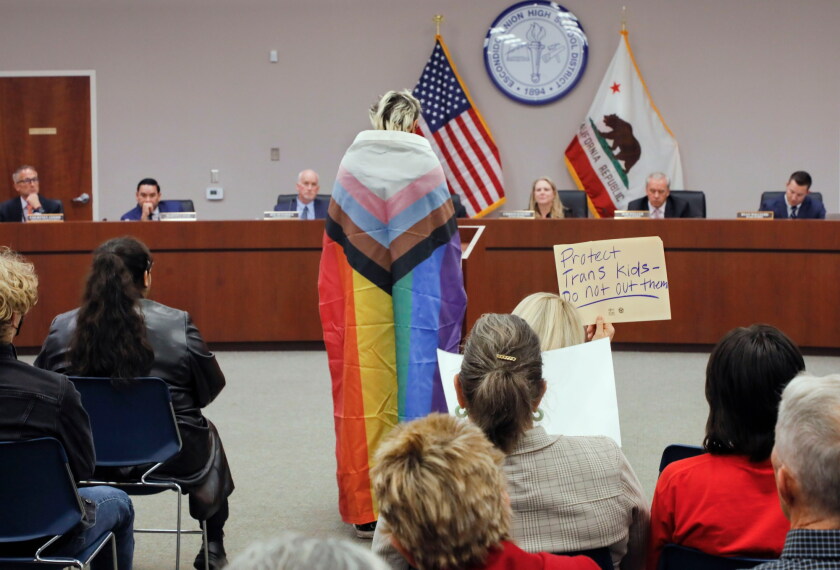
Teacher’s aide Amelia Mester, wrapped in a Pride flag, urges Escondido Union High School District not to have employees notify parents if they believe a student may be transgender in November 2025. A policy on the issue in the city’s elementary school district is the subject of a federal class-action lawsuit in which a judge just sided against the district.
Teacher’s aide Amelia Mester, wrapped in a Pride flag, urges Escondido Union High School District not to have employees notify parents if they believe a student may be transgender at a meeting in November 2025. Two parents and two teachers from the district sued in 2023, challenging California state guidance concerning student gender transitions and parental notification. The U.S. Supreme Court has now reinstated a lower-court decision overturning those state policies.
Charlie Neuman for The San Diego Union-Tribune/TNS
Law & Courts Appeals Court Allows Louisiana Ten Commandments Displays to Proceed
The court said it was premature to rule on the constitutionality of La. Ten Commandments displays.
3 min read
Students work under Ten Commandments and Bill of Rights posters on display in a classroom at Lehman High School in Kyle, Texas, Thursday, Oct. 16, 2025.
Students work under Ten Commandments and Bill of Rights posters on display in a classroom at Lehman High School in Kyle, Texas, Oct. 16, 2025. A federal appeals court has lifted a lower-court injunction blocking a Louisiana law that requires Ten Commandments displays, clearing the way for the law to take effect.
Eric Gay/AP
Law & Courts Social Media Companies Face Legal Reckoning Over Mental Health Harms to Children
Some of the biggest players from Meta to TikTok are getting a chance to make their case in courtrooms around the country.
6 min read
Social Media Kids Trial 26050035983057
Meta CEO Mark Zuckerberg leaves court after testifying in a landmark trial over whether social media platforms deliberately addict and harm children, on Feb. 18, 2026, in Los Angeles.
AP Photo/Damian Dovarganes
