School & District Management

Women Superintendents Experience Bias on the Climb to Leadership

By Evie Blad — March 22, 2024 3 min read
Woman stands in front of a staircase in different colors. She is about to walk up the stairs. Concept of standing in front of a challenge and finding the right solution and courage to move on.
  • Save to favorites
  • Print

Women in educational leadership report a range of biases—ranging from interpersonal slights and structural inequities—that make it difficult to attain and persist in top positions.

That’s the key finding of a survey of women superintendents, central office leaders, and state education officials released this week by Women Leading Ed, a network of superintendents committed to expanding the ranks of women leaders.

“Even when women are in the same spaces as men, they still are not playing the same game as men,” said CEO Julia Rafal-Baer.

To arrive at its findings, the organization surveyed 110 women in those leadership roles between November 2023 and January 2024 to ask them about their experiences and perceptions at work.

Among the key findings:

  • Fifty-seven percent of respondents said they have been passed over for career advancement opportunities that were offered to male colleagues.
  • Fifty-three percent of respondents said they believed their gender influenced the outcome of salary negotiations.

A steeper path to leadership

It will take intentional changes in culture and policies to ensure more women take leadership roles in education systems, Rafal-Baer said.

Previous findings show that, while the number of women in educational leadership is growing, men are still far more likely to land the roles than women.

In a September 2023 analysis, the ILO Group, a consulting group also led by Rafal-Baer, collected data about the superintendents of the 500 largest school systems dating back to 2018. In July 2023, women led 152 of those districts, compared to 139 in 2018, the organization found. The data suggested those large systems were slightly more likely to be female-led than districts nationally.

The gender imbalance is particularly notable because 77 percent of teachers are women, the latest federal data show.

Teachers and administrator talking outside school building.
E+ / Getty

Women are also more likely to be offered superintendent roles as internal candidates and more likely to first take the job on an interim basis, suggesting they often step into the role at tumultuous times, the group found. Rafal-Baer calls the pattern “the glass cliff.”

Bias compounds the challenges women educators face in advancing their careers, she said.

Concerns about work-life balance: 95 percent of respondents said they “believe that they have to make sacrifices that their male colleagues do not in their professional life.”

“My male counterparts are viewed as being quality role models when they choose to put family engagements above work responsibilities, but I am often pressured not to do the same,” an unnamed leader wrote in response to the survey.

Unfair expectations about appearance and behavior: 82 percent of respondents reported “external pressure to dress, speak, or behave a certain way because they are women.”

“In preparation for a presentation, I was told that I shouldn’t wear pants, I should wear a skirt so that I don’t come off as intimidating,” an unnamed district superintendent wrote.

Bias that affects career persistence: 59 percent of respondents reported that they considered leaving their jobs because of “stress and strain.”

A path forward for women leaders

More than 700 educational leaders, male and female, have signed an open letter in support of recommendations that Women Leading Ed has proposed to promote a equitable hiring processes and to better support leaders when they fill those positions.

Those recommendations include ensuring gender-diverse pools of candidates for leadership roles; setting clear, measurable goals that define success for leaders; job coaching; and comprehensive family leave policies.

At an April conference, Women Leading Ed will work with its members to design a model superintendent contract that addresses structural barriers. That may include measures like protected hours, when leaders know they can focus on family matters rather than responding to non-emergency requests, Rafal-Baer said.

Because 80 percent of respondents reported they had no training in negotiations, the event will also focus on developing members’ skills in negotiating their pay, forging agreements with vendors, and weighing the regular decisions they face on a day-to-day basis.

Events

This content is provided by our sponsor. It is not written by and does not necessarily reflect the views of Education Week's editorial staff.
Sponsor
Artificial Intelligence Webinar
Managing AI in Schools: Practical Strategies for Districts
How should districts govern AI in schools? Learn practical strategies for policies, safety, transparency, as well as responsible adoption.
Content provided by Lightspeed Systems
This content is provided by our sponsor. It is not written by and does not necessarily reflect the views of Education Week's editorial staff.
Sponsor
Reading & Literacy Webinar
Unlocking Success for Struggling Adolescent Readers
The Science of Reading transformed K-3 literacy. Now it's time to extend that focus to students in grades 6 through 12.
Content provided by STARI
Jobs Virtual Career Fair for Teachers and K-12 Staff
Find teaching jobs and K-12 education jubs at the EdWeek Top School Jobs virtual career fair.

EdWeek Top School Jobs

Teacher Jobs
Search over ten thousand teaching jobs nationwide — elementary, middle, high school and more.
View Jobs
Principal Jobs
Find hundreds of jobs for principals, assistant principals, and other school leadership roles.
View Jobs
Administrator Jobs
Over a thousand district-level jobs: superintendents, directors, more.
View Jobs
Support Staff Jobs
Search thousands of jobs, from paraprofessionals to counselors and more.
View Jobs

Read Next

School & District Management Five Snow Day Announcements That Broke the Internet (Almost)
Superintendents rapped, danced, and cheered for the home team's playoff success as they announced snow days.
Three different screenshots of videos from superintendents' creative announcements for a school snow day. Clockwise from left: Montgomery County Public Schools via YouTube, Terry J. Dade via X, Old Colony Regional Vocational Technical High School via Facebook
Gone are the days of kids sitting in front of the TV waiting for their district's name to flash across the screen announcing a snow day. Here are some of our favorite announcements from superintendents who had fun with one of the most visible aspects of their job.
Clockwise from left: Montgomery County Public Schools via YouTube, Terry J. Dade via X, Old Colony Regional Vocational Technical High School via Facebook
School & District Management A Cold Front Is Sweeping the Country. Can Schools' Heating Keep Up?
A spate of frigid temperatures across much of the country will present a test for schools' aging heating systems.
5 min read
20260122 AMX US NEWS CPS CANCELS CLASS FRIDAY DUE 1 TB
A crossing guard assists students as they arrive for classes at Chalmers STEAM Elementary school on Jan. 22, 2026, in Chicago. Extreme cold hitting much of the United States in the coming days could test schools' aging infrastructure and force school closures. Chicago Public Schools called off classes for Friday, Jan. 23.
Antonio Perez/ Chicago Tribune
School & District Management How Principals Are Coaching the Next Generation of School Leaders
Mentors give aspiring school leaders an unvarnished view of the principalship.
6 min read
Photo of school officials having conversation.
iStock
School & District Management How 4 Superintendents Are Bracing for Federal Funding Uncertainty Under Trump
Superintendent of the Year finalists discussed how they're preparing for potential cuts.
3 min read
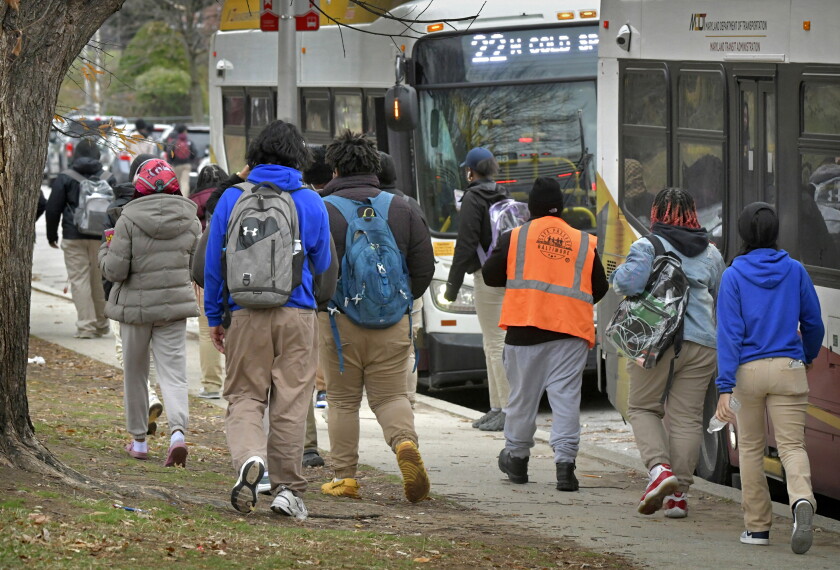
Students at Merganthaler Vocational-Technical High School board MTA buses at the end of the school day on Dec. 13, 2024 , in Baltimore. federally funded programs allows students to access resources they might otherwise not get—like tutoring and after-school programs, according to Baltimore Superintendent Sonja Santelises.
Students at Merganthaler Vocational-Technical High School board buses at the end of the school day on Dec. 13, 2024 , in Baltimore. Federally funded programs in the city's schools allow students access to services they might otherwise not get, such as tutoring and after-school programs, Baltimore Superintendent Sonja Santelises said at a recent panel discussion of the finalists for AASA's Superintendent of the Year award.
Amy Davis/Baltimore Sun/TNS