Student Well-Being & Movement

Surfing Approved as Hawaii’s Newest School Sport

By Linda Jacobson — June 09, 2004 3 min read
  • Save to favorites
  • Print

From now on, when Hawaii’s high school students grab their surfboards and head for Oahu’s North Shore—or other surfing destinations throughout the state—they might be doing so as the Kahuku High Red Raiders or the Na Ali’i team from King Kekaulike High School.

For the first time, perhaps as soon as next spring, public schools in Hawaii will be allowed to have official surfing teams. Currently, students are allowed to compete only as members of surfing clubs.

After a lobbying effort by high school students and supporters of surfing teams that stretched over several years, the Hawaii state board of education voted unanimously late last month to approve the sport.

“The interest is definitely there,” said Kim Ball, who owns Hi-Tech Surf Sports on Maui and runs an interscholastic surf competition. “It’s part of our fabric here.”

But the state board’s decision does not come with money, and it doesn’t resolve some of the issues that kept board members from allowing official teams in the first place in Hawaii’s statewide system.

According to Greg Knudsen, a spokesman for the Hawaii Department of Education, estimates on the cost of having school surfing teams reach as high as $2.3 million statewide. Such costs might include safety personnel, and expenses for transportation to practices and competitions.

“You don’t just run out to the field after school,” Mr. Knudsen said. “It would be a major commute.”

In the past, the state attorney general’s office held that the state education department would not be protected from lawsuits in the event of an injury, but has since changed that position.

“With proper precautions, they see that it could work,” Mr. Knudsen said. The education department, he added, will now be required to write regulations for the sport, though no deadline has been set.

Even though Hawaii is considered the birthplace of surfing—or “wave sliding,” as it is known in the Hawaiian language—those who oppose the approval of surfing as a high school sport have expressed concerns over schools’ liability if students are injured.

Some See Perils

The Oahu Interscholastic Association, an athletic league with 24 member schools on the state’s most populated island, did not take an official position on the issue, though local school athletic directors are among those most concerned about the dangers of the sport.

The risks, they say, include shark attacks, rough waves, and collisions with other surfers.

But Mr. Ball said practice in the water could be limited to twice a week, thus reducing such concerns. Other practice sessions could be spent swimming in a pool or working out with weights.

Mr. Ball added that the state board’s decision was just one hurdle to overcome, and that “we still have a long way to go.”

“Now we have to lobby each school individually,” he said.

The decision whether to have a surfing team will be up to individual high schools and leagues. The first step, Mr. Knudsen said, will probably be to allow students participating in surf clubs to “adopt their school affiliation.”

The question of whether there will be a state surfing championship also won’t be settled until it’s determined which schools and leagues have teams.

According to a statement released by the Hawaii High School Athletic Association, which has 78 public and private high schools as members, three of the state’s five leagues must sponsor a sport before a championship competition is held.

In addition, each of the five leagues requires three member schools to have a team before the league sanctions the sport.

Until then, “it would be premature to discuss an HHSAA state championship” in surfing, Keith Amemiya, the executive director of the association, said in the statement.

The most recent state championship approved by the organization was for girls’ water polo, which had its first such championship just last month.
A version of this article appeared in the June 09, 2004 edition of Education Week as Surfing Approved as Hawaii’s Newest School Sport

Events

This content is provided by our sponsor. It is not written by and does not necessarily reflect the views of Education Week's editorial staff.
Sponsor
Artificial Intelligence Webinar
Managing AI in Schools: Practical Strategies for Districts
How should districts govern AI in schools? Learn practical strategies for policies, safety, transparency, and responsible adoption.
Content provided by Lightspeed Systems
This content is provided by our sponsor. It is not written by and does not necessarily reflect the views of Education Week's editorial staff.
Sponsor
Student Absenteeism Webinar
Removing Transportation and Attendance Barriers for Homeless Youth
Join us to see how districts around the country are supporting vulnerable students, including those covered under the McKinney–Vento Act.
Content provided by HopSkipDrive
This content is provided by our sponsor. It is not written by and does not necessarily reflect the views of Education Week's editorial staff.
Sponsor
Reading & Literacy Webinar
Two Jobs, One Classroom: Strengthening Decoding While Teaching Grade-Level Text
Discover practical, research-informed practices that drive real reading growth without sacrificing grade-level learning.
Content provided by EPS Learning

EdWeek Top School Jobs

Teacher Jobs
Search over ten thousand teaching jobs nationwide — elementary, middle, high school and more.
View Jobs
Principal Jobs
Find hundreds of jobs for principals, assistant principals, and other school leadership roles.
View Jobs
Administrator Jobs
Over a thousand district-level jobs: superintendents, directors, more.
View Jobs
Support Staff Jobs
Search thousands of jobs, from paraprofessionals to counselors and more.
View Jobs

Read Next

Student Well-Being & Movement 3 Driving Questions to Create a Sense of Belonging in Schools
Students who feel they belong in their school are more likely to show up and learn.
5 min read
MVCS 1981
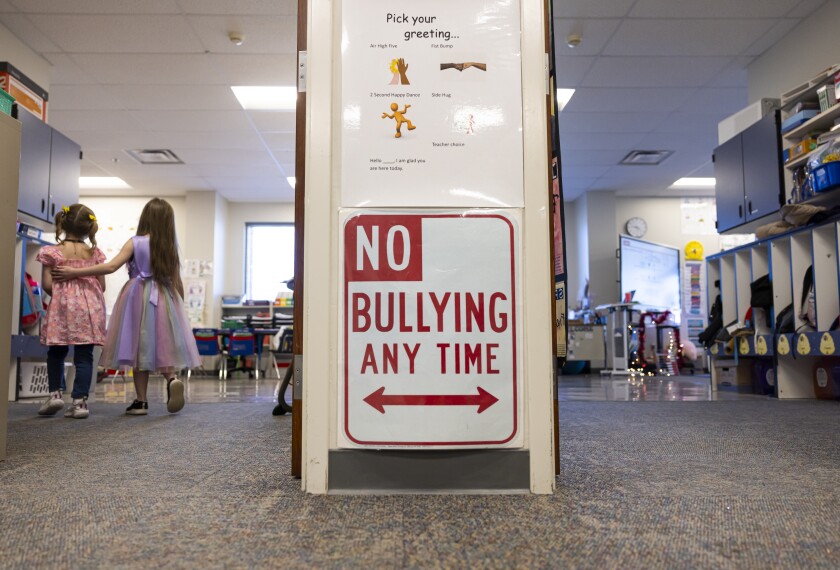
A sign discouraging bullying is seen as two students walk into a classroom at a school in Colorado Springs, Colo., on Feb. 12, 2026. Experts say creating a sense of belonging in school can help curb problems like bullying.
Kevin Mohatt for Education Week
Student Well-Being & Movement Opinion Why a Good School Needs Both Coaches and Referees
If teachers are forced into being referees, they can't fill that role properly or coach well, either.
6 min read
The United States Capitol building as a bookcase filled with red, white, and blue policy books in a Washington DC landscape.
Luca D'Urbino for Education Week
Student Well-Being & Movement Q&A Cellphones: The 'Most Formidable Adversary' Schools Have Ever Faced
The Spokane schools in Washington paired cellphone restrictions with expanded extracurricular activities.
5 min read
Students at Glover Middle School in Spokane, Wash. make bookmarks and snowflakes during Falcon Time on Dec. 3, 2025.
Students at Glover Middle School in Spokane, Wash. make bookmarks and snowflakes during Falcon Time on Dec. 3, 2025. The district has sought to encourage students to spend less time on devices.
Kaylee Domzalski/Education Week
Student Well-Being & Movement Want Kids to Have Better SEL Skills? Try Using Sports
In a panel discussion, district leaders and an expert discuss why sports is a great place to learn life skills.
3 min read
Students play basketball at Parkway Sports & Health Science Academy on Feb. 21, 2025 in La Mesa, Calif.
Students playing basketball at Parkway Sports & Health Science Academy on Feb. 21, 2025, in La Mesa, Calif. Some schools are using sports as a way to help students develop social-emotional skills.
Ariana Drehsler for Education Week
