Student Well-Being & Movement

Sports Illustrated Joins Programs to Address Steroid Use, Nutrition

By Laura Greifner — February 14, 2006 3 min read
  • Save to favorites
  • Print

Officials from Sports Illustrated announced last week that the magazine will join forces with two Oregon-based programs that discourage steroid and drug use by adolescent males and promote healthier lifestyles among young women.

As part of the partnership, which was announced here Feb. 8 at the National Press Club, Sports Illustrated awarded the Oregon Health and Science University a grant and space for public-service announcements in the magazine, worth $1 million.

The award will help the Portland, Ore., university promote the programs Athletes Training and Learning to Avoid Steroids, or ATLAS, and Athletes Targeting Healthy Exercise and Nutrition Alternatives, or ATHENA.

A new Web site called SI Schools will also be created as part of the partnership and will feature information on exercise and drug-abuse prevention, officials from the magazine added.

Sen. Joseph R. Biden Jr., D-Del., center, fields questions during a Feb. 8 news briefing about efforts to curb steroid use. Mr. Biden appears with Scott Burns, the deputy director of the White House Office of National Drug Control Policy, at left, and U.S. Secretary of Education Margaret Spellings.

“This is a critical issue that we absolutely must address,” said U.S. Secretary of Education Margaret Spellings, who was on hand to endorse the effort. “Real competitiveness starts with education. Students are unlikely to be successful in that endeavor if they’re not healthy.”

Based on recent information from the federal Centers for Disease Control and Prevention, between 500,000 and 850,000 high school students have admitted using steroids. From 1993 to 2003, the proportion of students who reported having used steroids increased from 1 in 45 to 1 in 16, according to the CDC.

Anabolic steroids can be injected or taken orally and are illegal without a prescription. They can bring rapid muscle growth, but also can damage the heart, kidneys, and liver, and cause other problems.

Model Programs

The ATLAS and ATHENA programs were developed by Dr. Linn Goldberg and Dr. Diane Elliot, both professors of medicine at OHSU, and funded through research grants from the National Institute on Drug Abuse.

ATLAS was created in 1993 for boys in middle and high school. The program targets alcohol use, illicit drug use, and the use of anabolic steroids and other sports supplements. Dr. Goldberg said the program has been shown to reduce combined drug and alcohol use by 50 percent, new anabolic-steroid use by 50 percent, and occurrences of drinking and driving by 24 percent.

“People think they can get bigger and stronger faster, be on the first team, get a college scholarship—there’s a lot of money and a lot of opportunity,” he said at the event.

ATHENA, which is aimed at girls in middle and high school, focuses on reducing eating disorders and the use of diet pills, and on promoting good nutrition and exercise. Students who participated in ATHENA showed a significant reduction in the use of marijuana, alcohol, and diet pills one to three years after high school compared to girls not in the program, according to Dr. Goldberg.

The programs are presented to individual school sports teams, and are led by student-athletes and facilitated by coaches. The programs, which organizers say have been used by more than 60 schools across the country, were named “model programs” by the U.S. Department of Health and Human Services.

ATLAS is 10 sessions long and ATHENA involves eight, but both have five-session “boosters” in the following years.

Congress included both programs in the Anabolic Steroid Act of 2004, which authorized $15 million a year from 2005 to 2010 for research and education related to steroid-abuse prevention, but the act was never funded.

Sens. John McCain, R-Ariz., and Joseph R. Biden Jr., D- Del., pushed the legislation and attended last week’s announcement.

“We’ve got to actually appropriate the money,” Sen. Biden said. “It’s not just about health. … This is about honor. That’s the purpose of sport.”
Events

This content is provided by our sponsor. It is not written by and does not necessarily reflect the views of Education Week's editorial staff.
Sponsor
Artificial Intelligence Webinar
Managing AI in Schools: Practical Strategies for Districts
How should districts govern AI in schools? Learn practical strategies for policies, safety, transparency, as well as responsible adoption.
Content provided by Lightspeed Systems
This content is provided by our sponsor. It is not written by and does not necessarily reflect the views of Education Week's editorial staff.
Sponsor
Reading & Literacy Webinar
Unlocking Success for Struggling Adolescent Readers
The Science of Reading transformed K-3 literacy. Now it's time to extend that focus to students in grades 6 through 12.
Content provided by STARI
Jobs Virtual Career Fair for Teachers and K-12 Staff
Find teaching jobs and K-12 education jubs at the EdWeek Top School Jobs virtual career fair.

EdWeek Top School Jobs

Teacher Jobs
Search over ten thousand teaching jobs nationwide — elementary, middle, high school and more.
View Jobs
Principal Jobs
Find hundreds of jobs for principals, assistant principals, and other school leadership roles.
View Jobs
Administrator Jobs
Over a thousand district-level jobs: superintendents, directors, more.
View Jobs
Support Staff Jobs
Search thousands of jobs, from paraprofessionals to counselors and more.
View Jobs

Read Next

Student Well-Being & Movement 3 Driving Questions to Create a Sense of Belonging in Schools
Students who feel they belong in their school are more likely to show up and learn.
5 min read
MVCS 1981
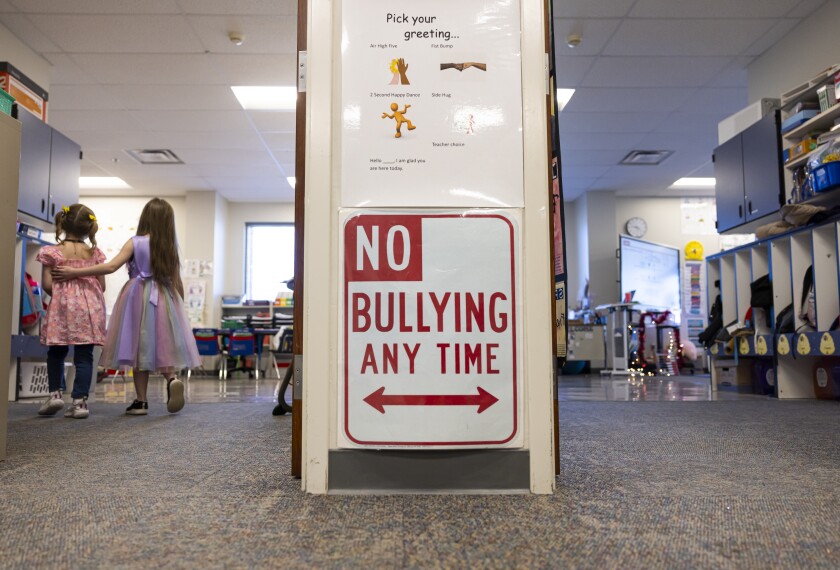
A sign discouraging bullying is seen as two students walk into a classroom at a school in Colorado Springs, Colo., on Feb. 12, 2026. Experts say creating a sense of belonging in school can help curb problems like bullying.
Kevin Mohatt for Education Week
Student Well-Being & Movement Opinion Why a Good School Needs Both Coaches and Referees
If teachers are forced into being referees, they can't fill that role properly or coach well, either.
6 min read
The United States Capitol building as a bookcase filled with red, white, and blue policy books in a Washington DC landscape.
Luca D'Urbino for Education Week
Student Well-Being & Movement Q&A Cellphones: The 'Most Formidable Adversary' Schools Have Ever Faced
The Spokane schools in Washington paired cellphone restrictions with expanded extracurricular activities.
5 min read
Students at Glover Middle School in Spokane, Wash. make bookmarks and snowflakes during Falcon Time on Dec. 3, 2025.
Students at Glover Middle School in Spokane, Wash. make bookmarks and snowflakes during Falcon Time on Dec. 3, 2025. The district has sought to encourage students to spend less time on devices.
Kaylee Domzalski/Education Week
Student Well-Being & Movement Want Kids to Have Better SEL Skills? Try Using Sports
In a panel discussion, district leaders and an expert discuss why sports is a great place to learn life skills.
3 min read
Students play basketball at Parkway Sports & Health Science Academy on Feb. 21, 2025 in La Mesa, Calif.
Students playing basketball at Parkway Sports & Health Science Academy on Feb. 21, 2025, in La Mesa, Calif. Some schools are using sports as a way to help students develop social-emotional skills.
Ariana Drehsler for Education Week
