Student Achievement

Southern States Make Progress on Some Education Goals

June 30, 2010 1 min read
  • Save to favorites
  • Print

Gathered in West Virginia for their annual confab, officials with the Southern Regional Education Board are releasing a series of reports today on the progress of their member states on four key goals: ensuring readiness for learning, raising achievement and closing gaps, preparing all students for college and careers, and improving college completion rates.

All 16 member states—from Texas to Delaware—get an in-depth review on those metrics and the reports show mixed results. (Gratuitious aside: One of my favorite colleagues here at EdWeek always jokes that we should rename the paper “Mixed Results” because we write about so many reports with those sorts of conclusions).

Overall, the states show favorable progress on indicators such as improving access to prekindergarten and narrowing achievement gaps, but all of them could gain from crafting policies to make sure kids can actually get into college, and perhaps even more vexing, earn a degree, according to the report.

It’s interesting to look at a state like Florida—which is generally viewed as one of the most aggressive states when it comes to K-12 reforms—and see that its high school graduates enroll in college at a rate of 54 percent, trailing the national average of 63 percent and the SREB-member states’ average of 62 percent. When it comes to college completion, though, Florida does better than the nation and the southern region, with a 59 percent six-year graduation rate for first-time freshmen who enrolled in 2002.

These reports are worthy of cover-to-cover reads—they are jam-packed with great data and descriptions of the states—and are based on SREB’s 2002 adoption of the Challenge to Lead agenda. Also, be sure to take a look at this other new report from SREB and the National Center for Public Policy and Higher Education that outlines policies that states should adopt to increase college readiness.
A version of this news article first appeared in the State EdWatch blog.

Events

This content is provided by our sponsor. It is not written by and does not necessarily reflect the views of Education Week's editorial staff.
Sponsor
Artificial Intelligence Webinar
AI in Schools: What 1,000 Districts Reveal About Readiness and Risk
Move beyond “ban vs. embrace” with real-world AI data and practical guidance for a balanced, responsible district policy.
Content provided by Securly
This content is provided by our sponsor. It is not written by and does not necessarily reflect the views of Education Week's editorial staff.
Sponsor
Recruitment & Retention Webinar
K-12 Lens 2026: What New Staffing Data Reveals About District Operations
Explore national survey findings and hear how districts are navigating staffing changes that affect daily operations, workload, and planning.
Content provided by Frontline Education
Education Funding Webinar Congress Approved Next Year’s Federal School Funding. What’s Next?
Congress passed the budget, but uncertainty remains. Experts explain what districts should expect from federal education policy next.

EdWeek Top School Jobs

Teacher Jobs
Search over ten thousand teaching jobs nationwide — elementary, middle, high school and more.
View Jobs
Principal Jobs
Find hundreds of jobs for principals, assistant principals, and other school leadership roles.
View Jobs
Administrator Jobs
Over a thousand district-level jobs: superintendents, directors, more.
View Jobs
Support Staff Jobs
Search thousands of jobs, from paraprofessionals to counselors and more.
View Jobs

Read Next

Student Achievement These Districts Turned Summer School Into an Inviting Destination for Students
Community partnerships helped with scheduling challenges. Themed programs heightened student interest.
6 min read
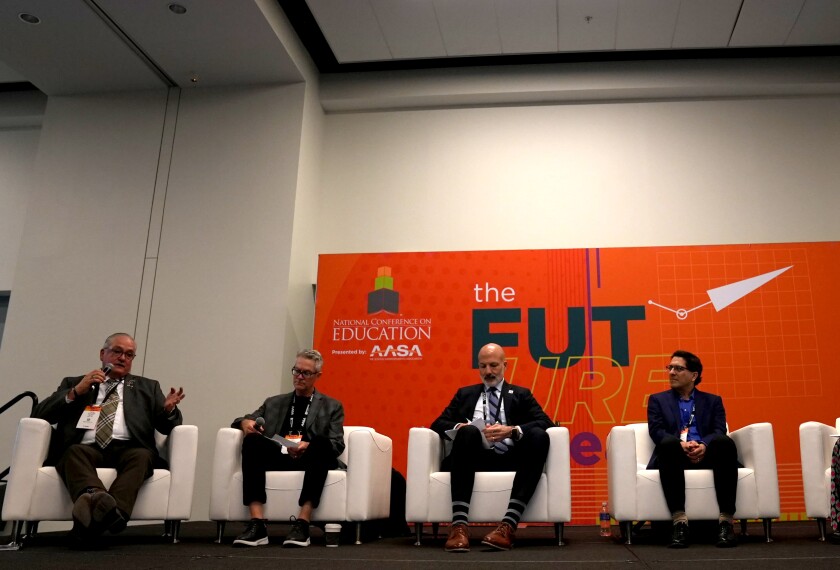
Panelists from left: Carlos Gonzalez, superintendent of the Roma Independent district in Texas; John Skretta, superintendent of Lincoln, Neb., schools; Joe Gothard, superintendent of Madison, Wis., schools; Ben Master, a senior policy researcher at the RAND Corp. speak on summer learning and student success at the National Conference on Education in Nashville, Tenn. on Feb. 13, 2026.
School superintendents, from left, Carlos Gonzalez, of Roma Independent in Texas; John Skretta, of Lincoln, Neb., and Joe Gothard, of Madison, Wis., along with Ben Master, a senior policy researcher at the RAND Corp., discuss summer learning and student success at the National Conference on Education in Nashville, Tenn., on Feb. 13, 2026.
Kaylee Domzalski/Education Week
Student Achievement The Case for Reading Tutoring Before 3rd Grade, Not After
New research suggests virtual tutoring can boost literacy learning before kids begin to struggle.
6 min read
First-graders in Chelsea, Mass. public schools meet with virtual tutors from Ignite Reading in 2025 as part of a study of the program.
First graders in Kelly Elementary School in Chelsea, Mass. meet with virtual tutors from Ignite Reading in 2025 as part of a study of the program. The Chelsea district is now targeting 1st graders for tutoring to make sure all of them meet reading benchmarks by the end of the year.
Courtesy of Chelsea Public Schools
Student Achievement Spotlight Spotlight on Prevention Over Remediation: The Role of Strong Tier 1 Instruction in MTSS
This Spotlight highlights how effective Tier 1 instruction in grades K–5 can improve literacy and math outcomes.
Student Achievement Opinion When Parents Question Grades, They Aren't Asking About Rigor
Clear expectations matter more to parents than complexity when it comes to student grades.
Thomas R. Guskey
5 min read
Screen Shot 2026 01 17 at 7.17.48 AM
Canva
