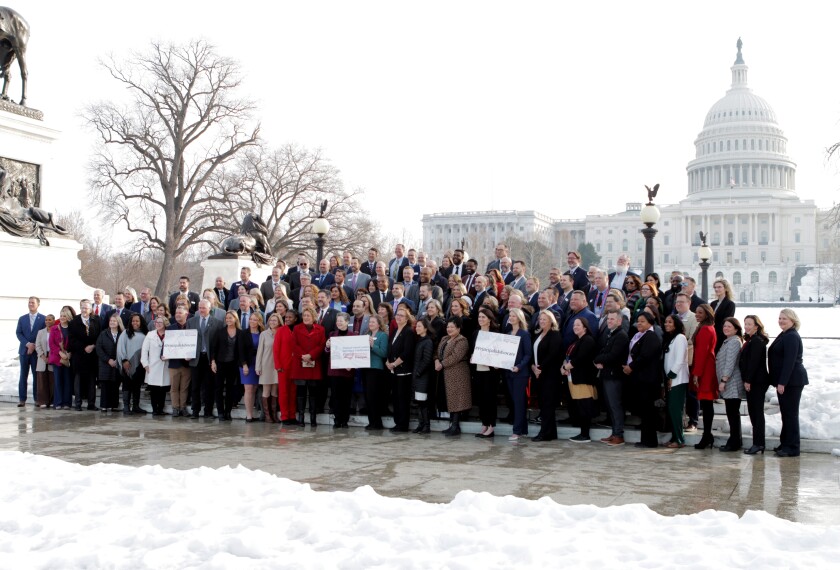
Educators, community leaders, and parents gathered here this month to promote stronger partnerships between schools and community-based groups as a powerful way to expand traditional notions of how schools operate.

The Coalition for Community Schools, a Washington-based organization that represents more than 100 state and national partners, hosted its national conference here March 9-11. “Community schools” work with local organizations and social-services providers to offer after-school programs, health services, counseling, and continuing-education classes.
More than 900 participants from across the nation—and several groups of international visitors from Quebec, the Netherlands, and Japan—filled seminars on school-based health clinics, visited Chicago schools that are working with community organizations, and heard researchers tout the academic and social benefits of having schools and communities share space and services.
The spirited discussions and packed ballrooms at the Hyatt Regency in downtown Chicago showed that the community schools movement is growing in both support and sophistication around the country, participants said.
With much of the national education debate focused on testing for accountability purposes and having all students meet higher standards in reading and mathematics, as required by the federal No Child Left Behind law, advocates here argued that the role communities can play in helping schools has too often been ignored.
Martin J. Blank, the director of the Coalition for Community Schools, said that education discussions such as the recent National Governors Association “summit” on strategies to improve high schools have left out an important voice.
“Our mission is to bring community to the forefront of education reform discussions and to refocus our nation on the importance of educating our children to be citizens of our democracy,” he said.
Chicago was chosen as the host city for the coalition’s national meeting because its school system has emerged as a leader in harnessing social-service agencies, universities, community-based groups, and other outside partners to provide a host of support for students and families.
There are now 67 “community schools” in the 437,000-student Chicago public school system. More than 30 nonprofit or social-service organizations act as “lead partners” in those schools.
Arne Duncan, the district’s chief executive officer, sees the city’s community schools initiative as a way to increase parental involvement in schools and help engage students to improve academically.
Mr. Duncan told participants that by teaming up with community-based organizations, Chicago’s community schools are now staying open seven days a week until 8 p.m. or later. In the process, he said, they are providing more opportunities for students and families to use computers for continuing education, gain access to counseling services, and share recreational facilities.
“We need all the help we can get,” Mr. Duncan told conference participants, noting the high percentage of low-income students and single-parent families in Chicago. “We want to make our schools centers of the community, community anchors, rather than an isolated island open five or six hours. We are really trying to redefine what school is.”
Mr. Duncan added that community schools showed greater improvement on state exams last year than the city’s other schools, and in some cases, helped reduce high rates of student mobility, a perennial challenge in urban districts.
C. Warren “Pete” Moses, the executive director of the Children’s Aid Society, a New York City organization that for more than a decade has worked in several community schools, described a “fragmented system of care” that has left schools, community groups, and social-service agencies working in separate worlds in trying to meet the needs of young people.
But community schools with mental-health workers, medical services on site, and a philosophy that includes parents in decisionmaking can go a long way to narrowing those divides, Mr. Moses told a seminar at the conference.
“Everything we do is pretty commonsensical,” he said, “with the exception that it is not very common.”