The fragile lace shawl educator Patricia Bilby was holding has been in her family for four generations. It took on still greater meaning as she stood on Ellis Island and learned about the experience her great-grandmother may have had when she arrived from Germany with the garment more than a century ago. But that wasn’t the only reason the New Jersey English teacher was misty-eyed at the culmination of last summer’s eight-day workshop on the storied island. Holding the hand-knit heirloom, she said she was newly appreciative of her immigrant students’ hardships, and excited about ways she could use her family’s story in the classroom to spark learning about immigrations past and present.

“I’m experiencing intense emotion here, and I’m motivated to try and create a similar experience for my students,” Bilby said. “For students [who are immigrants today], I’ve realized how disorienting and difficult it must be for them to have a foot in two places—to speak two languages.”
As part of a professional development program organized by the Save Ellis Island Foundation, the exhibits, databases, photo archives, and recorded interviews at the island’s museum helped put the nation’s current immigration debate into a broader historical context for her. The teacher from Bishop George Ahr High School in Edison and two dozen other participants sought to enrich lessons across the curriculum for students newly arrived in this country, as well as those whose ancestors planted roots long ago.
Many of the teachers present had already offered their students some lessons on immigration in the United States, primarily through standard literary selections. But there’s a palpable emotional impact to the site, which still seems to echo with the voices of the 12 million people who passed through between 1892 and 1954. As a result, said Dorothy Hartman, the foundation’s director of education and public programs, the setting tends to give teachers new insight into the importance of the topic and how the stories of the “huddled masses yearning to breathe free” can bring academic content to life.

“Being in the location has a certain power of its own,” Hartman noted. “There is a lot out there on the Internet on immigration, but some of the resources here and the experience of being here can’t be duplicated.”
Teachers at the session, which was held during the first two weeks of July, learned from scholars and park personnel about early immigration laws, the health inspections that officials conducted to control disease and gauge the mental acuity of aspiring citizens, and the ways the influx of millions changed the nation. They listened to recordings of immigrants who recalled their Ellis Island experiences and they toured nearby labor museums to get a feel for the stark working conditions many faced in their new country.
Peering at the displays of photographs, the stacks of weatherworn suitcases, and the personal effects at the museum, they were able to weave together stories of individuals and the economic and political realities that impelled them to risk the difficult ocean passage to reach America.
And during a day spent at a U.S. Department of Homeland Security station at Newark Liberty International Airport, the teachers observed current immigration policies in action as federal agents processed newcomers.
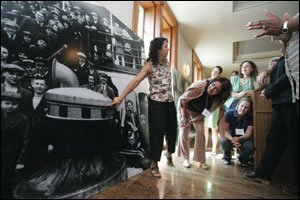
“This brings the current issues in immigration alive for them,” said Cynthia Garrett, the National Park Service superintendent of the island—“issues that are very much the same now as in the past.”
During their workshops, teachers learned to use artifacts like Bilby’s shawl to help students imagine what immigrants in that earlier era felt and experienced on their way to American citizenship. In an exercise using historical photographs, the teachers created their own narratives as they speculated what immigrants would write on postcards to their families back home.
In a haunting image of an immigrant family gazing across the harbor to the Statue of Liberty, one teacher saw both the hope for a better life and the sadness many felt about leaving their homeland. The teachers then discussed how those earlier experiences compared with those that immigrants face today.
The Ellis Island lectures, tours, and activities formed the basis of detailed lesson units the participants crafted as part of the workshop, which was first offered in 2005 through a grant from the Geraldine R. Dodge Foundation and the New Jersey Council on the Humanities. The units, which include reading assignments, writing activities, research, and oral presentations, meet state standards in English/language arts while also integrating topics for social studies, science, mathematics, computers, and other subjects.
After Pat Picinich attended the workshop during the program’s inaugural year, she beefed up her social studies unit on immigration. Each of her students at Our Lady of Sorrows School in South Orange, New Jersey, for example, adopted the persona of an individual or family who arrived at Ellis Island during the peak immigration years. The students—some of whom are recent immigrants from Nigeria—read related literary selections featuring true and fictional accounts of life in that era. They also wrote journal entries about the immigrants’ travels, and, after a field trip to Ellis Island, gathered artifacts and documents for their own museum exhibit.
Before the unit, which included world geography and the period’s important events, Picinich recalled, “They had no concept of what that time was like.”
Inspired by how much of an impact the lessons made, she attended the workshop again this year. “Even students who were not [the strongest learners] felt inspired to write page after page about what they learned,” she marveled.

Claudia Ocello, who helps run the foundation’s education programs, suggested a variety of ways to use artifacts and photographs in the classroom. As a demonstration, she stuffed an antique suitcase with the kind of clothing, keepsakes, and small household items that immigrants commonly carried with them on their journey. In small groups, the teachers passed around the items, looking for clues about the owner’s heritage, ethnicity, and economic status.
“If this came in a suitcase with an immigrant, what does it suggest to you?” Ocello asked as one group held up a simple cotton skirt and a blouse with no buttons. The educators concluded that the items, along with the iron skillet and handmade handkerchief, suggested modest beginnings in the immigrant’s home country.
Using enlarged photographs of immigrants, Ocello led the teachers through an analysis of the setting, clothing, and facial expressions, and urged the attendees to imagine themselves in the scene.
“You can see behind their eyes,” one teacher said. “You wonder where they came from, what they looked like as an old man years later, and where their progeny went.”
The workshops are intended to teach educators how to use historic sites in supplementary lessons and to encourage them to return to the island with their students during the school year. But they also introduce participants to the array of off-site resources that can augment lessons and make content more meaningful for students.
Cole Kleitsch was unaware of all the resources available on the topic until he attended the workshop here last year. Kleitsch, who teaches social studies at West Side 9th Grade Academy, a public school in Newark, soon began using a collection of photographs and documents on loan from the museum to supplement his curriculum.

His class of predominantly African American children at first showed ambivalence toward contemporary immigrants—an attitude the teacher says reflects the tensions between the city’s established and newcomer communities. So Kleitsch asked his students to compare the issues outlined in newspaper clippings from previous waves of immigration with those published recently. They then analyzed U.S. migration throughout history, including the journeys made by slaves via the Underground Railroad, to compare the conditions and prospects that inspired people to flee from their homes and families.
“The great wealth of stories hooks them into the subject and connects them to today’s headlines,” he said. “This clarified for my students that we’ve [incorporated large numbers of immigrants] before.”
At the completion of the unit, in which his students debated illegal immigration and other controversial issues related to the topic, Kleitsch’s class generally concluded that immigrants should be welcome in this country. “They agreed that we don’t mind if anyone comes in, but please knock on the front door first and don’t come in through the windows or break down the back door,” he said.
Many other Ellis Island resources will eventually be accessible online. The Save Ellis Island Foundation, which is working to raise millions of dollars to restore the historic buildings on the island, is hoping to spread its curriculum materials to farther-flung classrooms through an educational Web site now under construction.
!["This [workshop] brings the current issues in immigration alive for [teachers]," said Cynthia Garrett, the National Park Service superintendent of the island.](https://epe.brightspotcdn.com/dims4/default/cc8077d/2147483647/strip/true/crop/300x200+0+0/resize/300x200!/quality/90/?url=https%3A%2F%2Fepe-brightspot.s3.us-east-1.amazonaws.com%2F62%2Fd8%2F06ef3c7c4c0c03e843cc2a74d7e1%2F04ellis-6.jpg)
But for the teachers who visited last summer, it was learning about the educational value of the site firsthand that sparked their interest in the topic.
“Being here and reliving it is invaluable for these teachers, and it will come alive for my students,” said Marc Levenson, who teaches history at New Jersey’s Plainfield High School.
Levenson, who has a number of Hispanic immigrants as students, said he considered the topic of immigration to be dry before he attended the workshop. But no more.
“No matter what you’re teaching, you teach better when you have that fire in your eye,” he added. “I now have that interest in this topic, and when you are interested, your students are interested.”


