School & District Management

Panel Sets Federal Priorities for Research

By Debra Viadero — September 13, 2005 2 min read
  • Save to favorites
  • Print

A national advisory board signed off last week on broad guidelines to help the Department of Education decide what kinds of new studies and other research projects it should commission.

The new priorities will apply specifically to the Institute of Education Sciences, which is the department’s primary research arm. The institute is overseeing an estimated $575 million in projects, but only some of those efforts are funded at the discretion of institute staff members.

“This provides a public statement for staff inside the agency and for those outside the agency on the work that IES is going to focus on as a research agency,” said Robert C. Granger, the chairman of the 14-member National Board of Education Sciences and the president of the William T. Grant Foundation, of New York City.

Approving the priorities was one of the first tasks for the presidentially appointed board, which was created in 2002 to provide independent advice to the research agency.

The wish list the board approved was slightly expanded from an earlier draft that the institute put out for public comment in June. (“Learning by At-Risk Students Tops List of Proposed Research Priorities,” July 13, 2005)

Overall, the priorities set four long-term goals for the research agency:

• Studying education interventions that promote students’ academic learning and that can be widely deployed;

• Finding out what programs or policies do not work in education and which might not be cost-effective;

• Funding more basic research on the reasons that education programs, policies, and practices work in some places but not others; and

• Developing systems for delivering research on which policymakers, educators, and the public will come to rely.

“The institute has to demonstrate its usefulness by showing and producing things that school districts can use, and that’s exactly what you’ve got here,” said Jon Baron, a panel member. Mr. Baron is the executive director of the Coalition for Evidence-Based Policy, a nonpartisan Washington group.

In response to letters from advocates and national research groups, the final priorities were amended to include studies that more directly address the needs of students with disabilities, research that explores why program effects vary from place to place, and studies on parents’ roles in their children’s learning.

The draft of the priorities elicited 36 comments, and department officials said they considered most of them in making their revisions.

For example, some of the comments came from national groups who said the draft priorities focused too narrowly on studying learning in reading, writing, mathematics, and science when research was needed in other disciplines, such as civics and history, too.

‘A Set of Choices’

In response, Grover J. “Russ” Whitehurst, the institute’s director, said the language was changed to encourage research on reading and writing within a wider range of disciplines.

But the document’s overall focus on what it defines as the four core academic subjects remained intact.

“In no sense are our research priorities an indication that we think other topics are unimportant,” Mr. Whitehurst said. “But these are priorities, and priorities represent a set of choices.”

National research groups, such as the American Educational Research Association and the National Education Knowledge Industry Association, which are both based in Washington, generally praised the document for what they see as its clarity.

Mr. Whitehurst said he would use the guidelines to devise a research action plan for the board to consider at its next meeting, in January.

A version of this article appeared in the September 14, 2005 edition of Education Week as Panel Sets Federal Priorities for Research

Events

This content is provided by our sponsor. It is not written by and does not necessarily reflect the views of Education Week's editorial staff.
Sponsor
Special Education Webinar
Bridging the Math Gap: What’s New in Dyscalculia Identification, Instruction & State Action
Discover the latest dyscalculia research insights, state-level policy trends, and classroom strategies to make math more accessible for all.
Content provided by TouchMath
This content is provided by our sponsor. It is not written by and does not necessarily reflect the views of Education Week's editorial staff.
Sponsor
School & District Management Webinar
Too Many Initiatives, Not Enough Alignment: A Change Management Playbook for Leaders
Learn how leadership teams can increase alignment and evaluate every program, practice, and purchase against a clear strategic plan.
Content provided by Otus
This content is provided by our sponsor. It is not written by and does not necessarily reflect the views of Education Week's editorial staff.
Sponsor
College & Workforce Readiness Webinar
Building for the Future: Igniting Middle Schoolers’ Interest in Skilled Trades & Future-Ready Skills
Ignite middle schoolers’ interest in skilled trades with hands-on learning and real-world projects that build future-ready skills.
Content provided by Project Lead The Way

EdWeek Top School Jobs

Teacher Jobs
Search over ten thousand teaching jobs nationwide — elementary, middle, high school and more.
View Jobs
Principal Jobs
Find hundreds of jobs for principals, assistant principals, and other school leadership roles.
View Jobs
Administrator Jobs
Over a thousand district-level jobs: superintendents, directors, more.
View Jobs
Support Staff Jobs
Search thousands of jobs, from paraprofessionals to counselors and more.
View Jobs

Read Next

School & District Management On Capitol Hill, Relieved Principals Press for Even More Federal Support
With the fiscal 2026 budget maintaining level K-12 funding, principals look to the future.
7 min read
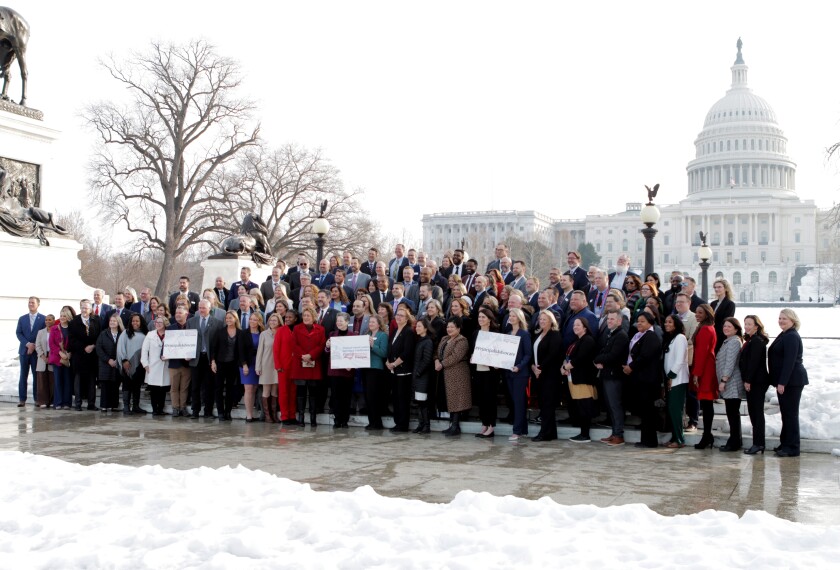
In this image provided by NAESP, elementary school principals gathered on Capitol Hill recently to meet with their state's congressional delegations in Washington
Elementary school principals gathered on Capitol Hill on Feb. 11, 2026,<ins data-user-label="Madeline Will" data-time="02/12/2026 11:53:27 AM" data-user-id="00000175-2522-d295-a175-a7366b840000" data-target-id=""> </ins>to meet with their state's congressional delegations in Washington. They advocated for lawmakers to protect federal K-12 investments.
John Simms/NAESP
School & District Management Q&A Solving Chronic Absenteeism Isn't 'One-Size-Fits-All,' This Leader Says
Proactive, sensitive communication with families can make a big difference.
7 min read
Superintendent Mary Catherine Reljac walks around the exhibition hall of the National Conference on Education in Nashville, on Feb. 12, 2026. Reljac is the superintendent for Fox Chapel Area School District in Pennsylvania.
Mary Catherine Reljac walks around the exhibition hall of the National Conference on Education in Nashville on Feb. 12, 2026. Reljac, the superintendent for Fox Chapel Area school district in Pennsylvania, is working to combat chronic absenteeism through data analysis and tailored student support.
Kaylee Domzalski/Education Week
School & District Management Opinion The News Headlines Are Draining Educators. 5 Things That Can Help
School leaders can take concrete steps to manage the impact of the political upheaval.
5 min read
Screen Shot 2026 02 01 at 8.23.47 AM
Canva
School & District Management Q&A When Should a School District Speak Out on Thorny Issues? One Leader's Approach
A superintendent created a matrix for his district to prevent rash decisions.
5 min read
Matthew Montgomery, the superintendent of Lake Forest schools in Ill., during the AASA conference in Nashville on Feb. 11, 2026.
Matthew Montgomery, the superintendent of Lake Forest schools in Illinois, is pictured at the AASA's 2026 National Conference on Education in Nashville, Tenn., on Feb. 11, 2026. The Lake Forest schools established a decisionmaking matrix that informs when the district speaks out on potentially thorny topics.
Kaylee Domzalski/Education Week
