

Today’s is the second post in a series on the impact ICE’s immigration raids are having on Chicago-area students, parents, teachers.
Only on Wednesday, federal agents followed an employee into a preschool—and detained her—as children were being dropped off for the day.
You can see Part One of the series here.
‘Am I Doing Enough?’
Maria Elena Ovalle, Ed.D., is the proud daughter of Mexican immigrants and an educator with 30 years of experience as an educator in Chicago:
It is difficult to keep up with the wearing emotions that come with being a teacher in a Latino school community where students and families are being targeted by ICE at this time. Staff and students see personally or via video ICE taking street vendors, people at laundromats, families at school drop-off, or people at work sites near schools.
Operation Midway Blitz is traumatizing children and youth in the quest to arrest without warrant or due process. Educators listen as students, regardless of status, share legitimate fears of being racially profiled and stopped or detained by armed ICE agents, of family members getting “taken,” of lack of finances due to detainments or fear of leaving homes, and of this being the new normal.
As an educator, one is naturally protective of students, so many teachers and staff are compassionate listeners and activists as we deal with these attacks on our school communities.
It is overwhelming to move between feelings of empathy, alertness, and helplessness when hearing the concerns from all angles (students, peers, community). Being a teacher has become more than focusing on student learning, it is worrying about our students’ and peers’ emotional well-being as we implement trauma-informed practices.
Some students and staff have parents or family members who have been taken to detention facilities, so PA and email notices during the school day about ICE being in the area are causing high anxiety for students and educators alike. For many educators, holding in emotions of anger, fear, frustration, and despair while putting on a smile or look of comfort as we teach or speak with students is an exhausting necessity.
In addition to the “business as usual” workday, many educators are volunteering by engaging in before- and after-school “watches” (standing outside of school being vigilant of ICE in the area), attending “Keeping Students Safe” and other training, participating in fundraising efforts, connecting with community organizations, and doing what we can to support our students and each other. Some of us also live in targeted communities, so the vigilance and fear for community doesn’t end with the school day.
What has been helpful for teachers is having members of our sanctuary team, family, and colleagues remind each other that it’s healthy to take breaks from the news and social media and to care for our own mental health.
The problem with taking a “break” for many of us is the guilt that weighs in after. There is a constant feeling of “Am I doing enough?” that comes in cycles as we deal with uncertainty and secondary trauma as the daily texts, alerts, and social media posts inform us that ICE is yet again in the area.

‘Maestra, tengo miedo’
Claudia M. Haro has been an educator for over 20 years in the southwest side of Chicago:
“Maestra, tengo miedo,” was what Roxana (name has been changed) expressed during dismissal. Kids were pouring out of the school onto our sidewalk to catch the bus or their rides when I noticed Roxana in the corner of our school lobby. She hesitated to leave the safety of our school building. Nervous because that same day agents from Homeland Security had been in our school area. As of January 20, 2025, ICE can enter schools if they have a warrant. This change has created chaos, confusion, and fear among our stakeholders, especially our students.
Our school is located in a primarily immigrant community where we have a diverse group of students from Latin America, specifically Mexico, Venezuela, Colombia, Guatemala, and Cuba, with a small group of students from China.
Since September 2025, Operation Midway Blitz has tormented our communities as federal agents abduct hundreds of people from our most vulnerable communities. Many times, our students have to witness these interactions in our communities or through social media. It has created trauma and anxiety among our children. As a result, many families have made the very difficult decision to not send their children to school.
The impact of having people abducted from our community has resulted in triggering trauma in our students that have already been put through so much. Our high schoolers are having to take on responsibilities that are customarily for adults, such as doing the grocery shopping for their families and dropping off or picking up siblings from a neighboring school. A local vendor has stopped working her tamale stand, and in her place, her high school-aged son is now working. The necessity to work has not disappeared.
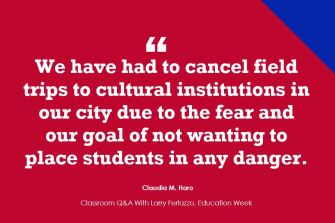
As a result of the raids, students have also been unable to experience high school in a traditional way. We have had to cancel field trips to cultural institutions in our city due to the fear and our goal of not wanting to place students in any danger. Our annual university fair and visits to our local colleges have been canceled after ICE showed up at a local community college. Our annual service-learning trip, which is a graduation requirement, has also been impacted because as educators we have to assess risk before taking kids anywhere in our city.
The most heartbreaking experience is when staff members have to escort students home due to this fear. The idea that this risk is coming from our government and the chaos of terror is coming from within, after our students are already struggling with so much emotional trauma, makes the situation worse.
Operation Midway Blitz has also alarmed our community so severely that even families that have citizenship have taken several safety precautions such as carrying proper identification, setting their own stricter curfews, and sharing location with multiple family members.
The harassment and trauma being done upon our Latinx community will have impacts beyond the classroom. These events will be an arrested development not just for our students but also for our country. Our young people will carry these scars, and we will always remember these dark days.
‘Desolate’ Streets
Maricruz González has been a bilingual science educator for 30 years:
On Sunday, September 7, 2025, at around noon, TikToks of a street vendor being detained by ICE in a southwest side neighborhood went viral, triggering a life of constant state of fear and impotence in his community. This scene and never-ending social media and rapid response notifications of ICE presence has had a detrimental impact on the lives of both documented and undocumented families trickling down into the communities’ economy.
My high school sits on a main intersection of the southwest side of Chicago that is predominantly Latino, 81%, many of whom are foreign-born and Spanish speakers. The community is found amid many large-chain businesses like McDonald’s, AutoZone, and Jewel-Osco and even more small businesses like coffee shops, restaurants, and bridal shops, that depend on the monetary investment of our students’ families.
Due to ICE presence, businesses are experiencing a significant decline in clientele. The owner of a mom and pop coffee shop across the street from school shared that prior to the ICE deployment, she had enough business for two employees throughout the day and that it was very busy between 5 p.m. and 8 p.m. Currently, she only has one employee and has had to reduce their working hours because she can’t afford two full salaries. She states that she is lucky if more than two customers come in between 5 p.m. and 8 p.m. She says “streets are pretty desolate shortly after school gets out.”
Almost doubling the number of multilingual learners (MLLs) in the past three to four years, my school has one of the largest populations of MLL students and families in the district. Many of these families fear ICE and have resorted to staying indoors as much as possible, making parent participation with the school community even more difficult than it already was.
Because ICE does not “discriminate” and will detain anyone with a resemblance of brown skin, even documented families hunker down at home and leave only when necessary. In the 20 years that I have been working at this school, parent advisory and bilingual advisory committee boards have been pretty easily filled. This school year, the struggle to fill the boards was real, requiring some members to hold an office position on more than one board. A couple of parents finally agreed to be members of the board but only if their participation was allowed to be from home.
A notable number of parents are opting to participate virtually for fear of encountering ICE and not being able to return home to their families. ICE has become a monumental barrier blocking parent access to school and community resources such as ESL, GED, and college informational workshops to name but a few.
Needless to say, ICE’s presence has the community frozen in fear to the detriment of our families and surrounding local businesses. When will these inhumane and unlawful acts end?

Thank you to Maria, Claudia, and Maricruz for sharing their thoughts.
Consider contributing a question to be answered in a future post. You can send one to me at lferlazzo@educationweek.org. When you send it in, let me know if I can use your real name if it’s selected or if you’d prefer remaining anonymous and have a pseudonym in mind.
You can also contact me on X at @Larryferlazzo or on Bluesky at @larryferlazzo.bsky.social .
Just a reminder; you can subscribe and receive updates from this blog via email. And if you missed any of the highlights from the first 13 years of this blog, you can see a categorized list here.


