When California set out nearly 10 years ago to reduce class sizes in the early grades, educators nationwide looked West with awe and envy at the ambitious move to ease the task of teaching millions of the state’s youngest students.
Across the Golden State, districts jumped at the chance to hire new teachers and lower the size of classes in kindergarten through 3rd grade, which in most areas exceeded 30 pupils. Within a year, the average class size for 1st grade had dropped to about 18.
California schools, it seemed, had struck pay dirt.
Today, class-size reduction remains immensely popular here and throughout the state, but its hefty costs have forced some trade-offs. While the state-administered program—with a budget of $1.6 billion in the current fiscal year—has largely survived California’s continuing financial crisis, Riverside and dozens of other school districts have been forced by budget constraints to pare down their own class-size spending—even as it has meant giving up state funding.
The program, meanwhile, has led to larger classes in the upper grades in many schools, and it has had to contend with an often-inadequate supply of qualified teachers. It also has been complicated by what school administrators see as rigidity in the class-size law. And research on the program’s impact on learning has largely been inconclusive.
“No district wants to eliminate the program—everyone seems to love it in spite of the lack of flexibility,” said Lynn Piccoli, an education fiscal-services consultant with the California Department of Education. “But sometimes they don’t have a choice.”
Only nine of the more than 800 eligible districts have completely abandoned their class-size-reduction programs this year, Ms. Piccoli pointed out. The main reason for shutting those down, she said, was a lack of space for classrooms.
Still, with districts continuing to struggle with tight budgets, Ms. Piccoli has seen a large increase in the number that have dropped the program in the 3rd grade. Other districts, she said, have moved to schedules that place children in reduced-size classes for just part of the day.
Cutting Back
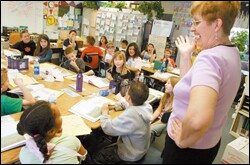
It’s midmorning on a cool, rainy day at Tomás Rivera Elementary School here in Riverside, where 2nd graders listen to a lesson on bears—grizzlies, kodiaks, and the smallest kind, Malayan bears. Their teacher, Freida Coe, even talks about bears that eat termites.
Across the breezeway that divides classrooms, Glenda Winn is teaching her 3rd graders about angles. Holding up two straws, she asks for volunteers to make an acute angle. About half the pupils eagerly shoot up their hands.
There is a striking difference between the two classes: Ms. Coe has 20 students. Ms. Winn has 32.
Like many other California districts, the 43,000-student Riverside Unified School District chose to drop a portion of its class-size-reduction program after budget cuts in the 2002-03 school year forced school leaders to review their academic programs. District officials concluded it was the only way to keep small classes in the earliest grades and avoid layoffs.
“It’s always better for the teacher, and probably the students, too, to not have as many kids in a classroom,” said Lynne Ennis, the principal of Rivera Elementary. “What I don’t really see is that it’s made the impact on achievement that we’d like to see.”
Money for bilingual education aides, instructional technology, and some staff-development programs was trimmed before Riverside did away with the smaller classes in 3rd grade. Officials reasoned that the 3rd graders would already have seen any benefits of smaller classes.
Rivera Elementary teachers say they see great benefits for the children who have been in smaller classes. Even though her 3rd grade class has nearly doubled in size, Ms. Winn says her pupils are better off having had three previous years of smaller classes than they would have been otherwise.
“We still benefit tremendously from having it in kindergarten to 2nd grade, because those kids are coming to us so prepared,” she said. Since smaller classes were implemented, Ms. Winn said, “very seldom have we had a child come in who was not reading at the grade level.”
Lessons Learned
The class-size-reduction program that then-Gov. Pete Wilson, a Republican, rolled out in 1996, was designed as an incentive for schools to lower their elementary grades to 20 or below, totaling about 3 percent of the state’s education budget in years since.
California school administrators soon found themselves competing to hire new teachers at a time when the state’s economy was thriving and relatively low-paying teaching jobs were a tough sell.
And when the districts found enough teachers, they often lacked enough classrooms to house them. Libraries, closets, and offices became classrooms. Some administrators assigned two teachers to classes of 40 students, a practice the state later banned.
Over the past eight years, those problems have subsided, many administrators say.
The economy has cooled, meaning that teachers are less likely to leave the profession for higher-paying jobs, state universities are producing more and better-qualified teachers, and requirements under the federal No Child Left Behind Act have pushed out many unqualified teachers. The state and most districts have also passed school construction bonds worth billions of dollars to build needed classrooms.
Looking back, educators say that the push for smaller classes has been a learning experience for just about everyone involved.
“If I had to do it over again, I would have resisted the temptation to roll out class-size reduction in four grades at once,” said Riverside Superintendent Susan J. Rainey.
Pressed to get teachers in front of classrooms, administrators quickly learned the value of a well-trained instructor. Ms. Ennis of Rivera Elementary School said that some of the interns and uncertified teachers that her district hired did well, but others did not.
Now, she and others say, the state’s universities are producing better-qualified teachers. Recently, Ms. Ennis has had a much larger pool of applicants to choose from. Given the federal No Child Left Behind law’s requirements for deeming teachers “highly qualified,” she added, “we don’t even entertain the idea of taking someone without credentials.”
Teachers also learned that leading a smaller class is not necessarily easier. For one, it requires more planning to cover more curriculum, and teachers at Rivera Elementary say they spend even more time grading papers because students are doing more work.
Ms. Ennis said even some veteran teachers floundered in the smaller classes because they had not planned enough work for the students. The state now requires professional development for teachers in the smaller classes.
“It’s a different workload,” said teacher Alicia Christian, who moved from a small 2nd grade class to a 33-student 4th grade class this school year. She said that when she was teaching a smaller class, she had more time to work individually with pupils, meet with parents, and evaluate student work.
Research Results
Research on the effects of California’s program has yielded mixed findings.
In recent years, California has seen some minor gains in its state-assessment scores and its National Assessment of Educational Progress scores. But many researchers and state officials say it is impossible to gauge whether those gains were a direct result of class-size reduction, because so many other reform measures—notably the state’s system of academic standards—were put in place about the same time.
Researchers at the RAND Corp., a think tank based in Santa Monica, Calif., have criticized class-size reduction as part of what they see as the state’s piecemeal approach to improving schools.
“Various people in California saw that the student-teacher ratios were very high, and they devised a program without thinking of the full systemwide implications,” said Stephen Carroll, a researcher with RAND. The most obvious effect, he said, “was a reduction in the overall certification status of the teaching force.”
Another report, released in 2000 by Policy Analysis for California Education, or PACE, a research group based at Stanford University and the University of California, Berkeley, found that the class-size program had exacerbated a statewide need for high-quality teachers, particularly in schools serving the neediest students.
State Superintendent of Public Instruction Jack O’Connell, who wrote the class-size legislation when he was a Democratic state senator, is convinced that the modest gains in state test scores in recent years have been a direct result of class-size reduction. He wants to expand the program to other grades. “Some of the largest gains we’ve ever made have been in class-size-reduction grades,” he said in an interview.
But some researchers say the smaller classes raise class sizes in upper grades. Even with the class-size program, California had an average of 27.4 students per class in the 2003-04 school year, according to state data. According to the most recent federal data, the average class size nationally was 21.1 in elementary grades and 23.6 in secondary grades in the 1999-2000 school year.
“The only way you get the largest class sizes in the country, and you have 20 students in K to 3, is to drop off a cliff after 3rd grade,” said Michael W. Kirst, a professor of education and business at Stanford and a co-director of PACE.
That seems to be true here in Riverside, which is a fast-growing outer suburban area 50 miles east of Los Angeles, where housing costs are considerably less than they are closer to the Pacific coast. Ms. Ennis said she has struggled to keep Rivera Elementary’s classes in the upper grades at a manageable level, or fewer than 34 students, as required by the teachers’ union.
Flexibility Sought
Most teachers and parents say they don’t need data to prove the class-size program is beneficial.
Parents in another Southern California district, the 50,000-student San Juan Capistrano schools, were so supportive of their district’s small-class program that when district officials announced plans to eliminate the 3rd grade component, the parents fought back. By raising more than $1 million through efforts that ranged from holding bake sales to soliciting corporate donations, they kept the program afloat this year.
But, despite the program’s popularity, school administrators say that more districts will abandon the program if they do not receive more flexibility in the law’s restrictions on class size.
State law mandates that for districts to qualify, class size must not exceed an average of 20.4 students in each class. Administrators must work carefully to make sure their classes do not go over that average, or they risk losing state funds for that class.
A measure signed last year by Gov. Arnold Schwarzenegger, a Republican, reduced the penalties districts face if they violate the requirements, though it did not go far enough, some educators say. Although most education groups have called for more flexibility, the state’s main teachers’ union, the California Teachers Association, and the state PTA have successfully lobbied against such changes.
Opponents fear that such revisions would allow administrators to chip away at the intent of the program in order to save money, and would open the door to larger classes.
Before class-size reduction, Barbara Kerr taught kindergarten and 1st grade in Riverside, where she typically had between 30 and 34 pupils, she said.
Now, as the president of the California Teachers Association, she’s speaking out against proposed state budget cuts that she fears will force more districts to eliminate the program.
“We have to take a stand, and right now we’re particularly not interested in compromise,” she said. “The hope when we started this program was that slowly but surely we’d expand it.”


