School & District Management

Md. Panel Urges Tougher Middle School Academics

By Debra Viadero — May 12, 1999 2 min read
  • Save to favorites
  • Print

A shot of academic rigor and better, more targeted teacher training may be the tonic for Maryland’s middle schools, according to a state committee.

As it previewed its thinking this month for the state school board, the Maryland Learning Years Task Force joined a growing number of educators nationwide calling for a second, more critical look at the middle school movement.

In Maryland and the rest of the country, schools have shown progress in making middle schools warmer, friendlier places, said Douglas Mac Iver, a researcher from Johns Hopkins University in Baltimore and the panel’s co-chairman. But, he added, “a lot of middle schools haven’t taken the second step in becoming high-performing schools that are academically excellent.”

In the 1970s, Maryland was at the forefront of the movement to create schools that are more attuned to the developmental needs of children ages 10-14 than traditional junior high schools or K-12 schools. Middle schools responded in part by creating smaller schools-within-schools, creating advisory periods, and carving out time for students to explore careers and hobbies.

But the lackluster performance of 8th graders on international assessments in recent years has led some national experts to call the middle years “an academic wasteland” where schools try to cover too many topics in too little depth. (“Muddle in the Middle,” April 15, 1998.)

Nurturing and Standards

In Maryland, 8th graders’ scores on state assessments have even begun dropping in some subjects, state officials say. And more students there drop out in 9th grade than in any other year.

“What the message has been previously has been that high academic standards are mutually exclusive from this whole nurturing thing, and I don’t think they are mutually exclusive,” said state Superintendent Nancy S. Grasmick, who appointed the task force last year. The group’s final report is expected next month.

In its preliminary report April 27, the 38-member task force recommended bolstering the curriculum for all students. “We need to make sure the curriculum is based on what we truly know they are capable of doing,” said Alice Haskins, the middle school coordinator for the Howard County, Md., schools and a panel co-chair.

But rather than retaining or promoting students who can’t keep up, the panelists said, schools should provide them with tutoring, extended-day and summer programs, or other alternatives. They called for particular attention to reading.

The most controversial recommendation, however, may be the call to require middle-level teachers to undergo more than 50 hours of training in curricular content and in the developmental needs of adolescents. Some 35 states now have specific licensing requirements for middle school teachers, but Maryland teachers can work in middle schools with either an elementary or secondary certificate.

Though he agrees with the general direction of the report, Karl Pence, the president of the 50,000-member Maryland State Teachers Association, said he was skeptical about the necessity for a separate restructuring of middle schools. “We are trying to make a commitment in Maryland to a higher level of high school graduate,” he said, “and we need to make sure that everything along the way has an academic focus that leads us to be successful there.”

Related Tags:

A version of this article appeared in the May 12, 1999 edition of Education Week as Md. Panel Urges Tougher Middle School Academics

Events

This content is provided by our sponsor. It is not written by and does not necessarily reflect the views of Education Week's editorial staff.
Sponsor
Artificial Intelligence Webinar
Managing AI in Schools: Practical Strategies for Districts
How should districts govern AI in schools? Learn practical strategies for policies, safety, transparency, as well as responsible adoption.
Content provided by Lightspeed Systems
This content is provided by our sponsor. It is not written by and does not necessarily reflect the views of Education Week's editorial staff.
Sponsor
Reading & Literacy Webinar
Unlocking Success for Struggling Adolescent Readers
The Science of Reading transformed K-3 literacy. Now it's time to extend that focus to students in grades 6 through 12.
Content provided by STARI
Jobs Virtual Career Fair for Teachers and K-12 Staff
Find teaching jobs and K-12 education jubs at the EdWeek Top School Jobs virtual career fair.

EdWeek Top School Jobs

Teacher Jobs
Search over ten thousand teaching jobs nationwide — elementary, middle, high school and more.
View Jobs
Principal Jobs
Find hundreds of jobs for principals, assistant principals, and other school leadership roles.
View Jobs
Administrator Jobs
Over a thousand district-level jobs: superintendents, directors, more.
View Jobs
Support Staff Jobs
Search thousands of jobs, from paraprofessionals to counselors and more.
View Jobs

Read Next

School & District Management Five Snow Day Announcements That Broke the Internet (Almost)
Superintendents rapped, danced, and cheered for the home team's playoff success as they announced snow days.
Three different screenshots of videos from superintendents' creative announcements for a school snow day. Clockwise from left: Montgomery County Public Schools via YouTube, Terry J. Dade via X, Old Colony Regional Vocational Technical High School via Facebook
Gone are the days of kids sitting in front of the TV waiting for their district's name to flash across the screen announcing a snow day. Here are some of our favorite announcements from superintendents who had fun with one of the most visible aspects of their job.
Clockwise from left: Montgomery County Public Schools via YouTube, Terry J. Dade via X, Old Colony Regional Vocational Technical High School via Facebook
School & District Management A Cold Front Is Sweeping the Country. Can Schools' Heating Keep Up?
A spate of frigid temperatures across much of the country will present a test for schools' aging heating systems.
5 min read
20260122 AMX US NEWS CPS CANCELS CLASS FRIDAY DUE 1 TB
A crossing guard assists students as they arrive for classes at Chalmers STEAM Elementary school on Jan. 22, 2026, in Chicago. Extreme cold hitting much of the United States in the coming days could test schools' aging infrastructure and force school closures. Chicago Public Schools called off classes for Friday, Jan. 23.
Antonio Perez/ Chicago Tribune
School & District Management How Principals Are Coaching the Next Generation of School Leaders
Mentors give aspiring school leaders an unvarnished view of the principalship.
6 min read
Photo of school officials having conversation.
iStock
School & District Management How 4 Superintendents Are Bracing for Federal Funding Uncertainty Under Trump
Superintendent of the Year finalists discussed how they're preparing for potential cuts.
3 min read
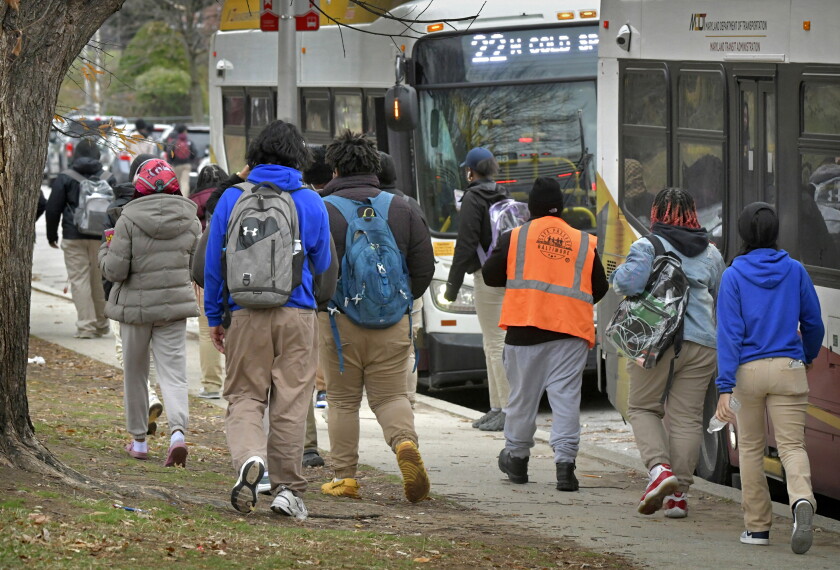
Students at Merganthaler Vocational-Technical High School board MTA buses at the end of the school day on Dec. 13, 2024 , in Baltimore. federally funded programs allows students to access resources they might otherwise not get—like tutoring and after-school programs, according to Baltimore Superintendent Sonja Santelises.
Students at Merganthaler Vocational-Technical High School board buses at the end of the school day on Dec. 13, 2024 , in Baltimore. Federally funded programs in the city's schools allow students access to services they might otherwise not get, such as tutoring and after-school programs, Baltimore Superintendent Sonja Santelises said at a recent panel discussion of the finalists for AASA's Superintendent of the Year award.
Amy Davis/Baltimore Sun/TNS