Includes updates and/or revisions.
School officials in Postville, Iowa, were still working last week to cope with the logistical and emotional aftermath of a raid on a local meatpacking plant by federal immigration authorities last week that left some students’ parents in custody and tensions high in the local Latino community.
David Strudthoff, the superintendent of the 600-student Postville Community School District, said the raid by U.S. Immigration and Customs Enforcement agents began at about 10 a.m. Monday, and he spent the whole rest of that day—until midnight—trying to ensure that the children whose parents worked at the Agriprocessors Inc. plant had someone to care for them.
“All of the Latinos [from the school district] were impacted,” Mr. Strudthoff said Tuesday in an interview. About 220 students in the Postville school system are from immigrant families, he said, and many children were separated from parents or siblings employed at the plant. Mr. Strudthoff said about 150 Latino students were missing from school on Tuesday, and he was planning to send faculty and staff members to their homes to tell parents that it was safe to send their children to school.
Mr. Strudthoff is also pondering the fact that more than a month ago, his district was served with a subpoena from the Iowa Division of Labor Services to provide detailed personal information about Postville students and some school employees.
In addition to demanding Social Security numbers and telephone numbers of all current students and some former students, the subpoena sought names of children who worked at two apartment buildings once owned by a school guidance counselor, who had sold those apartments to Agriprocessors’ chief executive officer.
The district complied with the subpoena, and two employees of the state labor department spent two full days poring over student records and collecting information, Mr. Strudthoff said.
Mr. Strudthoff said the state employees told him they were investigating possible violations of child-labor laws at the Agriprocessors plant, which employs about 600 Postville residents, many of them Latino. He said that two employees of the U.S. Department of Labor visited the school district on April 3—the same day that the two state employees handed the district the subpoena and began examining student records—but that the federal officials left after one hour.
Under the U.S. Supreme Court’s Plyler v. Doe ruling in 1982, undocumented students have the right to a free public education, and school employees aren’t permitted to ask students about their immigration status. But tensions have arisen between federal immigration agencies and school districts when immigration authorities have visited school campuses, learned that a student is undocumented, and detained a student. (“With Immigrants, Districts Balance Safety, Legalities,” Sept. 12, 2007.)
The state and federal labor officials made no mention of an impending immigration raid, Mr. Strudthoff said, and he doesn’t know if any student information was handed over to U.S. immigration authorities.
Gail Sheridan-Lucht, a lawyer for Iowa Commissioner of Labor David Neil, said she issued the subpoena to the school district as part of a joint investigation by the Iowa Division of Labor Services and the federal Labor Department of various labor practices of the Agriprocessors plant in Postville, including possible violations of federal and state child-labor laws. Because the investigation is still going on, she said she can’t divulge whether any information from the district was turned over to federal immigration officials.
Pat Reilly, a spokeswoman in Washington for federal Immigration and Customs Enforcement, or ICE, said she didn’t know anything about the state subpoena. She said that information is sometimes shared between state and federal agencies or between federal agencies in investigating “criminal matters.”
At the least, she said, the immigrants who were arrested at the Postville meatpacking plant Monday had violated federal immigration laws by illegally entering the country, which is a civil charge. She said that if they are found to have entered the country illegally and been removed once before, they would have a criminal charge pending against them.
Richard A. Rocha, a spokesman working in Iowa for ICE, confirmed that 390 people were arrested Monday at the Postville plant, including 12 minors. He said 56 of those detained—six of them minors—had been released as of Tuesday for “humanitarian reasons,” which can include the need to care for children. The men still in the custody of immigration authorities were being held in a building in Waterloo, Iowa, about 60 miles from Postville. Mr. Rocha said women were being housed in jails or detention centers, but he didn’t know where.
Mr. Strudthoff said, acknowledging that some parents of schoolchildren had been released, “We do have a number of women in our community walking around with ankle bracelets.” Overall, he characterized the raid as a “complete disaster,” noting that “we had about 10 percent of our community incarcerated for 10 hours.”
‘No Plan for Raids’
Mr. Strudthoff said that before Monday, the district had “no plan for raids.” When the district learned about the raid, he and other school employees met with Latino high school students and asked them for the best course of action to make sure their younger brothers and sisters were cared for.
The Postville district has only two buildings, located 10 yards from each other. Mr. Strudthoff said he paired each high school student with an elementary or middle school teacher, and they worked together to contact family members to make sure that children had somewhere to go when school was out at 3:30 p.m. He said that if both parents of a child were detained, the child was sent to St. Bridget Catholic Church, in Postville.
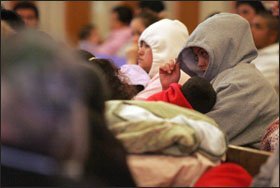
Mr. Strudthoff, who went to the church at about 4:30 p.m. Monday, said about 400 people concerned about the raid had gathered there. Some parents were with their children but didn’t want to go home because they were afraid ICE agents might show up there, he said.
“If you have ever been to a natural disaster where people lose their homes—the only difference was that it was a man-made disaster, not a natural one,” Mr. Strudthoff said. “People were in shock. Children were without parents.”
Mr. Strudthoff said representatives from the Red Cross provided bedding and other necessities. He went home at midnight, after he felt that each child from his district was accounted for.


