

When Jehibert Valderrama Hidalgo moved from Venezuela to the United States in 2024, he thought his new high school would look much like those he saw in Hollywood movies, with the jocks, the nerds, and the popular kids banding together. He, a foreigner with a faint grasp on English, would be the bullied outsider.
But Jehibert was surprised at the warm reception he got from his American peers when he enrolled at Ogden High School in Ogden, Utah.
“You’ll always find that gringo who says, “Hola, amigo!’” Jehibert told his schoolmate Yoana Estrada Altamirano, who moved from Mexico to Ogden and attended Ogden before she graduated last school year.
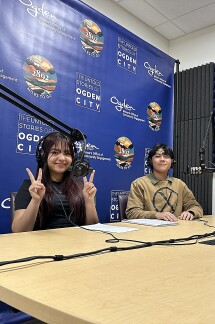
Their conversation—about moving to a new country and adapting to the food, culture, and their new high school—was featured on a podcast series called the Untold Stories of Ogden, a collaboration between the Ogden mayor’s office of community engagement and 2892 Miles To Go, a project that aims to highlight young people’s untold stories about their communities of origin.
Three episodes from the series, dubbed “New Americans,” featured free-flowing conversations in Spanish between six students who’d moved to Ogden from Spanish-speaking countries in the last two years.
The podcast series, produced by the six teenagers, aired last May against a backdrop of the Trump administration’s intensifying immigration crackdown that has depressed attendance and enrollment in schools with large immigrant populations.
A podcast that highlights immigrant students speaking about their experiences in a language they’re comfortable with serves as a good antidote to harmful and untrue stereotypes about them, said Alejandra Vázquez Baur, co-founder of the National Newcomer Network, a coalition that addresses challenges newcomers to the country face in schools.
It can also influence policymakers, she said.
“We can point to all this research and the data that show why it’s important to support immigrants’ integration into U.S. society,” Baur said. “But the stories are what sell.”


Students talk about ‘riding the culture shock curve’
At first, newcomers at Ogden High were reluctant to take up the podcasting opportunity, said Amanda Salgado, a teacher at the school who helps new entrants from Spanish-speaking countries with their English-language skills. Of the 1,100 students at Ogden, 190 students are multi-language learners.
In the six years she’s taught at the school, Salgado’s classroom has also become a safe space for students to share their struggles of adapting to a brand-new life in the United States.
Salgado knew she wanted a wider audience to hear and learn from stories that students have shared in her classroom—what it’s like to leave their families and friends behind, get used to a new culture, and navigate an increasingly anti-immigrant political climate.
When Salgado learned about the podcast opportunity in the community, she jumped on it, emailing the mayor’s office to get her students slotted in. Getting students to record their stories in their own voice, and language, could “open minds a little bit, and maybe create more empathy and curiosity about other people’s experiences,” Salgado said.
She picked six of her most outgoing students, who worked in pairs to decide what they wanted to talk about on the podcast.
Production started in February, and it took two months to pick discussion topics, create a loose script, record, and edit the podcast. Representatives from the mayor’s office helped Salgado and the students pick up the technical skills they needed to record and edit the podcast.
The students’ conversations are mostly in Spanish, peppered with English phrases they’ve picked up.
In each episode, the students run through their first impressions about their new country—bland food, quiet neighborhoods, muted New Year celebrations—and tackle deeper subjects, such as deciding on careers to explore.
Moving to a new country and adapting to a new culture is challenging enough, but doing it as they’re about to transition to adulthood can make the move much harder, Salgado said.
“I get sophomores, juniors, and seniors, and they’re trying to figure out their path in life,” she said. “They’re [also] dealing with the kind of the social-emotional effects of missing their countries and families and the things that they knew before.”
The number of students in Salgado’s newcomer classes has swelled in the last three years, though this year, she’s noticed a dip in students who are new entrants to the country. (That aligns with reports from schools across the country.) Still, she has more than 50 students this year to teach and help them adjust to life in the United States.
Salgado said new students go through a “culture shock curve.” At first, they’re excited to come to the United States because they have a particular image of the country in mind from social and popular media.
“As soon as it’s not so new anymore, there’s a dip for them emotionally and they have to cope with difficult feelings like, ‘This isn’t my country. I don’t know if I want to be here. I don’t like the food here,’” she said.
All three podcast conversations acknowledge this struggle. The students shared that they often felt embarrassed or frustrated when they couldn’t find the right words in English to respond to their friends and teachers, or had to use translators to get their point across.
Valeria Mendez, another student featured in the podcast, expressed her fears that she wouldn’t be able to meet career goals without perfecting English. Students like her “feel we won’t succeed if we don’t speak English,” the aspiring lawyer said.

As newcomer students find extracurricular groups and activities they’re interested in, they’re motivated to improve their English and break out of their shells. Jehibert, for instance, joined the school’s baseball team, which pushed him to learn the English words for “bat” and “glove.” Through a mix of gestures and simple English phrases, he can interact better with his coach and teammates.
The students also acknowledged some clear advantages of attending high school in the United States. They’re exposed to several subjects—such as STEM or career and technical education tracks like welding, robotics, and medicine—that they wouldn’t be able to access until college in their home countries.
Group activities can engage newcomer students better
Since the podcast aired, more students from Salgado’s class have shown interest in sharing their own stories and creating a homegrown version of the podcast at school. Jehibert said he enjoyed learning about how others like him processed their moves to Ogden, and would like to have similar conversations with non-Latino students as well.
Salgado has noticed the newcomer students becoming more comfortable in their new school: Students who once stuck together during lunch are now more interested in participating in the broader school community.
Salgado encourages these interests by connecting students to different coaches and teams, stepping in to translate for them, and gathering information for her students about tryouts and other opportunities.
When newcomers join teams, Salgado said she’s noticed English-speaking students want to get to know them better.
“It’s still difficult with the language,” Salgado said. “But both groups are now willing to try.”


