Student Well-Being & Movement

Educators Await Outcome on Health-Care Law

By Mark Walsh — March 17, 2015 2 min read
  • Save to favorites
  • Print

Educators are watching the latest challenge to the federal health-care law to come before the U.S. Supreme Court, with an eye to its potential impact on school districts’ employee-benefits policies. The justices heard extended arguments this month over a key provision of the Affordable Care Act.

There was no clear indication from their questions how the court will rule in the case of King v. Burwell (No. 14-114) on whether President Barack Obama’s administration is observing the law by allowing tax subsidies to go to individuals in 34 states that have declined to establish their own health-insurance exchanges.

A group of Indiana districts that is separately challenging the law’s employer mandate filed a friend-of-the-court brief on the side of four Virginia individuals who say in the case just heard by the court that they would be harmed by the ACA. Meanwhile, the National Education Association filed a brief in support of the law because it says the ACA has expanded health care to more Americans.

The Virginia residents say the law requires them to pay at least some amount out of pocket for coverage they don’t want. One of the challengers, Brenda Levy of Richmond, is a substitute teacher. During the March 4 arguments, some justices questioned whether she and the other challengers have legal standing, based on concerns that they might be eligible for alternatives such as veterans’ coverage or Medicare.

Michael A. Carvin, the lawyer representing the challengers, said that even though Ms. Levy will turn 65 this year, she still faces the prospect of penalties for not having health coverage in 2014.

The arguments moved quickly, though, to the merits of the case.

“The only provision in the [ACA] which either authorizes or limits subsidies says, in plain English, that the subsidies are only available through an ‘exchange established by the state under Section 1311,’ ” Mr. Carvin said.

Justice Elena Kagan told Mr. Carvin that “it’s not a simple four or five words. … It’s the whole structure and context of the provision.”

U.S. Solicitor General Donald B. Verrilli Jr. said that the challengers’ reading of the text “produces an incoherent statute that doesn’t work.”

Justice Antonin Scalia said the ACA probably has numerous “ill-considered” provisions, and Congress could be expected to step in and fix the law if the Internal Revenue Service rules at issue in the case were struck down.

“Well, this Congress … theoretically they could,” Mr. Verrilli replied, as a courtroom packed with several high-ranking U.S. senators and representatives laughed at his reference to congressional gridlock.

Justice Anthony M. Kennedy expressed federalism concerns, including that the challengers’ reading of the law would be so problematic for the states that didn’t establish their own exchanges that it would make the law unconstitutionally coercive. That might call for accepting the Obama administration’s interpretation to avoid such a constitutional ruling, he suggested.

Mr. Carvin said that Justice Kennedy’s logic on that point would jeopardize all manner of federal funding statutes, including the No Child Left Behind Act.

One member of the court was uncharacteristically quiet for most of the 80-minute argument: Chief Justice John G. Roberts Jr., who provided the pivotal vote in 2012 to uphold the ACA’s individual mandate.

A decision is expected by late June.
A version of this article appeared in the March 18, 2015 edition of Education Week as Educators Await Decision on Health Law

Events

This content is provided by our sponsor. It is not written by and does not necessarily reflect the views of Education Week's editorial staff.
Sponsor
Artificial Intelligence Webinar
Managing AI in Schools: Practical Strategies for Districts
How should districts govern AI in schools? Learn practical strategies for policies, safety, transparency, as well as responsible adoption.
Content provided by Lightspeed Systems
This content is provided by our sponsor. It is not written by and does not necessarily reflect the views of Education Week's editorial staff.
Sponsor
Reading & Literacy Webinar
Unlocking Success for Struggling Adolescent Readers
The Science of Reading transformed K-3 literacy. Now it's time to extend that focus to students in grades 6 through 12.
Content provided by STARI
Jobs Virtual Career Fair for Teachers and K-12 Staff
Find teaching jobs and K-12 education jubs at the EdWeek Top School Jobs virtual career fair.

EdWeek Top School Jobs

Teacher Jobs
Search over ten thousand teaching jobs nationwide — elementary, middle, high school and more.
View Jobs
Principal Jobs
Find hundreds of jobs for principals, assistant principals, and other school leadership roles.
View Jobs
Administrator Jobs
Over a thousand district-level jobs: superintendents, directors, more.
View Jobs
Support Staff Jobs
Search thousands of jobs, from paraprofessionals to counselors and more.
View Jobs

Read Next

Student Well-Being & Movement 3 Driving Questions to Create a Sense of Belonging in Schools
Students who feel they belong in their school are more likely to show up and learn.
5 min read
MVCS 1981
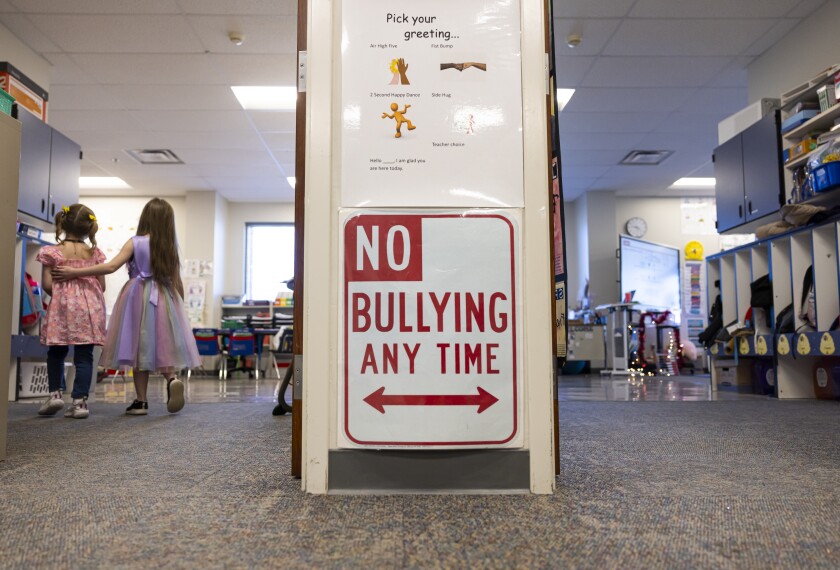
A sign discouraging bullying is seen as two students walk into a classroom at a school in Colorado Springs, Colo., on Feb. 12, 2026. Experts say creating a sense of belonging in school can help curb problems like bullying.
Kevin Mohatt for Education Week
Student Well-Being & Movement Opinion Why a Good School Needs Both Coaches and Referees
If teachers are forced into being referees, they can't fill that role properly or coach well, either.
6 min read
The United States Capitol building as a bookcase filled with red, white, and blue policy books in a Washington DC landscape.
Luca D'Urbino for Education Week
Student Well-Being & Movement Q&A Cellphones: The 'Most Formidable Adversary' Schools Have Ever Faced
The Spokane schools in Washington paired cellphone restrictions with expanded extracurricular activities.
5 min read
Students at Glover Middle School in Spokane, Wash. make bookmarks and snowflakes during Falcon Time on Dec. 3, 2025.
Students at Glover Middle School in Spokane, Wash. make bookmarks and snowflakes during Falcon Time on Dec. 3, 2025. The district has sought to encourage students to spend less time on devices.
Kaylee Domzalski/Education Week
Student Well-Being & Movement Want Kids to Have Better SEL Skills? Try Using Sports
In a panel discussion, district leaders and an expert discuss why sports is a great place to learn life skills.
3 min read
Students play basketball at Parkway Sports & Health Science Academy on Feb. 21, 2025 in La Mesa, Calif.
Students playing basketball at Parkway Sports & Health Science Academy on Feb. 21, 2025, in La Mesa, Calif. Some schools are using sports as a way to help students develop social-emotional skills.
Ariana Drehsler for Education Week
