School & District Management

Do Teachers’ Political Views Align With Their Unions?

By Alyson Klein — December 12, 2017 2 min read
  • Save to favorites
  • Print

Last summer, Laurie Villani picked up her monthly issue of the National Education Association’s magazine, NEA Today—which she likes to skim for teaching tips—and was disturbed by what she saw.

On the cover: an article referring to the heartache that President Donald Trump’s moves on immigration has created for the children of undocumented immigrants.

Villani, a Republican who voted for the president, was not amused. The magazine, she said, was “supposed to be about helping my career, helping me teach better.” She did not think the union “should be trying to sway me one way or the other.” Villani, who teaches kindergarten in Virginia’s Prince William County, sent the NEA a “rebuttal” to its piece.

Villani isn’t the only teacher who doesn’t always see eye-to-eye with her union. About 60 percent of the educators who responded to a survey by the Education Week Research Center belong to a teachers’ union. But more than 30 percent say the union doesn’t represent their political views, or only represents them a little. The survey found that 40 percent said they have “some” political views in common with their union. And 28 percent think agree with the union on “a lot” of issues.

Political-Survey-Teachers-Unions

Some teachers see the union as a big-money special interest group.

“I feel like the NEA spends a lot of money on left-wing candidates and not a lot on third-party candidates,” said Tim Erickson, a special education teacher at Detroit Lakes High School in northwestern Minnesota, and a political independent. “They toe the Democratic Party line. They are an example of a corporate lobbying group. .. I’m throwing my money to the far left when I want it to go to the common sense middle.”

About This Survey

The Education Week Research Center surveyed a nationally representative sample of teachers, school-based leaders, and district leaders about their politics and views on a wide range of K-12 issues. The 38-question survey was administered in September and October to 1,122 educators including 555 teachers, 266 school leaders, 202 district leaders, and 99 other school or district employees. The margin of error for the survey overall was plus or minus 5 percent. Followup interviews involved survey respondents who agreed to be contacted after the survey and were willing to be quoted on a range of subjects.

More Survey Findings:

  • Survey Paints Political Portrait of America’s K-12 Educators
  • Many Educators Skeptical of School Choice, Including Conservatives, Survey Shows
  • Educators Conflicted on LGBT Issues, Survey Shows
  • Survey Shows Educators Struggle With Impact of Immigration

Read the full report.

To be sure, plenty of teachers view the union and their politics in a positive light.

Laura Hansen, a Democrat who voted for Clinton and reading specialist in New Hampshire’s Hampstead School District, says she’s seen the union stand up for teachers who get into difficult situations. And she thinks they come down on the right side, more often than not, in making endorsements.

“I feel like my teachers’ union is a very protective blanket,” she said. She agrees with “about 90 percent” of their recommendations on political candidates and issues.

Jason Tackett teaches at Herald Whitaker Middle School in Kentucky’s Magoffin County. He is a Republican who voted for Trump. He also supports the Kentucky Education Association. “I think they are great,” he said of the union. Though he hasn’t had to call on the union for professional help at this point, from what he’s seen “they usually back you up.”

And when it comes to politics, he thinks his state affiliate is “pretty neutral. …. They want what’s best for teachers.”

Related Tags:

Events

This content is provided by our sponsor. It is not written by and does not necessarily reflect the views of Education Week's editorial staff.
Sponsor
Artificial Intelligence Webinar
Managing AI in Schools: Practical Strategies for Districts
How should districts govern AI in schools? Learn practical strategies for policies, safety, transparency, as well as responsible adoption.
Content provided by Lightspeed Systems
This content is provided by our sponsor. It is not written by and does not necessarily reflect the views of Education Week's editorial staff.
Sponsor
Reading & Literacy Webinar
Unlocking Success for Struggling Adolescent Readers
The Science of Reading transformed K-3 literacy. Now it's time to extend that focus to students in grades 6 through 12.
Content provided by STARI
Jobs Virtual Career Fair for Teachers and K-12 Staff
Find teaching jobs and K-12 education jubs at the EdWeek Top School Jobs virtual career fair.

EdWeek Top School Jobs

Teacher Jobs
Search over ten thousand teaching jobs nationwide — elementary, middle, high school and more.
View Jobs
Principal Jobs
Find hundreds of jobs for principals, assistant principals, and other school leadership roles.
View Jobs
Administrator Jobs
Over a thousand district-level jobs: superintendents, directors, more.
View Jobs
Support Staff Jobs
Search thousands of jobs, from paraprofessionals to counselors and more.
View Jobs

Read Next

School & District Management A Cold Front Is Sweeping the Country. Can Schools' Heating Keep Up?
A spate of frigid temperatures across much of the country will present a test for schools' aging heating systems.
5 min read
20260122 AMX US NEWS CPS CANCELS CLASS FRIDAY DUE 1 TB
A crossing guard assists students as they arrive for classes at Chalmers STEAM Elementary school on Jan. 22, 2026, in Chicago. Extreme cold hitting much of the United States in the coming days could test schools' aging infrastructure and force school closures. Chicago Public Schools called off classes for Friday, Jan. 23.
Antonio Perez/ Chicago Tribune
School & District Management How Principals Are Coaching the Next Generation of School Leaders
Mentors give aspiring school leaders an unvarnished view of the principalship.
6 min read
Photo of school officials having conversation.
iStock
School & District Management How 4 Superintendents Are Bracing for Federal Funding Uncertainty Under Trump
Superintendent of the Year finalists discussed how they're preparing for potential cuts.
3 min read
Students at Merganthaler Vocational-Technical High School board MTA buses at the end of the school day on Dec. 13, 2024 , in Baltimore. federally funded programs allows students to access resources they might otherwise not get—like tutoring and after-school programs, according to Baltimore Superintendent Sonja Santelises.
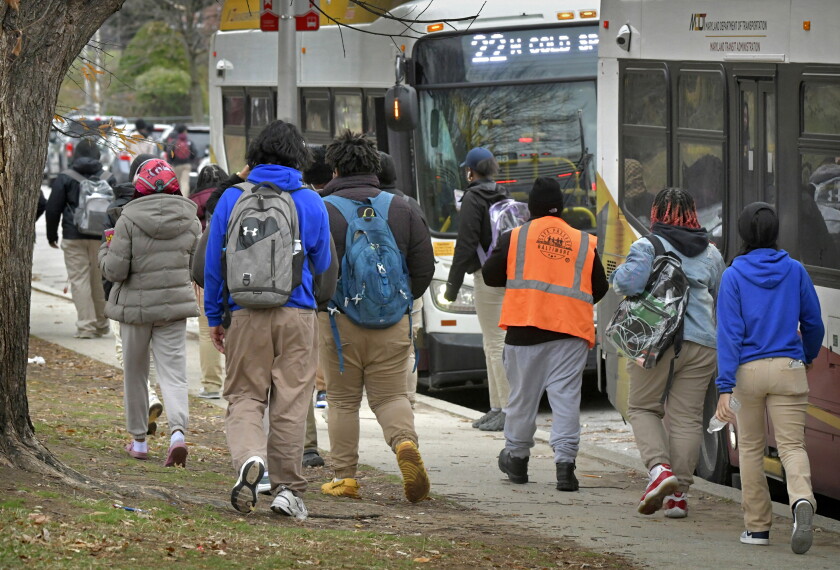
Students at Merganthaler Vocational-Technical High School board buses at the end of the school day on Dec. 13, 2024 , in Baltimore. Federally funded programs in the city's schools allow students access to services they might otherwise not get, such as tutoring and after-school programs, Baltimore Superintendent Sonja Santelises said at a recent panel discussion of the finalists for AASA's Superintendent of the Year award.
Amy Davis/Baltimore Sun/TNS
School & District Management Q&A Why This Leader Is Willing to Risk Losing His Job to Support Immigrant Students
This small Vermont district defies backlash to support immigrant families.
6 min read
A Somali flag, right, flies alongside the United States and Vermont flags outside the Winooski School District building, Wednesday, Dec. 10, 2025, in Winooski, Vt.
A Somali flag, right, flies alongside the United States and Vermont flags outside the Winooski School District building, Wednesday, Dec. 10, 2025, in Winooski, Vt. The district's effort to show support for Somali students drew intense backlash.
Amanda Swinhart/AP