
About twice a month, thousands of Iraqi teenagers and preteens gather across their country and make a very American pledge to use their heads, hearts, hands, and health for the greater good of their community, their country, and the world.
It’s the traditional promise of the 110-year-old 4-H Club.
Although most American troops have pulled out of Iraq, the 4-H Club remains. The club was imported about three years ago by a U.S. Department of Agriculture employee who was sent to the Middle East to help women develop their dairy-management skills. The organization now counts more than 3,000 Iraqi youths among its members.
While 4-H is often associated with rural America and agrarian life, its core mission is actually positive youth development, and that is much of the focus of the chapters in Iraq.
For example, “how not to hate each other” has been among the lessons taught in one Baghdad chapter, said Mustafa Hussain, 17, with the help of a translator. He and his fellow 4-Hers discussed American author Stephen Covey’s 90/10 principle—that says 10 percent of life is what happens to you and 90 percent is decided by how you react—to learn about anger management.
“I don’t care where the idea came from [for 4-H], whether from America or another country,” Mr. Hussain said. “I don’t want 4-H to end.”
From Cows to Kids
Neither does Mary Kerstetter, the USDA employee who has been dubbed the mother of 4-H in Iraq. Ms. Kerstetter, who works for the USDA’s National Resources Conservation Service in Albany, N.Y., volunteered for the agency’s Foreign Agricultural Service in 2009. She was accepted and tasked with teaching women in Anwar province dairy management and how to improve dairy production in their herds of cattle. She also taught Iraqis how to manage greenhouses. The goal was to teach modern agricultural technology.
Her focus quickly shifted, however.

“Sometimes when you’re working with the adults, they’re averse to learning new technology,” Ms. Kerstetter said. “Kids are kind of like a blank page on a book—you can really do something with them.”
When she looked into activities for Iraqi children, she found that “nobody was doing anything programwise for the kids. Four-H seemed like a natural fit.”
Once a Pennsylvania farm girl and 4-H member herself, Ms. Kerstetter remembered the anticipation of meeting nights. Her children were in 4-H, too.
Initially, the Anwar province clubs studied sheep breeds, wool products, and how to raise sheep. Ms. Kerstetter taught them about sheep breeds from around the world, working in geography lessons and notes about forms of government in other sheep-rich countries, including Finland. She taught them about products made from sheep aside from mutton and wool, such as soccer balls and cosmetics.
“I just wanted to broaden their horizons,” she said.
That is the mission of 4-H overseas, said Hiram Larew, the director of the Center for International Programs at the USDA’s National Institute of Food and Agriculture, in Washington. The creation of 4-H clubs in Iraq brought the number of countries with 4-H chapters to 81, not counting the United States, which has 6 million 4-H members. Many overseas clubs started as the chapters in Iraq did, following U.S. military occupation or presence. Chapters in South Korea celebrated their 50th anniversary a few years ago, roughly coinciding with the anniversary of the Korean War.
“We consider 4-H as a key strength in the U.S. diplomatic strategy,” Mr. Larew said. “We reach kids that we would not otherwise reach. Anything that can reach kids and, through kids, reach parents is potentially a very powerful tool to help and enable to help not only the current generation but the next generation.”
Expanding Frontiers
The USDA would like to expand 4-H to other embattled countries, and the agency is exploring expansions in sub-Saharan Africa, South America, parts of Asia, and countries that were once part of the Soviet Union.
Because the clubs engage and educate youths, they aren’t always welcome, said Lisa Lauxman, the director of the division of youth and 4-H at the USDA institute.
“Some people see that as a threat: People see that as empowerment,” Ms. Lauxman said.
Youth empowerment is a clear goal of the 4-H presence in Iraq, where some clubs spend time discussing the ills of war, encourage trust in the police and courts systems, and preach that women and men have equal rights.
“This [equal-rights theme] is very significant over there,” Ms. Kerstetter said. “I know these kids are going to be different.”
The clubs mix children who are rich with those who are poor, children of politicians with those whose parents do manual labor. Some clubs mix boys and girls and ethnic and religious groups.
“They are accepting each other as normal people; these kids are going to be leaders in 15 years,” Ms. Kerstetter said.
Eventually, her USDA assignment took her to Baghdad, where she began more 4-H chapters and was connected with Mohammed Lafta, who was running a nongovernmental organization there. Mr. Lafta soon became enamored with 4-H.
Passing the Torch
“It’s important here because it’s the first program that looks at the children and their goals for the future,” he said. “Other than 4-H, there is no such program.”
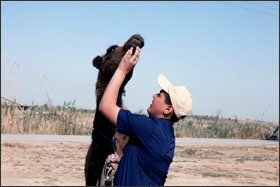
Since Ms. Kerstetter left Iraq last June, Mr. Lafta has taken up leadership of the organization and pressed for its expansion. At least one chapter has formed in each of Iraq’s 18 provinces. Activities across the country vary from raising animals to visiting museums and historical sites to planting trees. The 4-Hers also work on public-speaking skills and building confidence.
“At the first day when I was in 4-H, I [was] very shy and I felt scared,” said Sama Almosley, 16, with the help of a translator. She is a member of one of the Baghdad 4-H chapters. “But now I’m self confident.”
Ms. Almosley is also learning to use a computer for the first time.
Ms. Kerstetter wants to get more computers and financial support for the clubs, which don’t have an established governmental support system as American 4-H does. In the United States, land-grant universities and cooperative-extension services help support the clubs.
“This is the kind of thing that deserves support over there,” she said. “At the start of 4-H, some of these kids didn’t have any hope for the future. Now they believe they can make a difference. It really touches you.”
Maan Almosley, Sama’s father, said with the aid of a translator that he has noticed the difference in his own daughter. She’s gone from a shy girl with few friends to an open-minded social butterfly.
The 4-H organization “looks at the human attitude and cares about humanity,” Mr. Almosley said. “This is not just an American idea.”


