Sarah Schwartz is a reporter for Education Week who covers curriculum and instruction. Before joining the staff, she was as an Education Week intern, covering education technology. She has also worked at a middle school in New York City.
U.S. Sen. Maggie Hassan, D-N.H., left, listens as U.S. Sen. Tim Kaine, D-Va., speaks during a Senate Health, Education, Labor, and Pensions committee meeting at the Dirksen Senate Office Building on Capitol Hill in Washington on July 30, 2026. The committee advanced two bills related to reading, as well as another opposing the transfer of certain U.S. Department of Education offices to other agencies.
The desktop of a student at the Wells Preparatory Elementary School reflects the literature they're studying in Charlotte Owens' fifth grade class on Friday, March 8, 2024, in Chicago. Research supports children reading over the summer—but not specifically assigning reading lists or holding kids accountable for completing them.
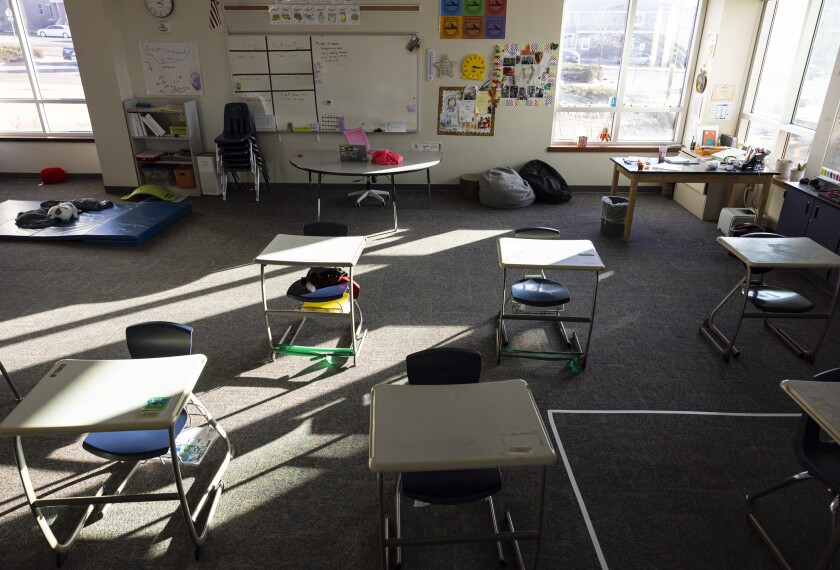
Research confirms what many educators know: chronic absenteeism undermines student academic recovery. A view of an empty classroom at a school in Colorado Springs, Colo., Feb. 12, 2026.
Children look at the Star Spangled Banner, the flag that inspired the lyrics of the American national anthem, at the Smithsonian's National Museum of American History on June 10, 2025, in Washington.
Students at Hudson Primary School study about what it means to be a citizen in this March 24, 2026 photo. The Pasco County school district is expanding its civics education program amid a state and national push to do so.
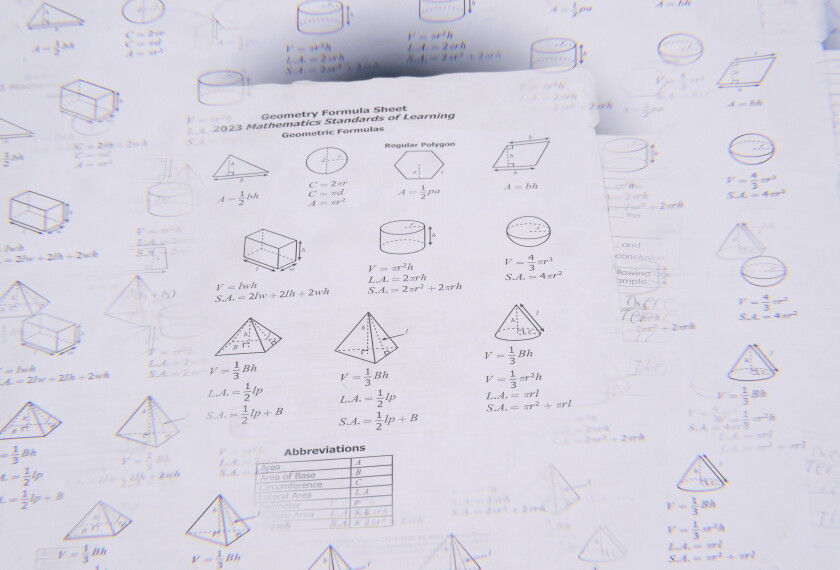
Details of math homework photographed in Annandale, Va. on June 8, 2026. Many teachers use multiple math programs in their classrooms—and the content doesn't always line up.
Alex Lucas, right, a college adviser at Dalton L. McMichael High School in Mayodan, N.C., works with junior Chloe Lester during an ACT prep session after school on March 11, 2014. ETS, another assessment organization, is acquiring ACT—though nothing will immediately change for students taking the ACT's college-entrance exam.
Ethan Hyman/Raleigh News & Observer/Tribune News Service via Getty <br/>
A classroom at an elementary school in Effie, La., on Aug. 22, 2025. Though debates over how to present the American story have been especially heated over the past five years, they've waxed and waned for decades.
Estes Elementary School kindergarten students Evelyn Bolmer, front left; Jase Bellamy, back right; and Eric Guarneros, front right, listen as their teacher Faith Harralson assists Bolmer with a math equation, as they ride pedal desks at school in Owensboro, Ky., Jan. 19, 2016. New research shows students who start kindergarten behind in reading and math are unlikely to catch up by 3rd grade.
State Board of Education Vice Chair Pam Little votes on a proposed required reading list during a meeting at the Barbara Jordan Building in Austin, Texas, on Tuesday, June 23, 2026. Critics have argued that both the list and proposed social studies standards attempt to embed religious teaching in public school classrooms.
A copy of one of the National Reading Panel's work products is shown in this June 17, 2026 photo. The influential report, now more than 25 years old, has long served as a cornerstone of the “science of reading” movement, shaping state legislation, curriculum, and teacher professional development.
An educator at Holcomb Elementary School in Oregon City, Ore. works with students on phonics and phonemic awareness on Feb. 5, 2025. New studies point to the mix of factors teachers should consider when selecting texts for students.
Students eat lunch at an elementary-middle school on May 7, 2026, in Detroit. The 2025 release of the National Assessment of Educational Progress’ Long-Term Trend data indicates that 13-year-old middle schoolers' scores in reading and math have stagnated, showing no statistically significant changes from the last test administration in 2023.
What's to blame for huge decreases in student achievement over the past decade? Some say a less intensive federal role in school accountability after the No Child Left Behind law was replaced. Anjanette McNeely remembers the pressure of making sure her school met "adequate yearly progress" during the NCLB era. The teacher leads a reading block with her kindergarten students at Windridge Elementary School in Kaysville, Utah, on Dec. 4, 2025.
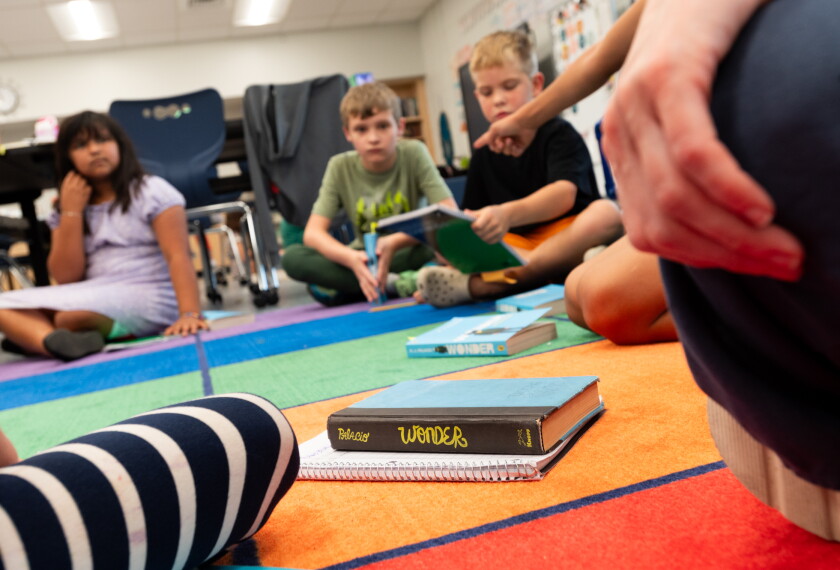
Students in Laura Patranella's 5th grade class at Vogel Elementary School in Seguin, Texas, read copies of <i>Bud, Not Buddy</i> on Nov. 3, 2025. On average, middle and high school teachers assign four full-length books a year, a new survey shows.
English for Speakers of Other Languages teacher Anna Kyle assists 10th grader Welhore Wendela Noah in algebra at Annandale High School on April 8, 2026 in Annandale, Va. More schools are devising ways to help students who struggle in math catch up without taking them out of grade-level classes.
A student learns to plot a matrix in an introductory algebra class at John Adams High School in South Bend, Ind., on April 17, 2026. Nationally, teachers say many students reach middle and high school with gaps in their foundational math skills.
Anjanette McNeely teaches a reading block with her kindergarten students at Windridge Elementary School in Kaysville, Utah, on Dec. 4, 2025. New research shows significant shifts in how teachers are teaching reading, as well as the materials and PD they receive, but some still use older methods.